image description
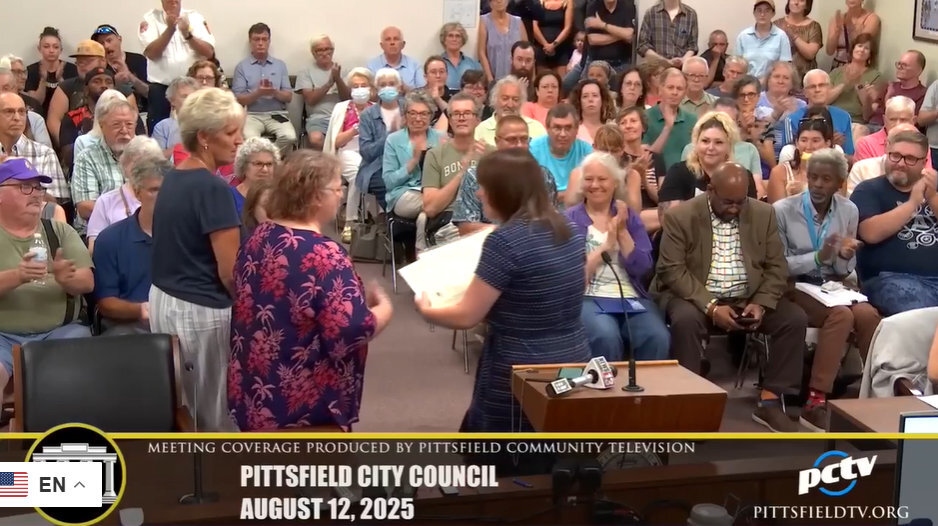
Director of Administrative Services Catherine Van Bramer presents mayoral citations to Cora Scarborough and Pat Rosse for their life-saving actions in this screenshot from Pittsfield Community Television's recording of the Aug. 12 City Council meeting.

Pittsfield Senior Center Staffers Save Life on Hot June Day
By Brittany PolitoiBerkshires Staff
Print Story | Email Story

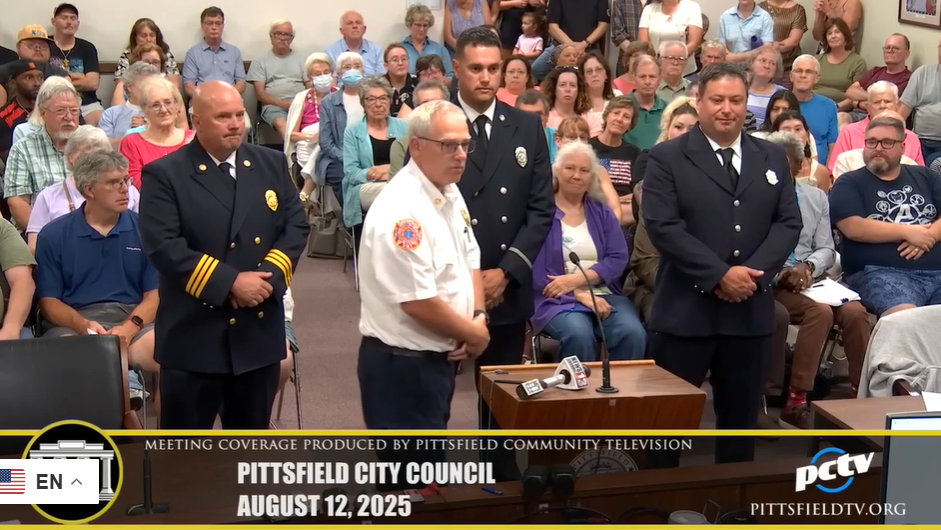
Fire Chief Thomas Sammons presents the department's new Deputy Chief Matthew Packard, left, Fire Capt. Kevin Brady and Fire Lt. Jesse Underwood-Miller.

PITTSFIELD, Mass.— Two Senior Center staff members saved a woman's life while she was having a medical emergency on an extremely hot June day. 

During last Tuesday's City Council meeting, Cora Scarborough and Pat Rosse were recognized for their actions on June 17, when they helped stabilize a senior citizen having a seizure in a hot car near the Ralph Froio Senior Center before emergency responders arrived. 

The woman had reportedly been in a medical emergency for over half an hour. 

"They were alerted to a senior experiencing a medical crisis in their parked vehicle. Upon locating the individual, they discovered the senior had been having a seizure for over 40 minutes and was unresponsive. Without hesitation, they immediately called 911 and began rendering aid," explained Director of Administrative Services Catherine Van Bramer, as Mayor Peter Marchetti was in a meeting with the Lt. Gov. Kim Driscoll. 

"They calmly spoke to the individual in an effort to keep them alert, and took crucial measures, including applying cold compresses and carefully positioning the senior on their side to prevent choking." 

Emergency responders arrived shortly after, and Van Bramer said, "thanks to the quick and decisive actions of Cora and Pat, the senior was transported to the hospital and made a recovery." 

"Due to their calmness in being under pressure and providing prompt first aid response, you saved this individual's life," she said while turning to Scarborough and Rosse. They were presented with certificates of recognition as the council chambers applauded. 

Theresa Bianchi, chair of the Council on Aging Board, said it was "truly a remarkable situation" that the women responded to without hesitation.

"It, of course, was a very steamy, hot day in June that unfortunately we've had too many of, and this woman was just unresponsive and in a medical crisis," she said. 


"They really do exemplify the excellence of our center staff, and we would just like to thank you for taking the time to recognize them, as we do, and our entire community." 

The council also congratulated the permanent appointments of Deputy Chief Matthew Packard, Fire Capt. Kevin Brady and Fire Lt. Jesse Underwood-Miller.

Fire Chief Thomas Sammons said, "these guys put the time and the effort in to make the department and the city better."

The council also authorized the execution and consummation of opioid settlement agreements. City Solicitor Devon Grierson explained, "This is simply a vote to authorize the mayor to vote to enter into those settlement agreements." 

The National Consortium recommends that the mayor approve the Purdue Plan, sign the Governmental Entity Settlement Agreement, and participate in all nine new opioid defendant settlements. 

All 55 state attorneys general have signed a $7.4 billion settlement with Purdue Pharma and its owners, the Sackler family, for distributing opioids that fueled an addiction epidemic. State and local governments in Massachusetts could receive as much as $105 million from this settlement over the next 15 years, contingent on bankruptcy court proceedings. 

"Under the Sacklers' ownership, Purdue made and aggressively marketed opioid products for decades, fueling the largest drug crisis in the nation's history," Mass.gov reads. 

"The settlement ends the Sacklers' control of Purdue and their ability to sell opioids in the United States. Communities across the country will directly receive funds over the next 15 years to support addiction treatment, prevention, and recovery." 

Councilors didn't get to all agenda items because a required vote to continue the meeting for another hour after 10 p.m. failed to reach two-thirds. This included Ward 1 Councilor Kenneth Warren's petition to exclusively use the funds for homeless issues related to opioid addiction. 

He confirmed that the council will still have to accept the funds and explained, "I will support this, knowing that we'll have another chance, because I think those funds should go elsewhere, and we'll deal with that on another night." 


Tags: firefighters,   opiods,   recognition event,   

If you would like to contribute information on this article, contact us at info@iberkshires.com.

BRTA Focuses on a New Run Schedule

By Breanna SteeleiBerkshires Staff

PITTSFIELD, Mass. — The Berkshire Regional Transit Authority is still working on maintaining its run schedules after dropping the route realignment proposal.

Last Thursday's meeting was Administrator Kathleen Lambert's first official meeting taking over the reins; retiring director Robert Malnati stayed during a transition period that ended last month.

Lambert is trying to create a schedule that will lessen cancellations. There was a two-hour meeting the week before with the drivers union to negotiate run bids and Lambert is working with the new operating company Keolis, which is taking over from Transdev.

The board spoke about anonymous emails from drivers, which Lambert said she has not seen. iBerkshires was not able to see those letters, but has received some. 

"They were lengthy emails from someone describing themselves as concerning BRTA employee, and there was a signed letter from a whole group of employees basically stating their concerns. So, you know, to me, it was a set of whistleblowers, and that, what my understanding is that this really triggers a need for some type of process to review the merits of these whistleblowers, not going to call them accusations, but basically expressions of concern," said member Stephen Bannon.

A letter iBerkshires received spoke of unhappy drivers who were considering quitting because of decisions being made without "input from frontline staff," frustration and falling morale, and the removal of the former general manager shortly after Lambert came in.

Lambert said it's difficult to navigate a new change. She also noted many drivers don't want to do Saturday runs and it has been hard negotiating with drivers on the new runs.

"I would like you all to keep in mind that the process of change is super difficult. Transdev has been here for 20 years, and some of these drivers have never known any other operating company, the way some of the operations have been handled has been archaic," she said. "So getting folks up to speed on how a modern transit system works is going to be painful for them. So I don't want to say that I'm unsympathetic, because I am sympathetic, but I am trying to coax people along with a system that's going to seem very strange to them."

The board spoke about better communication between them and Lambert, citing cooperation will be best moving forward.

"There's just a lot of stuff in the air right now, and there are a lot of fires to put out to make this a coordinated effort. And if we don't keep our communications open and be straightforward, then you get blindsided about how you know the input that you could get from us about your position, and how you know what's going on in your direction, and we get blindsided. And I think that we have to make sure that this is a collaboration," said member Sherry Youngkin.

"Both sides have responsibilities, because in the long run, this advisory board is going to have to make decisions as to how we brought forward and if we've gone forward in a fair and helpful way. And I think that's hopefully what everybody is looking for also." 

Transdev and Keolis held a three-day recruiting event interviewing almost 40 candidates and offering jobs to eight, but only three stayed on to start training. Lambert said it was disappointing but she will keep trying to retain more people.

In her first report to the board, she noted that ridership dipped a little over 10 percent, but still remains higher than last year, adding that was because of cancellations of services because of the lack of drivers.

Like the last meeting, some of the advisory board members were torn over the start of the Link413 service, worried that the start of the service took drivers away and the numbers of riders are low.

Lambert, however, said the ridership has doubled from last month.

"As I've spoken before, we have, generally, a six-month adoption for brand-new service before you can really go in and evaluate, are you being successful based on the grant that my predecessor wrote along with the team for PBTA and RTA, we are ahead of schedule, which is pretty good, so I'm hoping that will continue to improve," she said.

Member Renee Wood said the board never approved the service, adding the only thing she could find in the minutes was a vote to accept the equipment. She said it was supposed to be put on the agenda to discuss.

"The Link413 service has been three years in the making. It's been a grant that was accepted and has been working with our partners, PVTA and FRTA, to put into place. So I don't have the entire history of how that process worked, but it's been three years in the making, and did we not understand that once we accept that grant that we were going to put in new service?" Lambert said.

The board discussed if Title VI, the Civil Rights Act, was followed with an accurate review and accurate amount of time for public comment period on the service changes and if its attorney should review if the  grant conditions were properly followed.

Lambert said changes had the 60-day comment period included in the proposed route realignment packet, giving the opportunity for the community to respond to that as well but will look into the legality of the situation with their attorney.

View Full Story

More Pittsfield Stories