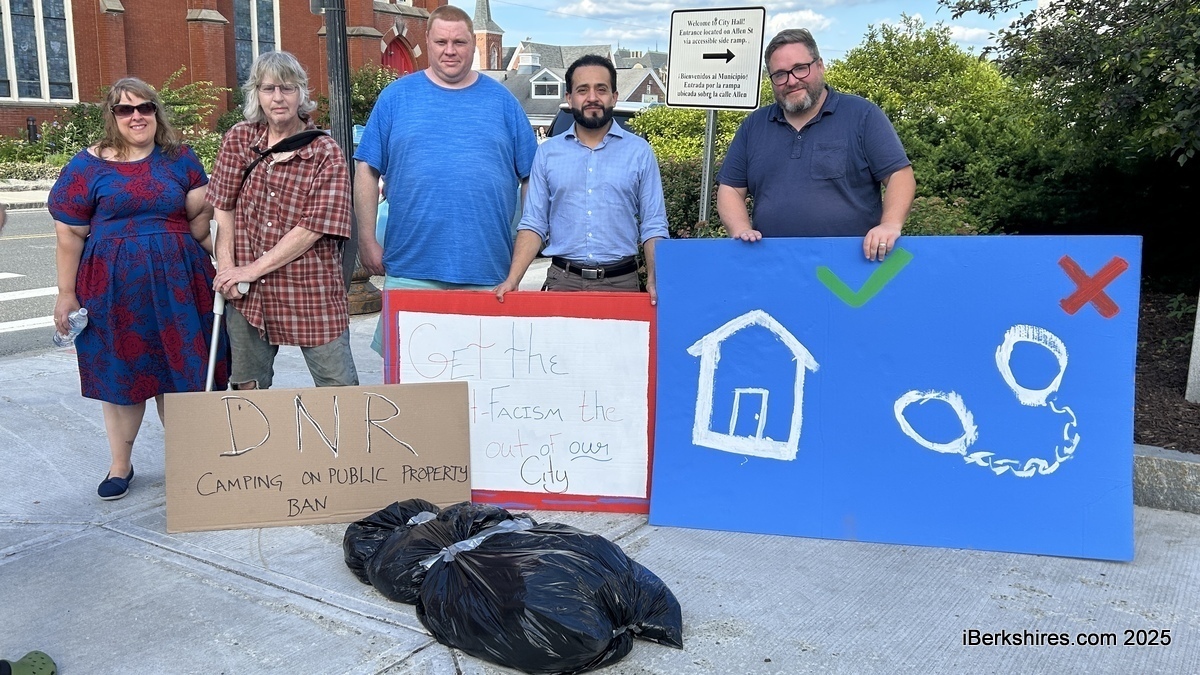
Amended Camping Ordinance Sent to Pittsfield City Council
PITTSFIELD, Mass. — The controversial public camping ordinance has been referred back to the City Council with several "compromises."
This includes the removal of criminalization language, a new fine structure, and some exceptions for people sleeping in cars or escaping danger.
The amendments made at Monday's Ordinance and Rules subcommittee meeting followed some 90 minutes of comments from the public on a regulation seen by many as targeting the homeless population.
The vote was 3-2, with subcommittee members Kathleen Amuso, Rhonda Serre and Peter White in favor and Chair Dina Lampiasi and Patrick Kavey voting against.
"I want to be clear: all, all, all criminal penalties have been removed from this ordinance, whether it be a person camping in public or whether it be someone aiding someone to do so. All has been eliminated from this ordinance, even though there seems to be some confusion in the general public as to whether or not it has or has not," Mayor Peter Marchetti told the subcommittee.
"… I offer up this revised ordinance for your consideration, as it is a fair compromise. The intention of this ordinance has been and continues to be to find ways to create boundaries of the activities that are taking place in our public spaces that constitute public health and safety hazards. I cannot condone behaviors by anyone who urinates, defecates, throws up, and leaves unattended belongings and spaces that are to be accessed by all."
Community members spoke during open microphone to express their outrage over the proposal.
"Just for the record, not a single one of us is in favor of [defecating] in doorways," said Michael Hitchcock, co-director of Roots & Dreams and Mustard Seeds.
The mayor proposed about 10 amendments that were included in the referral. These add sections to allow temporary car sleeping on public property where parking is permitted and excuse people who are camping to avoid clear and imminent danger to life or serious bodily injury.
The fine structure now begins with a warning and then goes from $25 for the second offense to $300 for the fourth and subsequent offenses. Marchetti also introduced an option to perform voluntary community service as an alternative to monetary fines.
It was also modified to allow camping on private residential property with consent from the owner, removing a three-night cap.
Lampiasi, of Ward 6, said she found the original version "offensive."
"That's why the energy in the room was the way it was. That's why what happened in the community got as nasty as it was. When you have people that are already at the margins of society with nothing, nothing to their name, maybe a backpack, if they're lucky, maybe a shopping cart that they've taken from a business and they're keeping a few blankets, a few shirts, maybe something special to them, that they've been able to take from their home, they're holding on to, and they're hoping they don't lose somewhere," she said.
"These people, that's all they have, and we're telling them, 'You can't sleep in our parks. You can't sleep downtown,' where you know that there are cameras and you won't be raped, you won't be beaten, you won't have all these terrible things happen to you because you're sleeping in the doorway of a state building. You know there's a camera there. That's what we're talking about right now."
She added that nearly two hours into the meeting, "I'm a little bit concerned that none of this discussion tonight has brought us to what the amendments are."
"Nobody has brought that up, and I'm not scolding my committee members but we have serious work here to do, and it feels as though some are more focused on moving this piece of legislation forward without really figuring out what we're doing and I don't think that's what we're here to do," she said.
"We have 11 people on our council, and 11 people need to have a good understanding of what's before them, and if we send it forward as it is, I have several questions that I don't quite have answers to."
Kavey, of Ward 5, said that even if the council were to pass the ordinance as is, "I don't necessarily know if this is how to solve this problem."
A few community members said this policy is like something that President Donald Trump's administration would propose.
"You are endorsing Donald Trump by passing this ordinance, and fascism, and we will remember you, and we will call you fascists for passing this," said resident Patrick Doyle.
"Capitalism has failed us. This endorses violence against the most struggling, and you all have beds to go home to."
Serre of Ward 7 said the City Council does not run with a political party attached to its name for very good reason.
"We are not Republicans, and we are not Democrats, we are not MAGA, we are not Big, Beautiful Bill. We are none of that. We are Pittsfield, and we are here for that reason only, not for politics," she said.
"… We are human beings, and that's what is pushing us forward, and that passion is good. No matter what side you're on, that passion is good. I think I'd like to applaud the mayor. I think this bill is much better. I think he was very open to revisions and hearing what everybody had to say and learning what solutions could be here."
She said this may or may not be the final ordinance, "but I think the rest of my colleagues deserve a right to also debate this issue and have conversations around this matter, so for my purposes and the purposes of continuing to revise and find the appropriate solution. I am going to support moving this to the City Council for further discussion."
Amuso, a councilor at large, said Monday's night discussion had been more purposeful and pushed for further collaboration.
"However you feel, whatever you think of this petition, we can do better. The petition is one piece, but we can do better for our city, for the people of the city, for the unhoused, all of the above, all of the things that we need to do. So let's go forward. Let's work together," she said.
"Even if this passes, we can change it. We can update it. We can modify it. If it doesn't pass, we still work on some of these initiatives, and these are steps that we can take to make our city better, and we're better when we work together, and we're always going to have differences, and that's OK."
White, council president, emphasized the importance of mutual respect in these conversations.
"When somebody disagrees, the respect isn't two ways. That has to change. If people are going to be invited in to work collaboratively on an issue, they need to feel welcomed to do that," he said.
"…I’ll be supporting this. I'm glad the changes were made to it, and I hope that there are further changes made to it, and I'm hoping that we make enough changes in this city that we don't have to have it at all. However, we need more tools than what is currently available to make this city welcoming to all, and also to have it be that we're still bringing people not just downtown. This isn't a downtown ordinance."
Tags: camping, homeless, ordinance & rules ,