image description
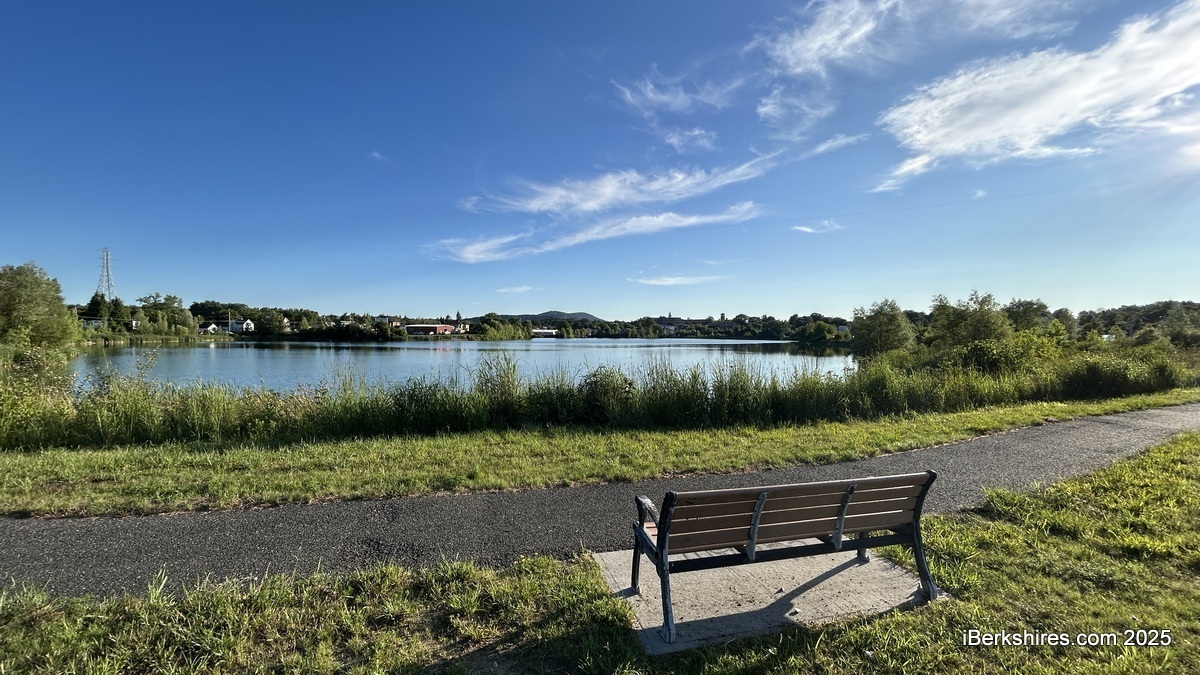
The bottom of the 26-acre Silver Lake is capped to prevent PCBs and other contaminants from seeping into the water.

Repairs Planned for Silver Lake's Underwater Cap
By Brittany PolitoiBerkshires Staff
Print Story | Email Story


PITTSFIELD, Mass.— Starting next month, a thinning portion of Silver Lake's underwater cap will be repaired. 

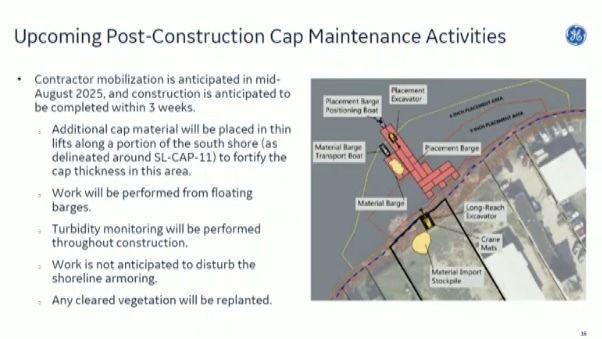
During a public hearing on Tuesday, members of the U.S. Environmental Protection Agency's New England Region 1 and General Electric detailed the three-week-long project beginning in August. An additional 6 to 9 inches of cap material will infill a three-quarter acre area of the lake, totaling about 810 cubic yards. 

In 2023, monitoring required by the 2000 Consent Decree revealed that a southern area of the cap along East Street reduced to a thickness of 9.4 inches, down from 14. Work will be done behind the site of the former Kentucky Fried Chicken. 

The cap is designed to sequester PCBs. It is composed of three years — 6 inches of capping materials, a 6-inch isolation layer that absorbs PCBs, and a 2-inch "mixing" zone. 

"There are many reasons that can affect the thickness of the cap, and this is why we do monitoring, so we can see that it's still performing as we expect," design engineer Mark Gravelding said, pointing to consolidation of materials, sediment deposition, ecological activity, and other factors that can break down the cap. 

"… We had a robust program to monitor what was being placed, but there can be variations, and that's why we monitor."

That program included four rounds of sampling from the cap's construction in 2013 to 2023. Gravelding reported there is "really no concentration" of polychlorinated biphenyls (PCBs) in the cap's top layer, and it's decreasing over time. Testing has shown a 63 percent reduction in surface water PCB concentrations following remediation and a 90 percent decrease in whole-body fish tissue concentrations. 

"All these just show us that the cap is performing as we expect it to perform," he said. 

Berkshire Environmental Action Team Executive Director Jane Winn said Silver Lake is an unlined "toxic waste dump" with very high levels capped, and is in the water table. 

In 2000, GE entered into the Consent Decree with the EPA, Massachusetts, the State of Connecticut, and other affected parties that required GE to address PCBs and other hazardous contaminants in soils, sediment, and groundwater in several Removal Action Areas in or near the city. 

Under the contract, GE was required to remove contaminated bank soils, remove and replace sediments near an outfall from the GE plant, cap the entire 26-acre lake bottom, and perform periodic reviews of the cap's effectiveness and integrity. 

"Pittsfield got the real raw deal compared to everyone else," Winn said. 

"I really object and feel totally betrayed that the last time, back in what, 2018, the depth of at least one of the places was below the 14 inches. I feel we were guaranteed that 14 inches, and it was a betrayal not to have it fixed back then. Being down to 9-plus inches now is unacceptable." 

In the 2023 samples, five parts of the cap were 14 inches thick. She added that those "have to be below 14 inches now." 


"To me, that's betraying the people of Pittsfield, and I think EPA and GE should be ashamed of that," Winn said.

The work area will be monitored one and five years after completion, and the lake's entire cap will be checked in 2033. In 2014, a 3,400-square-foot southern area of the cap was filled with an additional 45 cubic yards of cap material to reach the required cap thickness.

Winn wasn't the only community member to speak at the meeting, as several raised concerns about the capped lake's impact on the environment and human health. 

Judith Herkimer, from the Housatonic Environmental Action League, said the negotiated settlement has "really little to do with the protection of human health and the environment." 

"Silver Lake has been a particular thorn, has been a particular sadness, has been a particular atrocity at this site, and it continues to this day," she said. 

"Although we will always say that we appreciate the engineers and what they have been able to do to contain as best possible under the provisions within the Consent Decree, it's not enough. It's not enough. You have never fully characterized all of the chemicals that even originally existed at that site." 

Herkimer said the provided data was "essentially averaging," that is within the constraints of the Consent Decree. 

"It's what was negotiated, and it's all variables of averaging. Whether it's on the land, whether it's in the water, whether it's in the air, you average everything out," she added. 

"You called for this public meeting. People are here. Give them the information that they deserve, that they're kind of, in an indirect way, that their taxes pay for and people want to know." 

A member of the project team said they could discuss a meeting or informational package to address concerns raised. Herkimer argued that HEAL has given plenty of comments, but there has been no action. 

Jo Anne Kittrell, of the EPA's public affairs office, said Silver Lake is one of around 134 Superfund sites in Region 1, "but everybody on the team, this is just our No. 1 site." 

GE 0167 Final EPA Silver Lake Fact Sheet by Brittany Polito


Tags: contamination,   EPA,   PCBs,   

If you would like to contribute information on this article, contact us at info@iberkshires.com.

BRTA Focuses on a New Run Schedule

By Breanna SteeleiBerkshires Staff

PITTSFIELD, Mass. — The Berkshire Regional Transit Authority is still working on maintaining its run schedules after dropping the route realignment proposal.

Last Thursday's meeting was Administrator Kathleen Lambert's first official meeting taking over the reins; retiring director Robert Malnati stayed during a transition period that ended last month.

Lambert is trying to create a schedule that will lessen cancellations. There was a two-hour meeting the week before with the drivers union to negotiate run bids and Lambert is working with the new operating company Keolis, which is taking over from Transdev.

The board spoke about anonymous emails from drivers, which Lambert said she has not seen. iBerkshires was not able to see those letters, but has received some. 

"They were lengthy emails from someone describing themselves as concerning BRTA employee, and there was a signed letter from a whole group of employees basically stating their concerns. So, you know, to me, it was a set of whistleblowers, and that, what my understanding is that this really triggers a need for some type of process to review the merits of these whistleblowers, not going to call them accusations, but basically expressions of concern," said member Stephen Bannon.

A letter iBerkshires received spoke of unhappy drivers who were considering quitting because of decisions being made without "input from frontline staff," frustration and falling morale, and the removal of the former general manager shortly after Lambert came in.

Lambert said it's difficult to navigate a new change. She also noted many drivers don't want to do Saturday runs and it has been hard negotiating with drivers on the new runs.

"I would like you all to keep in mind that the process of change is super difficult. Transdev has been here for 20 years, and some of these drivers have never known any other operating company, the way some of the operations have been handled has been archaic," she said. "So getting folks up to speed on how a modern transit system works is going to be painful for them. So I don't want to say that I'm unsympathetic, because I am sympathetic, but I am trying to coax people along with a system that's going to seem very strange to them."

The board spoke about better communication between them and Lambert, citing cooperation will be best moving forward.

"There's just a lot of stuff in the air right now, and there are a lot of fires to put out to make this a coordinated effort. And if we don't keep our communications open and be straightforward, then you get blindsided about how you know the input that you could get from us about your position, and how you know what's going on in your direction, and we get blindsided. And I think that we have to make sure that this is a collaboration," said member Sherry Youngkin.

"Both sides have responsibilities, because in the long run, this advisory board is going to have to make decisions as to how we brought forward and if we've gone forward in a fair and helpful way. And I think that's hopefully what everybody is looking for also." 

Transdev and Keolis held a three-day recruiting event interviewing almost 40 candidates and offering jobs to eight, but only three stayed on to start training. Lambert said it was disappointing but she will keep trying to retain more people.

In her first report to the board, she noted that ridership dipped a little over 10 percent, but still remains higher than last year, adding that was because of cancellations of services because of the lack of drivers.

Like the last meeting, some of the advisory board members were torn over the start of the Link413 service, worried that the start of the service took drivers away and the numbers of riders are low.

Lambert, however, said the ridership has doubled from last month.

"As I've spoken before, we have, generally, a six-month adoption for brand-new service before you can really go in and evaluate, are you being successful based on the grant that my predecessor wrote along with the team for PBTA and RTA, we are ahead of schedule, which is pretty good, so I'm hoping that will continue to improve," she said.

Member Renee Wood said the board never approved the service, adding the only thing she could find in the minutes was a vote to accept the equipment. She said it was supposed to be put on the agenda to discuss.

"The Link413 service has been three years in the making. It's been a grant that was accepted and has been working with our partners, PVTA and FRTA, to put into place. So I don't have the entire history of how that process worked, but it's been three years in the making, and did we not understand that once we accept that grant that we were going to put in new service?" Lambert said.

The board discussed if Title VI, the Civil Rights Act, was followed with an accurate review and accurate amount of time for public comment period on the service changes and if its attorney should review if the  grant conditions were properly followed.

Lambert said changes had the 60-day comment period included in the proposed route realignment packet, giving the opportunity for the community to respond to that as well but will look into the legality of the situation with their attorney.

View Full Story

More Pittsfield Stories