Pittsfield Looks to Codify Flag Displays
PITTSFIELD, Mass. — The city is looking to codify a flag display policy that sets boundaries while allowing for municipal government speech.
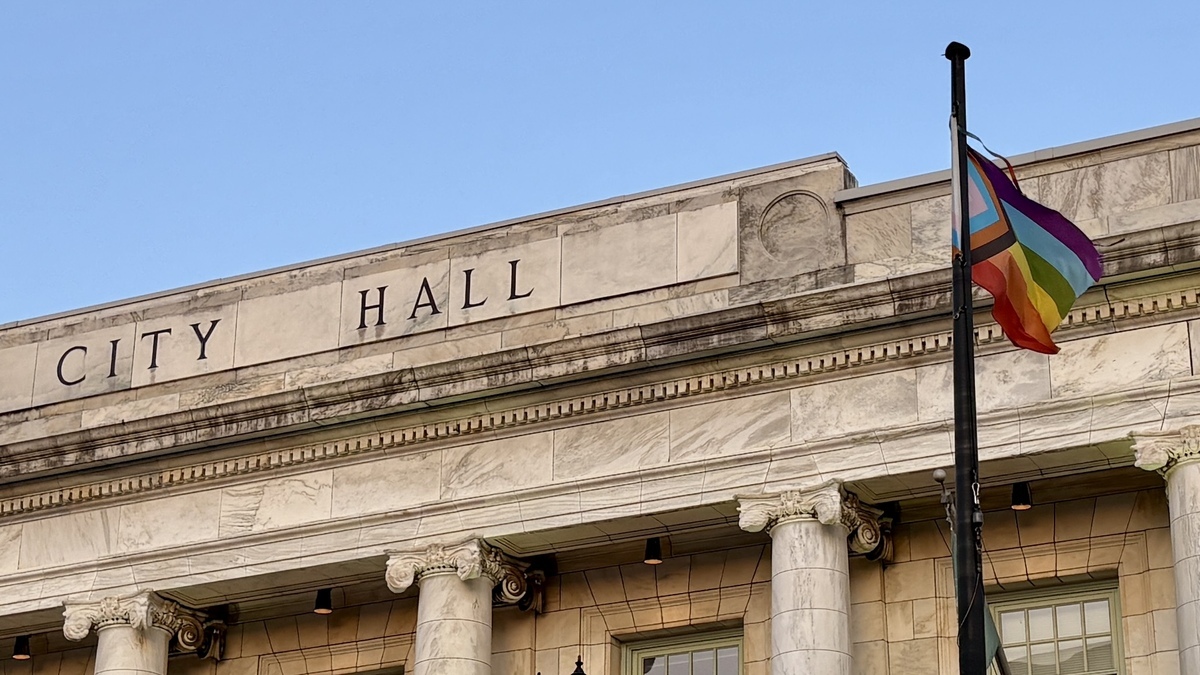
Under the proposed ordinance, Pride and Juneteenth flags are safe.
On Monday, the Ordinances and Rules subcommittee supported guidelines that allow Pittsfield's flag, the United States and commonwealth flags, flags of other nations recognized by the U.S. government, and flags commemorating significant events or causes consistent with the city's values and mission.
"We have had a lot of conversations about what flags are flown on city flag poles, and there is no policy for the city currently," Mayor Peter Marchetti explained.
"And so, leaving ourselves wide open with no flag ordinance being set, any request that is made to fly a flag, you have to make a decision as to whether or not you think it's appropriate, leaving yourself open for discrimination issues."
He added that the policy was basically put forward with the American flag, Massachusetts flag, POW/MIA flag, and any flag that is deemed appropriate, "For example, if we were having Pride month in the city of Pittsfield, like we currently have now, and the city was to declare Pride Month, you could fly the Pride flag. On Juneteenth, the city declared Juneteenth Day, we could fly the flag, and so that's what we're aiming to do here."
The City Code would be amended by adding a new section, Article IX: Flag Displays and Governmental Expression on Municipal Property "to establish clear and uniform guidelines for the display of flags on municipal flagpoles, including but not limited to those located at City Hall, to ensure such displays represent official government speech."
It states that "Municipal flagpoles are not intended to serve as forums for free expression by the
public," and that "All flag displays on municipal flagpoles constitute government speech."
"The City of Pittsfield retains sole discretion over the selection, scheduling, and duration of any flag displays on municipal flagpoles," the proposed ordinance reads.
Ward 5 Councilor Patrick Kavey asked if "flags commemorating significant events or causes consistent with the city's values and mission" should be tightened up.
"Should you have specific examples?" he asked City Solicitor Devon Grierson. "For example, this mayor and another mayor could greatly differ on what they think is an appropriate flag."
Grierson explained that it would be on an administration-by-administration basis.
"The point of this ordinance was to make it so that the flag poles of the city are no longer a public forum, if they ever were," he said.
"Because as a public forum, anybody could request that a flag be put up, including flags that would represent hate speech or anything offensive. So what this ordinance does is allow the administration to use governmental speech to decide which flags get put on city flag poles."
Also supported was a proposed amendment to City Code Chapter 14 that makes it unlawful to have an open container of any alcoholic beverage while on, in, or upon a public way, sidewalk, common, park, conservation area, recreation area, beach, or on any city-owned property. Previously, Section 14-7.1 did not include possession of any alcoholic beverage as an unlawful violation.
Marchetti explained that with the current ordinance, the Police Department is only allowed to take enforcement action for people who are drinking alcoholic beverages in public.
Also on the agenda for Monday's meeting was a controversial ordinance proposal to ban public camping, seen as a way to target unhoused people.
"This ordinance came after some conversations with members of the police department, as we are talking about all of these issues, I think the one thing that we can agree to tonight is what we're trying to eliminate is the inappropriate behaviors. Drinking in public is one of those," he said.
"The ordinance that we have on the books actually requires a police officer to actually watch them ingesting the alcoholic beverages, so just simply having it in their possession does not account for drinking in public. They have to physically watch the drinking take place."
It was clarified that this wouldn't affect permitted events and outdoor dining.
There were concerns about setting the police up for an illegal search and seizure. Grierson said, "We have very well-trained police officers who know the difference between reasonable suspicion and not having reasonable suspicion," as it's a threshold set by the Supreme Court.
When asked how the police would handle a situation where a person has a brown bag with a bottle in it that they refuse to show, councilors were told there is no blanket answer for that situation because each is different.
"If they're not doing anything wrong, and they're holding a bag and they're just walking, they're not drawing any attention. If we get a phone call for a rowdy group, then the officers are going to arrive, and they'll form their opinions based on what they're being met with," said Pittsfield Police Lt. Cheryl Callahan, who oversees the co-responder program.
"And every scenario can be different, so they would take each individual into account to what's happening. Could there be plain clothes officers off to the side, seeing something different and radioing over to patrol officers who are uniformed? Certainly. Do we have both plain clothes and uniformed officers? Yes. So we'll take each step as we go."
The amendment reads:
"It shall be unlawful for any person to possess an open container of any alcoholic beverage as defined in Chapter 13 8, Section I of the Massachusetts General Laws while on, in, or upon any public way, sidewalk, common, park, conservation area, recreation area, or beach or upon any City-owned property within the limits of the City of Pittsfield. This section shall be enforced pursuant to a fine as indicated in Chapter 4 1/2, § 4 1/2-2 or pursuant to MOL c. 272, § 59, as applicable. Upon final adjudication of any charges brought pursuant to this Subsection, any unopened alcoholic beverages seized in enforcing this Subsection shall be disposed of within thirty (30) days of such date unless the person entitled to lawful possession of said beverages petitions the Chief of Police for their return."
Tags: flags,