Pittsfield Subcommittee Says Camping Ban Needs More Work
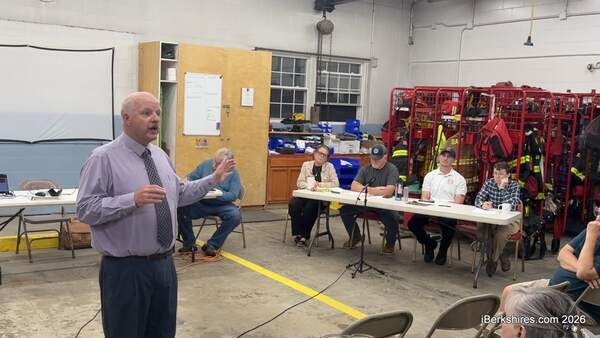
PITTSFIELD, Mass. — The Ordinances and Rules subcommittee wasn't ready Monday night to make recommendations on a controversial ordinance proposal to ban public camping, seen as a way to target unhoused people.
On Monday, it tabled the ordinance proposal after adopting amendments to remove criminalization language and the three-day ban limit for camping on private property.
A revised version will come back on July 28.
Subcommittee members would also like to see the fine structure re-evaluated.
Member Rhonda Serre rhetorically asked, "Why are you imposing civil penalties on people that have no resources?"
"Let's find what we do agree on," she told the community members, advocates, business owners, and city employees in City Council Chambers.
"We agree that homelessness does not mean you're addicted to drugs. We agree that homelessness does not mean you're lawless. We agree that being homeless does not make you a criminal. We also agree that small businesses are not all demons. They're a necessary part of our community and our neighborhood, just like you are. And then the final one is, yeah, rent is too damn high," she continued.
"So my point is, if we all can agree on this, and then we realize there is a very small subsection of the unhoused population who are doing 99 percent of this behavior that is disgusting to all of us."
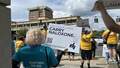
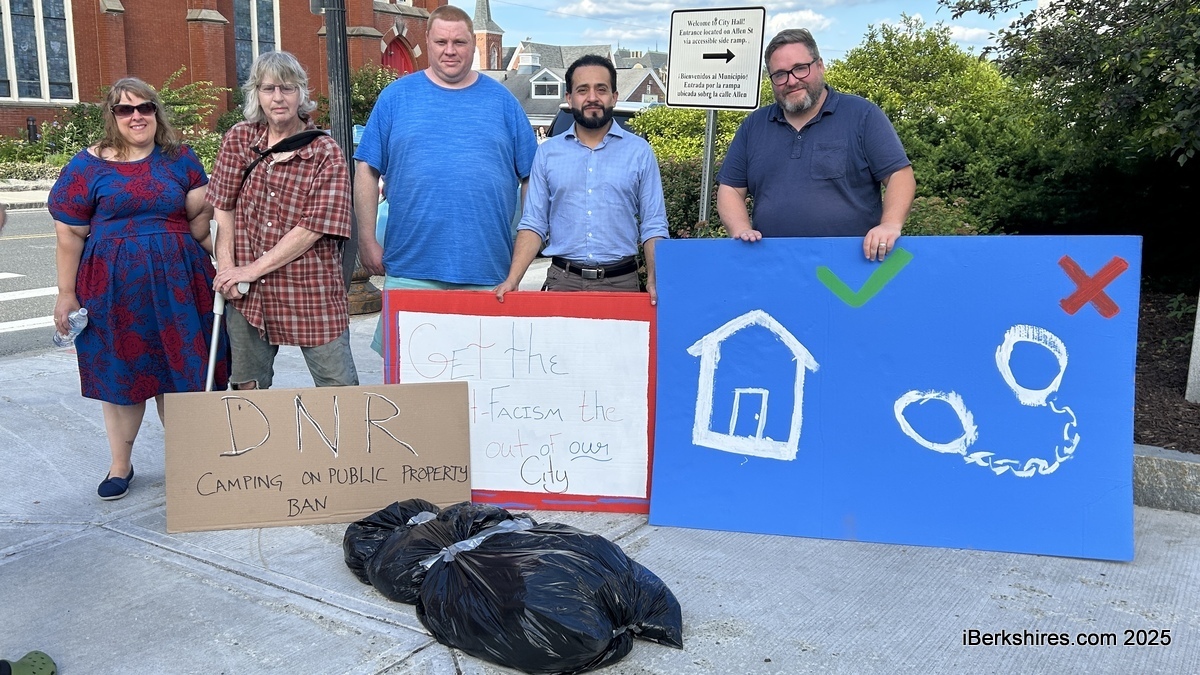
Before the meeting, some open-microphone speakers protested outside of City Hall with signs and a fake body bag. Michael Hitchcock, co-director of Roots & Dreams and Mustard Seeds, said ordinance should not be passed without "a lot more" community conversation, "And that community conversation cannot take place in three-minute increments."
"This rush to pass it will help prevent us from finding solutions in the future when people have any kind of record of criminalization or further trauma from the unequal enforcement this ordinance was designed for," he said.
"Please, just don't pass it, start over and do it reasonably with input from people who know what they're talking about. Most homeless people are not mentally ill drug addicts. Most homeless people have a job and are trying to [not to] be noticed because it's an issue of shame, because some people don't understand it's an economic issue and not a moral one."
An unhoused individual pointed to the lack of public bathrooms and other amenities, mixed with the threat of being arrested for going to the bathroom outside.
"There's no humanity left for us," he said. "So when we act like animals, it's because you guys, it's because the community as a whole portrays us that way."
The meeting's open microphone portion lasted about two hours. This was the second City Council subcommittee review for the proposed ordinance; there was a similar turnout at the Public Health and Safety subcommittee meeting in early June.
"This ordinance exacerbates every systemic bigotry this city has shown for 100 years," resident Ephraim Schwartz said.
Resident Shannon Stephens called it "barbaric" and continued to ask where people will go if the shelters are full and they can't sleep outside.
"This unjust and absolutely vile ordinance is clearly targeted at our most vulnerable community members. And in a time where the world is so so ugly, you decide to add to the chaotic state of affairs under the guise of public safety. What about their safety?" she asked.
"This ordinance is especially bold, considering the Council for Community and Economic Research declared the cost of living in Pittsfield 2.5 percent higher than the national average. We are essentially witnessing our own decline, because most of us are just a few missed paychecks from being unhoused ourselves."
Stephens said the city should focus on eliminating zoning restrictions and building more public housing, which will lead to reduced housing costs.
"We can look into boarding houses or single-room occupancies. We can revise land-use regulations and let people down on their luck set up camp there. We need to expand lower-income renting opportunities, and we need to stop the gentrification of Pittsfield. We need to focus on housing first," she said.
"Do you know how hard it is to not have a bathroom, to not have a shower, not have a cell phone glued to your hand? Do you know how hard it is to sleep outside in the rain, in thunderstorms, in the snow? Do you know how stressful it must be knowing at any moment you could be robbed, sexually assaulted, or attacked? No, you don't even consider those things because you don't have to."
Some spoke in support of the proposal from a business standpoint.
"It's a very difficult look when they're sitting having lunch at [Patrick's Pub] and across the street, the business owner is looking and saying, 'What's the matter with your city,' as they watch people panhandling," Pittsfield Economic Revitalization Corp. President Jay Anderson said.
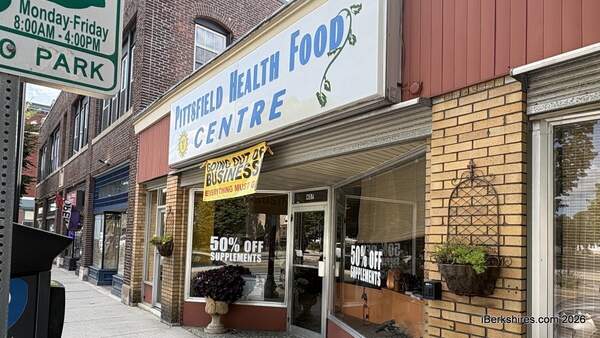
David Tierney, a property and business owner, said he was branded as a "cruel, heartless, evil, fascist, business owner" the last time he spoke in front of a committee like this.
"Despite what you might believe, we, the business community, truly feel for the homeless, and we are trying to understand the drug addicted. These are two separate issues. Many people will make you believe that it's only one issue, but it is two issues," he said.
"The homeless issue, the mayor, the City Council, their partners, [Zion Lutheran Church], are all doing great work trying to resolve this. We still have a long ways to go, and we, the business community, support them wholeheartedly. However, it is my understanding that the addictive people will not be allowed into these facilities because of the issues that they cause. So why is the business community bearing all the burden of this issue, while the social services and the police receive millions of taxpayers' dollars?"
"If you truly believe the drug addicted are not the problem, and you think that it's a good thing to let them sleep in our doorways, please walk in our shoes. Take the drug addicted home where you have invested all your money, where your livelihood is. Let them sleep on your porch. Let them use your sidewalk as a toilet. Let them leave dirty needles in your bushes. Let them steal your stuff. Let them have sex behind your garage in front of the neighbors' kids, because this is all what is happening on North Street."
President & CEO of Lee Bank Charles "Chuck" Leach said he heard "a lot of great arguments" from one side, "But I don't think we've heard enough from the other side, which is how challenging it is to be in small business."
"And the risk that they took to go into business, the belief that they had, the creativity that they had to make the plunge, engage with a bank, take some financing, or put their own money into it. And what I hear is that every single day, they're afraid to go to work, their employees are afraid to go to work, and they're challenged by trying to make their business work," he said.
"… The businesses that I know well, whether they're customers or not, are not to be demonized, and are not necessarily in it just to make a profit. In many cases, it's a community passion. They're doing it because they love it. They're doing it because they believe in this community. They want to employ people, and I feel like they should be heard here, and I feel like we've only heard one side, and I don't think they should be demonized for trying to run a business."
He said he doesn't know what the answer is but wants to see strategies that protect business owners as well, explaining, "I'm sympathetic to everybody else that we've heard from, but I'm also extremely sympathetic to the reality that [business owners] live every day."
Mayor Peter Marchetti again said this ordinance was put forward as a "communication starter."
"I know that I'm not the smartest person in the room and the rocket scientist to be able to come up with these solutions, but we've been talking about this for a very long time with no solutions," he said.
Councilor at Large Kathy Amuso said this is one of the most difficult and challenging things she has worked on "because this is people's lives and there's nobody in this room that wants anybody to be homeless and hungry."
"I don't like that there are two sides to this room because we all want Pittsfield to be better. The people that have businesses on North Street, they take pride in their business. They want to serve the people of Pittsfield. They want you to come into their business," she said.
"But they also didn't sign up to clean up after people because they defecate there or they have needles there and but they do recognize that sometimes people need a place to sleep, and I think we all need to be respectful. I think we have so much more to do, and it does take a lot of time."
City Solicitor Devon Grierson was asked to review the fine structure that ranges from $50 for the first offense to $300 for third and subsequent offenses. Among other amendments, councilors would like to see a lesser, more flexible fee structure.
"Look at our snow removal," Ward 5 Councilor Patrick Kavey suggested.
"Think about that, maybe, because it starts with a warning, and then it starts with information about what wrong behavior is and how to rectify your behavior, and then we fine you after that, and we track it. So why don't we start there?"
Tags: homeless,