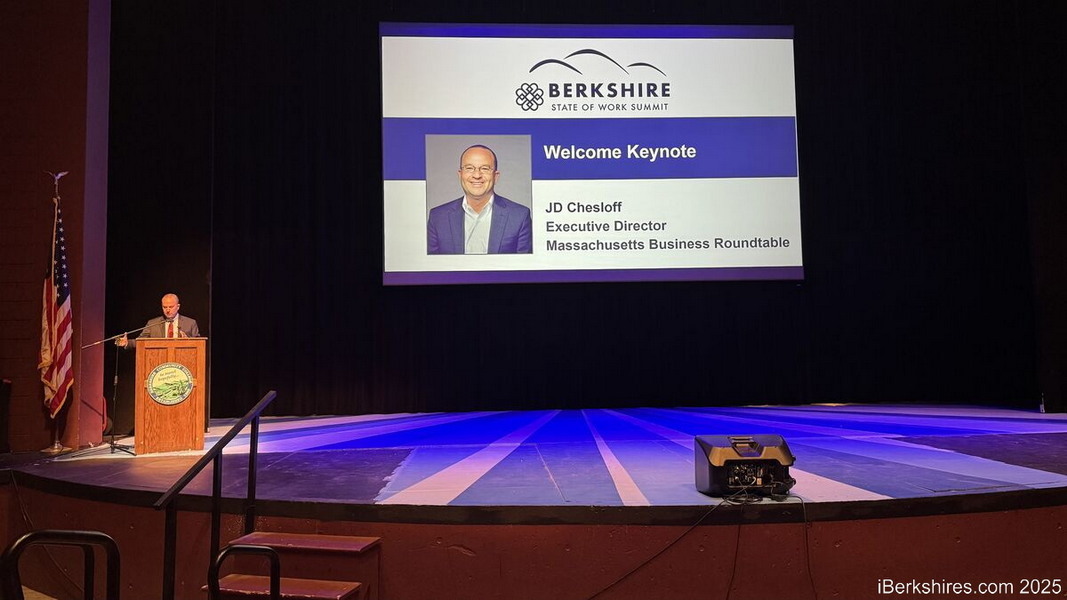
PITTSFIELD, Mass — Berkshire Community College (BCC) hosted the 2025 Berkshire State of Work Summit, "From Hiring to Thriving: A New Era of Workplace Culture," on Wednesday.
The event was presented by BCC, MassHire, Berkshire Innovation Center, Berkshire Regional Planning Commission and 1Berkshire and was held on the college's main campus.
The conference focused on the workforce challenges and opportunities facing Berkshire employers, from attracting the right talent to ensuring their employees flourish in a supportive and dynamic work environment. There were 15 sessions and about 40 speakers at this year's event bringing around 200 people.
The executive director of workforce development and community education at BCC, Linda Clairmont, started the morning off speaking about the challenges of the workforce.
"We've all had these conversations with each other in various ways about the challenges of the current workforce, and we're going to hopefully chart a new course toward a more resilient, inclusive and dynamic workplace," she said.
She brought up how many workplaces have different generations working there simultaneously leading many different approaches to work.
"A data point that has been especially interesting to me over these past weeks of planning is the idea that we might in our workplace have five generations of employees, so someone in their 70s, 60s, 50s, 40s, 30s, 20s, right? And there are distinct differences in how each generation approaches work, and so for you, for employers, this can be a real challenge," Claremont said.
Clairmont asked the audience to keep in mind what usually gets asked at the end of a job interview: what are “the top three things that you need to feel successful, rewarded and engaged in your workplace?”
"Carry those thoughts with you throughout the day today as you engage with the various sessions that you're attending. Especially at the end of the day when we reconvene here in the theater to talk about the overall themes of the day,” she said. “Today is just the beginning. Throughout the day, the BCC summit team will be listening carefully for the common themes that we think could be explored in future sessions."
BCC hopes to use this data to take on these workplace challenges in the future.
"Our goal is to help us and you create thriving workplaces."
BCC President Ellen Kennedy introduced the keynote speaker JD Chesloff, who is the president and CEO of the Massachusetts Business Roundtable.
"For us at the round table, we believe that workforce development and economic development are really one of the same. There's no distance between the two," he said.
He spoke about what other places were doing to help with hiring.
"As I have visited other states and even other countries this consistent theme emerges. Other places are much more intentional about aligning their economic development and their workforce development strategies. In North Carolina, for example, their community college system prioritizes in-demand industries such as manufacturing and tech, ensuring this pipeline of workers for that industry, which then they use to attract employers and build an entire cluster," he said.
Chesloff discussed his time in Berkshire County growing up and the local hiring climate and what some employers are doing to find alternative solutions for recruiting, retention, and employee work readiness.
"We know that the state and the Berkshires has a talent crunch caused by the cost of living, by demographic trends, by changes in immigration policy, by the migration of talent. So what do we do about it? And this is the fun part. This is why we're all here today," Chesloff said.
He suggested Massachusetts employers had trouble filling talent and were hiring remotely or those out of state or elsewhere when they could do it here.
"We have the talent right here in Massachusetts. It's right here in our communities. We just need to remove the barriers to their barriers to the workforce. So we can do this by adjusting language barriers, by adjusting the high cost of health, of child care, training through co ops, internships, apprenticeship, connecting graduates from our outstanding institutions of higher education like the one we're in today, more intentionally with employment opportunities. This is the stuff we're working on," he said.
Chesloff suggested four strategies for them to think about: think differently about hiring, support employees needs in the workplace, advocate, and seek out new partnerships.
BCC President Ellen Kennedy said its critical to start coming together to converse on this topic and work to figure out what to do.
"I think we're in an incredibly disruptive moment in some ways. I think there's so much happening at the national level, which not only doesn't quickly impact us, but seems to be impacting everyone much more quickly. I think JD Chesloff talked about it, that businesses are rethinking quick investment in things. They're delaying making decisions that would grow workforces. And I think all of us are trying to figure out, how do you navigate in this kind of time? It's a real inflection point across the nation, across the world, and it's happening right here in Berkshire County. So I think it's a critical time to be having these conversations. And I think the best minds need to come together, and that's what you have today, some really great people coming together to have honest and clarifying conversations about what to do," she said.
If you would like to contribute information on this article, contact us at info@iberkshires.com.
Your Comments
iBerkshires.com welcomes critical, respectful dialogue. Name-calling, personal attacks, libel, slander or foul language is not allowed. All comments are reviewed before posting and will be deleted or edited as necessary.
No Comments
BRTA Focuses on a New Run Schedule
By Breanna SteeleiBerkshires Staff
PITTSFIELD, Mass. — The Berkshire Regional Transit Authority is still working on maintaining its run schedules after dropping the route realignment proposal.
Last Thursday's meeting was Administrator Kathleen Lambert's first official meeting taking over the reins; retiring director Robert Malnati stayed during a transition period that ended last month.
Lambert is trying to create a schedule that will lessen cancellations. There was a two-hour meeting the week before with the drivers union to negotiate run bids and Lambert is working with the new operating company Keolis, which is taking over from Transdev.
The board spoke about anonymous emails from drivers, which Lambert said she has not seen. iBerkshires was not able to see those letters, but has received some.
"They were lengthy emails from someone describing themselves as concerning BRTA employee, and there was a signed letter from a whole group of employees basically stating their concerns. So, you know, to me, it was a set of whistleblowers, and that, what my understanding is that this really triggers a need for some type of process to review the merits of these whistleblowers, not going to call them accusations, but basically expressions of concern," said member Stephen Bannon.
A letter iBerkshires received spoke of unhappy drivers who were considering quitting because of decisions being made without "input from frontline staff," frustration and falling morale, and the removal of the former general manager shortly after Lambert came in.
Lambert said it's difficult to navigate a new change. She also noted many drivers don't want to do Saturday runs and it has been hard negotiating with drivers on the new runs.
"I would like you all to keep in mind that the process of change is super difficult. Transdev has been here for 20 years, and some of these drivers have never known any other operating company, the way some of the operations have been handled has been archaic," she said. "So getting folks up to speed on how a modern transit system works is going to be painful for them. So I don't want to say that I'm unsympathetic, because I am sympathetic, but I am trying to coax people along with a system that's going to seem very strange to them."
The board spoke about better communication between them and Lambert, citing cooperation will be best moving forward.
"There's just a lot of stuff in the air right now, and there are a lot of fires to put out to make this a coordinated effort. And if we don't keep our communications open and be straightforward, then you get blindsided about how you know the input that you could get from us about your position, and how you know what's going on in your direction, and we get blindsided. And I think that we have to make sure that this is a collaboration," said member Sherry Youngkin.
"Both sides have responsibilities, because in the long run, this advisory board is going to have to make decisions as to how we brought forward and if we've gone forward in a fair and helpful way. And I think that's hopefully what everybody is looking for also."
Transdev and Keolis held a three-day recruiting event interviewing almost 40 candidates and offering jobs to eight, but only three stayed on to start training. Lambert said it was disappointing but she will keep trying to retain more people.
In her first report to the board, she noted that ridership dipped a little over 10 percent, but still remains higher than last year, adding that was because of cancellations of services because of the lack of drivers.
Like the last meeting, some of the advisory board members were torn over the start of the Link413 service, worried that the start of the service took drivers away and the numbers of riders are low.
Lambert, however, said the ridership has doubled from last month.
"As I've spoken before, we have, generally, a six-month adoption for brand-new service before you can really go in and evaluate, are you being successful based on the grant that my predecessor wrote along with the team for PBTA and RTA, we are ahead of schedule, which is pretty good, so I'm hoping that will continue to improve," she said.
Member Renee Wood said the board never approved the service, adding the only thing she could find in the minutes was a vote to accept the equipment. She said it was supposed to be put on the agenda to discuss.
"The Link413 service has been three years in the making. It's been a grant that was accepted and has been working with our partners, PVTA and FRTA, to put into place. So I don't have the entire history of how that process worked, but it's been three years in the making, and did we not understand that once we accept that grant that we were going to put in new service?" Lambert said.
The board discussed if Title VI, the Civil Rights Act, was followed with an accurate review and accurate amount of time for public comment period on the service changes and if its attorney should review if the grant conditions were properly followed.
Lambert said changes had the 60-day comment period included in the proposed route realignment packet, giving the opportunity for the community to respond to that as well but will look into the legality of the situation with their attorney.
The Berkshire Regional Transit Authority is still working on maintaining its run schedules after dropping the route realignment proposal. click for more
The town election is less than a month away and, unlike recent ones, all open seats are uncontested, with even a vacancy remaining on the Planning Board.
click for more