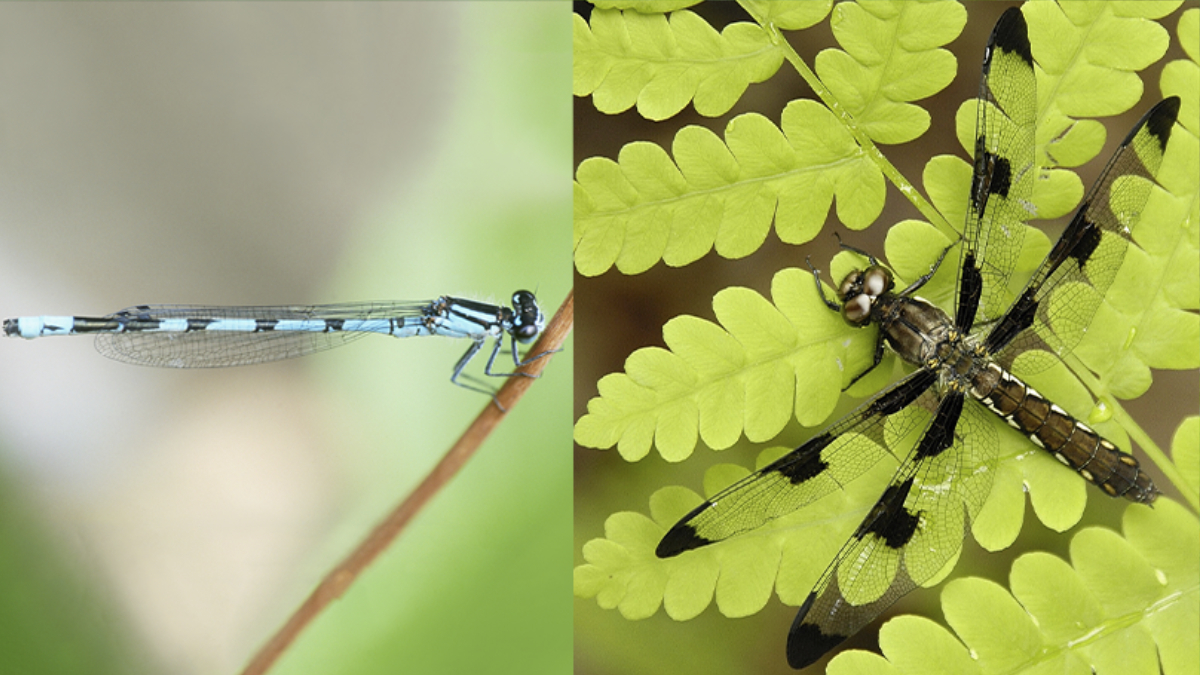
As spring moves towards summer and temperatures start to rise, native insects begin to take flight. Perhaps none are as extraordinary as dragonflies and damselflies. Dragonflies and damselflies are part of the order (scientific grouping) known as Odonata, an ancient group of insects that have been found in the fossil record as far back as 300 million years! There are over 160 species of "odonates" found in Massachusetts ranging in color from drab brown to bright red, blue, green, and even purple.
Keep reading to learn about dragonflies and damselflies, then look for them on your next outing. Simply sit near, walk close to, or boat along the edge of a lake, pond, river, or small stream to see these impressive hunting insects in action!
Life Cycle
These majestic flyers don’t always look like their adult forms. Wingless dragonfly and damselfly larvae (or nymphs) spend 10-36 months living underwater in rivers, lakes, and ponds. These juveniles swim and stalk through the submerged muddy terrain in search of other aquatic insects, tadpoles, and even small fish to prey upon. As they grow, nymphs undergo a series of moltings, shedding their exoskeleton for a slightly larger one each time.
When young dragonflies and damselflies are ready to take their adult form, they crawl out of the water for one final transformation. This metamorphosis does not occur within a cocoon, nor does it take days like with butterflies. Instead, adult dragonflies and damselflies hatch out of their own juvenile skins by cracking joints along the back of their exoskeleton and pushing themselves out of their nymphal form. The emerged adult rests in place, pumps blood into its wings to help them harden and spread, and finally takes to the sky. The entire process occurs within hours from the time they crawled out of the water.
Hunting adaptations
Odonates have large, compound eyes that provide almost 360-degree vision. Each dragonfly eye contains up to 28,000 lenses; damselflies may contain 7,000 lenses. The extraordinary optical ability makes it easy for these insects to pinpoint moving prey. In the air, dragonflies are the most skillful of insect flyers. They can move in virtually any direction. This is a skill that is nearly unique to dragonflies and damselflies and makes capturing prey rather easy. Dragonflies eat large insects including damselflies and even other dragonflies. Though they are more delicate fliers, damselflies are equally efficient hunters and consume large amounts of mosquitoes.
Damselflies vs dragonflies
Damselflies:
delicate and small-bodied with narrow abdomen
head is wider than long, with eyes separated by more than their own width
forewings and hindwings are similar in shape
hold their wings pressed above the body or only partially open at rest
weak fliers
Dragonflies:
stout and large-bodied
head rounded, with eyes covering much of the top and sides of the head
forewings and hindwings are different shapes
hold their winds out straight to the sides when at rest
strong flier
Fun facts
The name "darner"—a family of large dragonflies—comes from the insects' resemblance to a darning needle.
Like birds, male odonates are often more colorful than females—a trait evolved to help attract a mate.
Dragonfly ancestors soared the skies before dinosaurs dominated the earth and had a wingspan of over 2 feet, making them the largest insect ever to live.

If you would like to contribute information on this article, contact us at info@iberkshires.com.
Your Comments
iBerkshires.com welcomes critical, respectful dialogue. Name-calling, personal attacks, libel, slander or foul language is not allowed. All comments are reviewed before posting and will be deleted or edited as necessary.
No Comments
Companion Corner: Cookie at No Paws Left Behind
By Breanna SteeleiBerkshires Staff
NORTH ADAMS, Mass. — There's an adventurous cat at No Paws Left Behind looking for his forever home.
iBerkshire's Companion Corner is a weekly series spotlighting an animal in our local shelters that is ready to find a home.
Cookie is a six year old grey and white domestic shorthair who has been at the shelter for a couple of months.
The shelter's Executive Director Noelle Howland introduced us to him.
"He came in, actually, with a couple other cats. It was just due to having too many cats in a house, and he came in with, we believe he might be like the father to the others. The others all were adopted over the last couple weeks, so he's the last one still here."
Cookie is a very friendly cat and he is always interested in the other cats to play or hang out. He can do well with other animals and any age but don't let his age fool you as he is still very active and very outgoing.
"He does well with other cats, he would do fine with being at home with dogs, kids. I know, like some people like seeing, a six year old cat you would think he may be not as active, but he is very active, outgoing, vocal. So, I think if you were somebody that was looking for a cat that was active and had a personality that I feel like he'd greet you at the door. He lets you know when he wants food. Really, he can go home with anything, as long as you want a cat that will let you know he's there, he'd be great."
He is quite adventurous as well. He enjoys climbing and exploring around his space. While he may be a bit shy to newcomers at first once he gets to know you he will talk to you and want to play.
"He likes to explore up high, so I think if you had a tall cat tower or windows for him to explore, he would love that, because he always is trying to get up high and get on the cabinets to see what's up there. There's not much he doesn't like, and then he can be a little like shy at first with new people, where he'll kind of go up to you and then walk away, but once he trusts you and is used to you, he's the easiest going social cat," she said.
Cookie does have a bit of a sensitive stomach and would be better if he has certain foods.
"We've tried a lamb or turkey food, and he's had a sensitivity to that, so we've been having him on just salmon and rice food, and he's been perfectly fine, no issues. So, otherwise, aside from the sensitivity, he's perfectly healthy and normal."
Cookie is waiting to be your next family member, if you want someone to talk to and lounge around with this is your boy.
"I really just think if you're looking for a social cat, he's going to be a great companion for somebody. I don't think it matters if you're… it doesn't matter your age. I think he would be happy to just have somebody keep him company and give him attention," she said.
If you think Cookie is your next companion be sure to fill out the form on their website and email or drop it off to No Paws Left Behind today.
Last week, families, attorneys, social workers, and agency staff gathered at the 18 Degrees Family Resource Center to honor four families who overcame obstacles, such as addiction, successfully navigated the system, and were ultimately reunited with their children. click for more
The Boys & Girls Club of the Berkshires provides programs and services that support children throughout the year, including EEC licensed childcare, afterschool programs, summer camp, academic support, sports and recreation, swimming, arts and enrichment activities, leadership development, wellness... click for more
Just five months after opening, The First has already become a community hub for individuals in need of resources or a place to decompress.
click for more
The Licensing Board voted to suspend Bei Tempi's liquor license for five days, determining that it was "more likely than not" that the bar served at least one underage patron alcohol.
click for more