CBRSD School Committee OKs $36M Budget
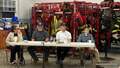
DALTON, Mass. — The Central Berkshire Regional School Committee approved a gross final budget of $36,643,001 for fiscal 2026, an increase of 2.70 percent over this year.
The biggest cause of the increase is from insurances. The district's active health insurance premiums increased by 16 percent; retirees had an increase of 20 percent, and a 3 percent increase in dental, said Gregory Boino, director of finance and operations.
Another large increase was for special education transportation costs, which increased $135,000, "and it's just to meet the actual expenditures where we're living right now," Boino said.
The district's Special Education Out of District Tuition line decreased by $214,350 because students are aging out of those out-of-district placements, he said.
The Finance Committee also decreased the other post-employment benefits, or OPEB, amount by $350,000, so next year, the district will be funding it with $50,000, Boino said.
The Finance Committee discussed how there is a deep need for the community to petition the state to change Chapter 70 education aid and rural aid, School Committee member Paul Farella said prior to the budget update.
"The way that they work makes it extremely difficult for us to make a budget that is fair to towns when you have some that have high percentages of assessment and others with negative it can create a sticky situation," he said.
.png)
The district has school choice funds, and by the end of this year, they should have about $1.7 million.
The district put $350,000 in, and $200,000 is anticipated to come in next year. "So, we will be around 1.5 million or 1.6 million if things continue with school choice the way it is right now," Boino said.
If the district does not get enough rural aid, there is enough in school choice to cover those costs next year, he said.
"That's an important thing just to highlight that we need to have the reserves in school choice to offset the chance that we don't get Rural Aid, and it would be a big gamble to budget for Rural Aid and not have the school choice funds to back it up," said Michael Henault, assistant superintendent.
The biggest thing this year is the changes in the district's revenue changes, especially in its grant and revolving funds, Boino said.
"The Finance subcommittee added more [budget lines] into rural aid next year, so in [fiscal year 2025] we had about $720,000 in salaries out of rural aid. Next year in our [fiscal year 2026], we'll be using just over $1.2 [million,]" Boino said.
"The other thing we'll be using next year is some of our school choice fund. We have not done that last couple of years, but we do have $340,000 salaries out of school choice next year. So, the variance year-over-year of our grant funds for salaries did see an increase but only an increase of $99,000."
The other place the district has funds used in the budget is through circuit breaker, the special education tuition. At the end of FY26, the district will have about 600,352 in the fund, Boino said.
"We are prepaying some special ed tuition this year, about $313,000, so this leaves our gross operating budget at $32,233,498," he said.
"That is the number that needs to be appropriated either through state aid, local funds, and town assessments."
The biggest change in the revenue projections are the excess and deficiency appropriations, Boino said.
The district will use all of its excess and deficiency funds in FY26 rather than leaving $250,000 in the fund like they normally do in case of emergencies popping up in the year, he said.
"At the end of this fiscal year, there will be no money left to start the next excess and deficiency fund with what we have left this year," Boino said
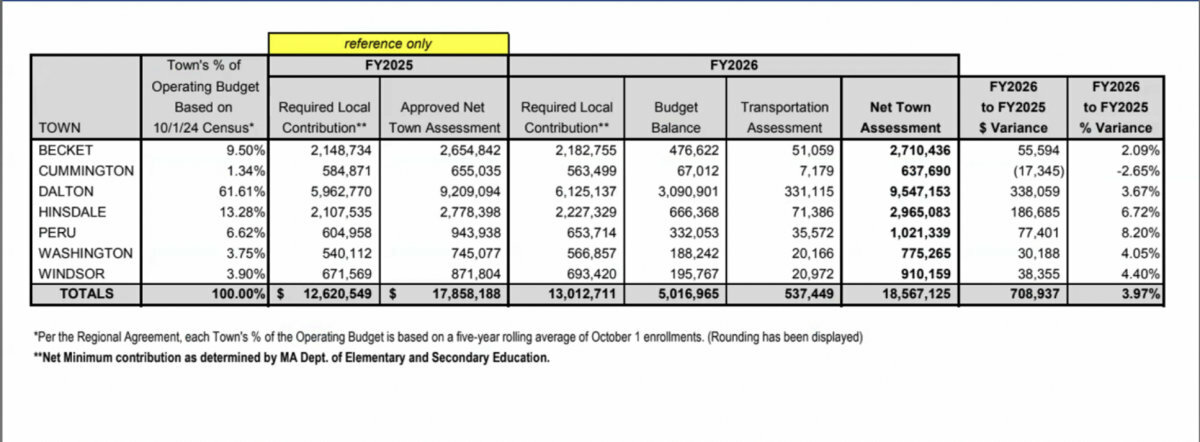
"So, that leaves our town assessments at 3.97 percent year-over-year."
As the largest of the seven communities in the district, Dalton's assessment is projected at $9,547,153, an increase of $338,059 or 3.67 percent.
Other town assessments are Becket at $2,710,436, an increase of $55,594 or 2.09 percent;
Hinsdale at $2,965,083, an increase of $186,685 or 6.72 percent; Peru at $1,021,339, an increase of $77,408 or 8.20 percent; the town of Washington at $775,265, an increase of $30,188 or 4.05 percent; and Windsor at $910,159, an increase of $38,355 or 4.40 percent.
Cummington had the only decrease, of $17,345, bringing it to $637,690.
The salaries line item is anticipated to increase by $772,000, or 3.98 percent.
There are increases of $1,271,000 in the salaries line item. This includes additional positions that were added last year after the FY25 budget was approved.
These additions include one full-time school adjustment counselor who splits their time between Wahconah Regional High School and Craneville Elementary School, a half-time districtwide English language learner teacher, and a full-time special education teacher at Craneville.
There is also an addition of one full-time Bridges teacher at Nessacus Regional Middle School. The Bridges program was started last year specifically for students two to three years below grade level.
It also included 2.2 full-time equivalent paraprofessionals because of individualized education programs and student needs, Boino said.
The salaries line item also decreased by $469,000 due to reductions in positions and retirements, he said.
The district's capital budget has an increase of $299,019 because of the Becket Washington project coming off the books but also going out for bond for the Wahconah project, Boino said.
Biono said he is tracking the excess and deficiency fund, but the district will not know the amount until the end of this fiscal year.
"I am tracking that to be a little, I'm gonna say lower right now because I want to scare anybody, than we have seen in the past," he said.
There will not be a holiday insurance premiums this year.
"So, all the years since I've been in this position, we have seen a premium holiday where employees in the district do not have to pay their June premiums, that saves us close to $400,000," Boino said.
"So, that been kind of feeding our at the end of the year our [excess and deficiency.] We are not going to see that this year, so I do expect our E&D to be less next year. And we don't have that $250,000 to start the fund off each year, so we'll be looking for that as well."
Tags: CBRSD_budget, fiscal 2026, school budget,