Dalton Candidates Talk Fire District, Green Initiatives
DALTON, Mass. — Dalton voters will choose from four candidates at the Feb. 3 special election to decide who will fill the vacant Select Board seat.
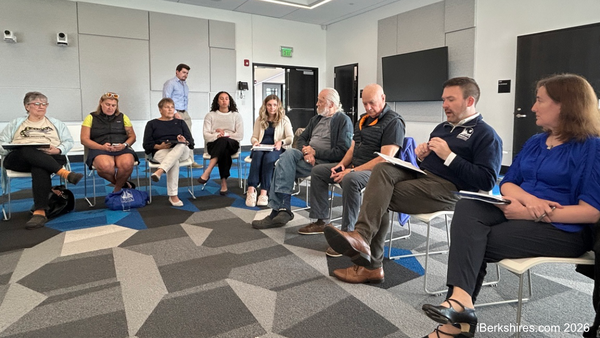
The four candidates on the ballot, Robert Collins, Rich Haley, Levi Renderer, and Patrick Carsell appeared at a forum Wednesday night to highlight their perspectives on issues including transparency and collaboration, the condition of the police station, and roads and sidewalks.
The previous article covered the discussion on the police station and the town's infrastructure, including roads and sidewalks.
Here's a quick summary of the other topics covered during the forum:
The candidates discussion on housing, transparency and collaboration within town government, and how the town can reduce the financial burden on taxpayers. It is available on iBerkshires' YouTube channel and embedded below. Follow the chapters in the description to bring you to the desired section.
The forum was also recorded by Dalton Community Television.
Fire District
Local officials have commented that some residents are unaware that the Fire District is a separate governing body from the town. There have been some criticisms previously as to whether the district should remain independent.
Do you think the town should explore the benefits and downfalls of integrating the district into the town's purview?
All candidates agreed that this is a subject that should be investigated.
Carsell enthusiastically said yes.
"To elaborate on that a little bit more. I had a question, what were to happen if they were to collaborate? I can't answer that, but that needs to be thoroughly investigated, I think, at this point in time" he said.
"It's 2025 people."
He highlighted how the district has been separate from the town government for a long time.
According to the district website, the district's charter was granted by the Legislature on April 7, 1884.
"I think it would make sense for us to look towards the future and the benefits of what may happen if we were able to do that especially given the the track record that's happened in the last couple of years anyway," Carsell said.
Renderer said it should be explored and that he has heard opinions from people on opposing sides.
"I think that certain residents have some very pertinent information to how this stuff was started, and the effects that it would have if you separated them," he said.
"There is some things that they put in place when they were designed, and I think that it definitely should be investigated and looked at."
Everyone should have an opinion on this subject and people should know the impact these two entities collaborating would have, he said.
"Being on the Fire Department, I do know quite a bit about that and they're both great, you know, entities, and they work well together now," Renderer said.
"I think that people just really need to understand what that would entail if you did combine them."
Haley said he would be open to discussing whether the district should be integrated into the town government.
He highlighted how when he first moved to the area, the Fire District being a separating governing body from the town was confusing, especially when he got two tax bills.
"That can definitely be confusing for some, and I would definitely be open for it. Obviously, like everyone else said, you gotta weigh the pros and cons. If the pros outweigh, then we should probably do it," he said.
"If we don't do it, then you have to say why. That's the biggest thing is just exploring all your options and making sure we make the right choice for the town."
Collins said whether the district should merge with the town is unclear, but it is something that should be studied to determine the benefits and shortcomings.
"The Water Department and the Fire Department have stood alone for years and years. They've come under scrutiny over the past few years. They've taken their lumps and bumps, but they're actually functioning," he said.
The town would have to determine the merger's financial implications for taxpayers, especially considering the structural improvements to aging water lines, Collins said.
Green Initiatives
The town has a very active Green Committee, which is developing a climate action plan.
Do you think the board should support these initiatives, and if so, how can it aid in the committee's efforts, including its attempts to reduce the town's reliance on fossil fuels?
Renderer said the board should support all committees but noted that he sells fossil fuel, so he felt like this was not a fair question.
"I sell gas. I sell oil to Berkshire County, Dalton, a lot of customers. I know a lot of ways that you can reduce your carbon footprint by increasing your efficiencies. Also, sell electric heat pumps. They have their uses," he said.
After reading the draft climate action plan, which the town is in the process of developing, he said he felt that the goal of half the cars in town being replaced with electric by 2030 is an unrealistic because of the vehicles' cost and the infrastructure needed to charge them.
The Green Committee has been working on electric vehicle charging stations. The town has chargers at the Community Recreation Center, Wahconah Regional High School, and Senior Center.
"Yeah, I'd support them. I [would] also help them. I go into houses all the time and try to help them save on their fuel costs because fuel costs are going up. And we want to keep people warm, but you don't want to force people into being cold because of initiatives that somebody's going to dictate to you," Renderer said.
"I think it could be done slowly, methodically, thoughtfully, and it definitely, you know, could reduce, we could definitely reduce our carbon footprint from eliminating a lot of waste."
Haley said there are ways the town could potentially save money through green initiatives and would love to hear what committee members have to say.
"Just finding different ways to save the town taxpayers money because ultimately, if we go green, it's going to reduce our carbon footprint, which could reduce the amount of money that we have to pay for some of our bills and everything else to keep the lights on. It's going to reduce those costs," he said.
He also mentioned that the state has incentives for towns to go green that can be considered.
Collins said he would "100 percent" support the Green Committee and pointed out how they have secured "at least $100,000 of grant money" for the town.
He also recommended the town consider installing a solar field on the landfill behind the Department of Public Works building, as nothing else can be done with it.
"The town could generate anywhere around $200,000 to $250,000 a year … every four years, you're creating a million dollars of capital for the town to use to implement and improving its old, rundown buildings, and bringing them up to upgrade with heating systems, insulation, windows and all that," he said.
Carsell urged residents to check out the Green Committee's climate action plan. Information on its initiatives and goals can be found here.
"I took the survey today. I happened to grab this from one of our residents, and it's amazing. I mean, the work they've done already," he said.
He highlighted how he has a hybrid vehicle and has solar panels on his home.
"If we're going to be thinking about new buildings in town, you've got to absolutely be considering adding solar to save on electricity and any other way we can eliminate fuel," Carsell said.
"These splits are wonderful. It's a heat pump that gives you air conditioning and heat. It runs off electricity. I don't have an electric bill anymore. I'm very thrilled about that."
The town could potentially avoid expenses and roll that into whatever kind of load the town would get.
"There are also tax incentives. We don't know exactly what they'd be unless we contact the mass save or whoever the government and find out what potentially we can save but a good amount of that is going to be reimbursed over time," he said.
What is the role of a select board member?
All candidates agreed that their role if elected is being the voice of the people.
"I don't really have specific personal needs. I believe in selflessness. I believe in helping people," Renderer said.
"I get to help people all the time in my business, now that I'm at people's houses, helping them when usually they don't have heat, hot water, helping them with a solution to make them more efficient and save money in their energy needs. And I just think being a representative and helping people with their needs."
Renderer is a salesman at Mirabito Energy Products and has volunteered as a Restorative Navigator with the Center for Restorative Justice in Bennington, Vt., during which time he visited the unhoused population living in emergency shelters. More information on his and the other candidates' backgrounds here.
Haley said being on the Select Board means working with the four other "great individuals" on the board and serving the residents of Dalton.
The board is the voice and ears of the people. They have to listen to town residents and weigh everyone's point of views and determine what is best for the town. Your neighbor may not share in your perspective, he said.
"Sometimes that's easy. Sometimes it's not so easy. I'm elected. I work for the people. I have to make sure that the board stays on track, and we work as a team to serve the people, make sure that town stays as beautiful as it is, and making sure other departments have that same goal and aligned with the town's goals as well," Haley said.
Collins emphasized the need for collaboration between the board, town manager, and department heads.
"I believe that I'd be the advocate and voice of the people of the town. I would listen to your your cries and concerns, and advocate for policies and procedures within the government to move some of these issues forward," he said.
The boad needs to work as a "unit" based on input from the residents to implement a five to 10 year police where the town can achieve its goals much easier while lessening the financial burden over time, Collins said.
Carsell highlighted how he thinks independently and is a team player and said the Select Board has to listen to the complaints of the people, residents and business owners.
As a member of the board, he would listen to these concerns, investigate them, come up with a personal assessment, and bring it to the board for discussion, input, and develop new ideas about solutions, he said.
"I'd like to keep Dalton a wonderful, safe and secure place to live. We need to focus on roads and sidewalks. Personally, that's what I've had a complaint with over the years. Is the condition of some roads in town, not so much, sidewalks, but I understand sidewalks," Carsell said.
"I know people are using them regularly, and they need to be both esthetic and functional. So, the maintenance and infrastructure of the town would be most important to me, and without overburdening the taxpayer, of course."
Tags: candidate forum, election 2025, town elections,