Mount Greylock Committee Talks Goals, Improvement Plan
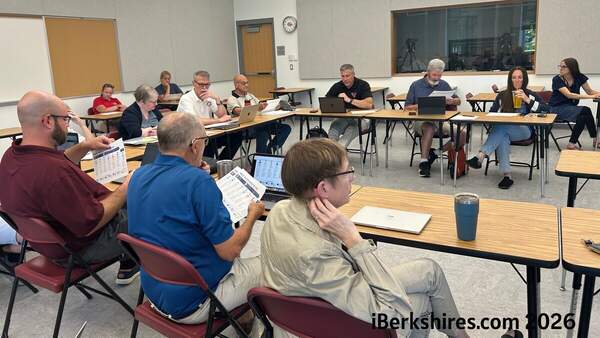
WILLIAMSTOWN, Mass. — The Mount Greylock Regional Schools interim superintendent Thursday walked the School Committee through his goals for the remainder of the 2024-25 school year and gave a status update on the District Improvement Plan the committee approved earlier this year.
"We are in a unique spot in that I'm very happily an 'interim,' " Joseph Bergeron told the committee at its monthly meeting. "I will probably be serving you this way until the end of June 2026.
"I'm trying to offer meaningful goals and meaningful metrics but do that in a way where I want to get through this school year and then have one more year where we'll, hopefully, see progress."
After the abrupt departure of former Superintendent Jason McCandless in the middle of his contract last spring, the School Committee voted to elevate its assistant superintendent to the interim position with a goal of appointing a new full-time superintendent during the 2025-26 school year.
On Thursday, Bergeron laid out four specific criteria on which he wants the School Committee to evaluate his performance over the next eight months — in addition to the day-to-day administration of the preK-12 district.
Those goals included: revising or re-affirming bias-based, bullying and sexual harassment/discrimination incident response capabilities; completing a plan of action for increased literacy across all grade levels within the district; leading the hiring process for the next permanent principal at Williamstown elementary school; and further developing two-way communication between the district and our students, staff and community.
Three of the four goals align directly with aspects of the District Improvement Plan.
For the fourth, Bergeron promised a hiring process that will be "collaborative and comprehensive" and said that he will be developing a hiring committee that includes staff, community members, parents and guardians of pupils and administrators.
"We want to make sure to conduct that search in a way that has a broad reach," Bergeron said.
Bergeron's first goal on incident response capabilities will involve bringing updated policies back to the School Committee by July and developing training for all staff for the 2025-26 school year.
The new policies and procedures need to include "accountability measures," Bergeron said.
"To me, that means two things: one is an explicitly stated approach to sharing data with the public and two is a well-defined documentation of what is provided to parties [involved in an incident]," he said.
"We're already working toward [Goal 1], and I think we have a good commitment to concrete movement, whether it's revising or reaffirming and better explaining, better teaching, what we do. I feel it will happen prior to the end of June."
The fourth goal, developing better two-way communication in the district, will involve expanded use of the ParentSquare communication app to share information with members of the school community, starting a weekly update from the superintendent for families and launching a "check-in" tool to gather regular, monthly feedback from students, staff and families.
Bergeron talked extensively about increasing literacy (his second goal) in the district both in his presentation on the District Improvement Plan and in the discussion of superintendent goals.
He told the School Committee a team of teachers and administrators are working with the Massachusetts Dyslexia Institute to develop recommended resources and professional development for educators. The district also is looking to expand its assessment tools and intervention resources.
"[The districtwide team has] done a lot of learning over efforts both within and outside the district over the last year," Bergeron said. "We do need to go through a process of documenting the proposed improvements within our curricular offerings and the tiers of support we offer. We need to provide justification for the resources needed to implement that path."
The literacy improvement initiative is one of several areas in the District Improvement Plan that Bergeron highlighted as having potential implications for the fiscal year 2025-26 budget and beyond.
School Committee member Carolyn Greene at one point asked whether Bergeron had specifics on the size of those implications, particularly given the interest of finance committees in Lanesborough and Williamstown that also are heading into the FY26 budget season.
"What we have done over the last few years is try to telegraph earlier and earlier in every budget season: Here are the realities of our wants and interests," Bergeron said. "In reality, not all of these [initiatives] will translate into, 'Here's a proposed budget.' If we were to do everything we want to do, we could pretty quickly stack up a 10- to 15-percent budget increase. That's nothing we plan on doing.
"I will be a little bit more upfront in December and January February to say, 'Here's what it would cost if we were able to … ' But, ultimately, we will also pare that down into something smaller."
Reviewing the curriculum and materials through the lens of addressing bias — one of 15 objectives in the DIP — was another area where Bergeron pointed out potential budget impacts.
But it also was an area where he was able to point to success in the work the district already has done.
"It's been going so well that the state is actually promoting the process that was developed as a model for other districts," Bergeron said. "We've had a couple of districts reach out to us saying, 'We heard you've got something great. Can we learn from it?' which is wonderful.
"It is a little bit of proof, but, at the same time, the proof is in: After we've gone through the first year and do continuous review every year after, the results that come after it."
Tags: MGRSD, school improvement,