image description
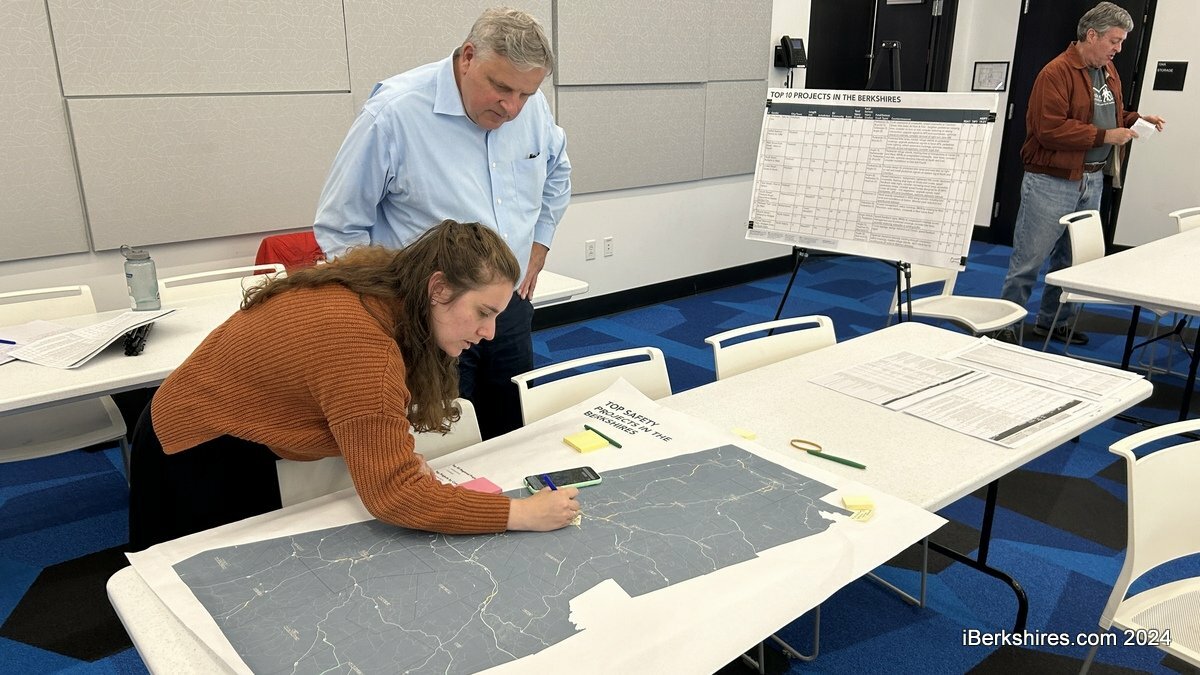
Jeff Maxtutis and Anna Sangree, transportation planners with Beta Group, make notes on a safety analysis map at last week's meeting on a traffic safety action plan at Berkshire Innovation Center.
image description
Nicholas Russo of BRPC presents some of the safety challenges in the Berkshires.
image description

BRPC Releases Draft Safe Travel and Equity Plan for Streets
By Brittany PolitoiBerkshires Staff
Print Story | Email Story

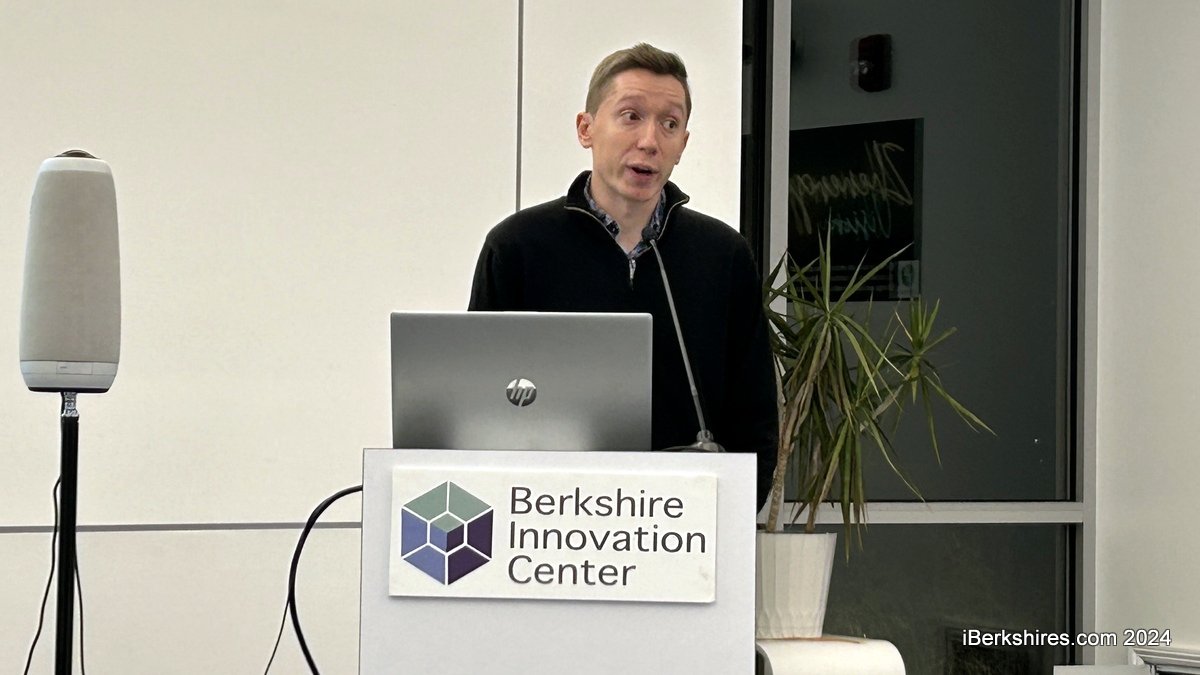
Nicholas Russo, senior transportation planner with BRPC, presents findings from the action plan on Thursday.

PITTSFIELD, Mass. — With the help of federal and state funds, the Berkshire Regional Planning Commission is trying to make streets safe and equitable for all modes of transportation.

Last week, a draft action plan was released for the Safe Travel and Equity Plan for our Streets (STEPS.) The long-term project aims to reduce fatalities and serious injuries in traffic and non-modal accidents.

Community members gathered at the Berkshire Innovation Center and virtually for a public meeting on the effort on Thursday.

"In 2021 almost 43,000 people were killed in motor vehicle crashes across the United States. Of which, 7,300 were walking," Senior Transportation Planner Nicholas Russo explained.

"And millions more were injured — sometimes permanently — each year."

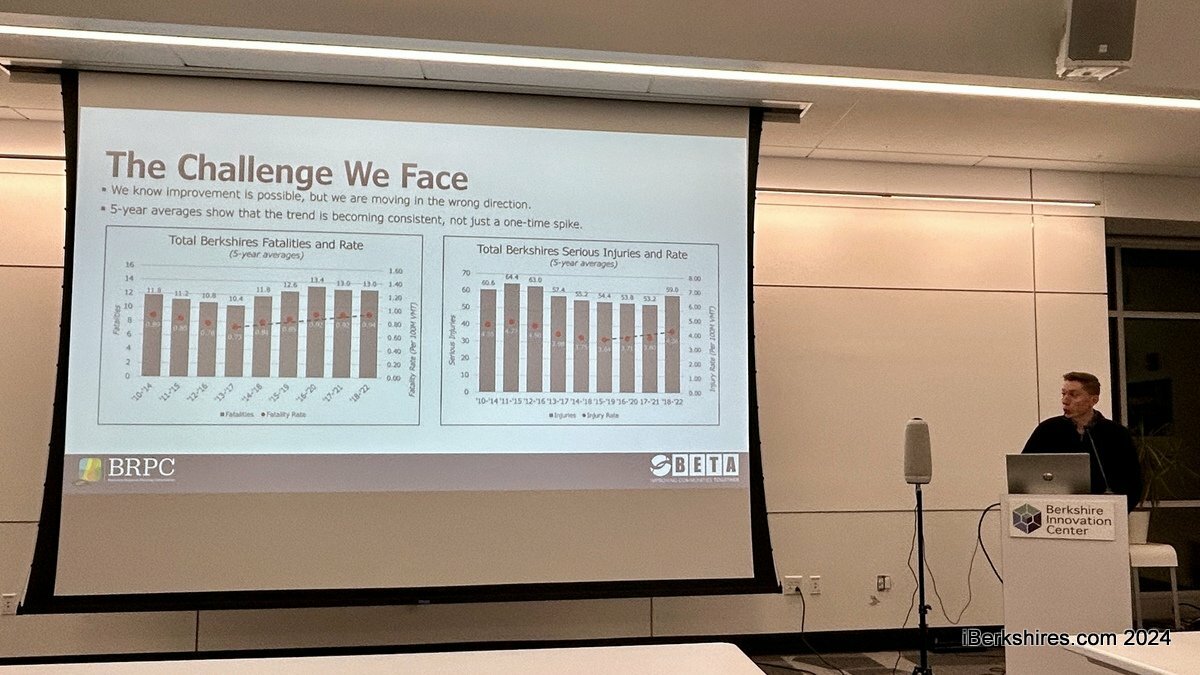
Five-year averages for Berkshire County show a consistent upward trend, with 13 fatalities from 2018 to 2022 and a 0.94 fatality rate per 100 million vehicle miles traveled. For the same period, there were 59 series injuries at a rate of 4.26 per 100M VMT.

Between 2018 and 2022, 12 vulnerable or non-motorized road users were killed or serious injuries.

"So what are we doing about it? We're adopting the safe system approach through the Safety Action Plan. A safe system looks at our transportation system from more angles than just people and their vehicles and behaviors," Russo said.

"The guiding principles that inform the safe system are that any death or serious injuries on our roads are unacceptable and if there are, we know there’s more work that needs to be done."

BRPC was awarded about $200,000 from the Safe Streets and Roads for All federal funding program and about $50,000 from the Massachusetts Department of Transportation to conduct the plan and make way for future implementation funding to get recommendations online. Implementation grants can range anywhere from $2.5 million to $25 million.

Earlier this year, BRPC, working with consultation partners at BETA Group Inc., began to develop a Comprehensive Safety Action Plan informed by crash data. The process included public meetings, an online survey, municipal stakeholder interviews, and a comprehensive review of regional crash data.

On Nov. 4, the draft action plan was released for public review and comment.

The STEPS initiative aims to reduce fatalities and serious injuries to zero, or "Vision Zero," focus resources equitably on communities that could benefit most from reducing casualties and increasing transportation options, and continues to track safety statistics in the county.


Russo acknowledged that there is always going to be the possibility of human error in the transportation system and they can’t possibly legislate or eliminate all mistakes made by road users.

"We know responsibility is shared, not just between other travelers but between the people who design, who legislate, who enforce, and plan on roadway systems so we all need to take a part in reducing these numbers," he said.

"We know the safety is proactive, that we should try and look forward and prevent crashes from happening before where they occur based on what we know from the past, and redundancy in the system is crucial."

The initiative points out that law enforcement can only do so much and creating streets that are self-enhancing helps everyone. This includes streets designed for a desired target speed rather than accommodating the speed of traffic, making non-vehicular options attractive, and designing for the surrounding environment.

This could look like best practice designs for bicycles, closing sidewalk gaps, continued ADA upgrades, well-maintained road infrastructure, trafficcalming measures, and access management on busy roads.

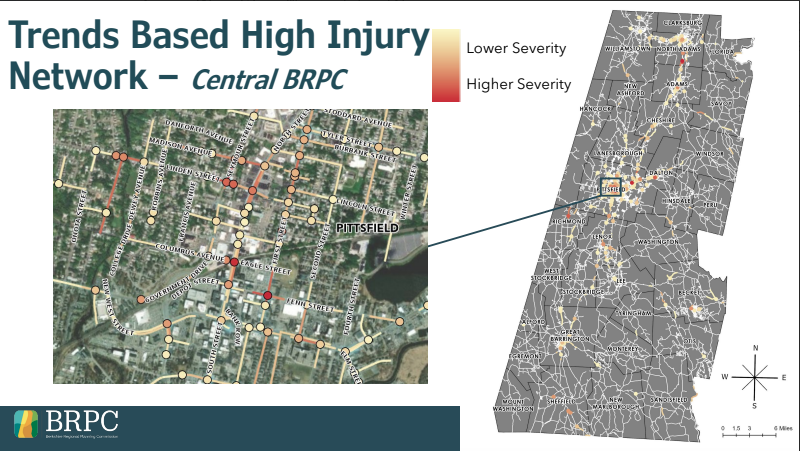
The action plan identified places in the county with known fatalities and injuries as well as high-risk locations, forming a High Injury Network map. Pittsfield has the first seven priority locations, with the First Street, Tyler Street to Fenn Street corridor coming in at No. 1 with seven fatal or serious injury crashes and 68 injury crashes.

Recommended countermeasures include curb extensions at crosswalks, raised crosswalks, bike lanes, and longer pedestrian crossing times.

"Our ultimate goal is to reach zero by 2040," Russo said.

"I know that seems very far away but that basically tracks with how we had been seeing our progress trending before we started going in the wrong direction so I think that kind of gives us a baseline that's realistic and achievable but something we have time to work towards and to figure out as we go."

The action plan will be presented to the Berkshire Metropolitan Planning Organization in early 2025 and the SS4A program will be funded through 2026.

During the question and answer portion, residents pointed out parts of the county that may need safety features for pedestrians, including College Way in Pittsfield and Church Street on the Massachusetts College of Liberal Arts, where a student was recently hit in the crosswalk.

"We have so many angry drivers, people who feel entitled, and I think it's part of where we have to come together and care about each other a little more," said Marjorie Cohan, Berkshire Bike Path Council president.

Another resident pointed out that pedestrians also need education so that they can avoid behaviors that may result in a crash.

Berkshire County residents are invited to review the draft report and provide feedback during the comment window from Nov. 4 through Dec. 2.


Tags: pedestrians,   safe streets,   traffic safety,   
If you would like to contribute information on this article, contact us at info@iberkshires.com.

BRTA Focuses on a New Run Schedule

By Breanna SteeleiBerkshires Staff

PITTSFIELD, Mass. — The Berkshire Regional Transit Authority is still working on maintaining its run schedules after dropping the route realignment proposal.

Last Thursday's meeting was Administrator Kathleen Lambert's first official meeting taking over the reins; retiring director Robert Malnati stayed during a transition period that ended last month.

Lambert is trying to create a schedule that will lessen cancellations. There was a two-hour meeting the week before with the drivers union to negotiate run bids and Lambert is working with the new operating company Keolis, which is taking over from Transdev.

The board spoke about anonymous emails from drivers, which Lambert said she has not seen. iBerkshires was not able to see those letters, but has received some. 

"They were lengthy emails from someone describing themselves as concerning BRTA employee, and there was a signed letter from a whole group of employees basically stating their concerns. So, you know, to me, it was a set of whistleblowers, and that, what my understanding is that this really triggers a need for some type of process to review the merits of these whistleblowers, not going to call them accusations, but basically expressions of concern," said member Stephen Bannon.

A letter iBerkshires received spoke of unhappy drivers who were considering quitting because of decisions being made without "input from frontline staff," frustration and falling morale, and the removal of the former general manager shortly after Lambert came in.

Lambert said it's difficult to navigate a new change. She also noted many drivers don't want to do Saturday runs and it has been hard negotiating with drivers on the new runs.

"I would like you all to keep in mind that the process of change is super difficult. Transdev has been here for 20 years, and some of these drivers have never known any other operating company, the way some of the operations have been handled has been archaic," she said. "So getting folks up to speed on how a modern transit system works is going to be painful for them. So I don't want to say that I'm unsympathetic, because I am sympathetic, but I am trying to coax people along with a system that's going to seem very strange to them."

The board spoke about better communication between them and Lambert, citing cooperation will be best moving forward.

"There's just a lot of stuff in the air right now, and there are a lot of fires to put out to make this a coordinated effort. And if we don't keep our communications open and be straightforward, then you get blindsided about how you know the input that you could get from us about your position, and how you know what's going on in your direction, and we get blindsided. And I think that we have to make sure that this is a collaboration," said member Sherry Youngkin.

"Both sides have responsibilities, because in the long run, this advisory board is going to have to make decisions as to how we brought forward and if we've gone forward in a fair and helpful way. And I think that's hopefully what everybody is looking for also." 

Transdev and Keolis held a three-day recruiting event interviewing almost 40 candidates and offering jobs to eight, but only three stayed on to start training. Lambert said it was disappointing but she will keep trying to retain more people.

In her first report to the board, she noted that ridership dipped a little over 10 percent, but still remains higher than last year, adding that was because of cancellations of services because of the lack of drivers.

Like the last meeting, some of the advisory board members were torn over the start of the Link413 service, worried that the start of the service took drivers away and the numbers of riders are low.

Lambert, however, said the ridership has doubled from last month.

"As I've spoken before, we have, generally, a six-month adoption for brand-new service before you can really go in and evaluate, are you being successful based on the grant that my predecessor wrote along with the team for PBTA and RTA, we are ahead of schedule, which is pretty good, so I'm hoping that will continue to improve," she said.

Member Renee Wood said the board never approved the service, adding the only thing she could find in the minutes was a vote to accept the equipment. She said it was supposed to be put on the agenda to discuss.

"The Link413 service has been three years in the making. It's been a grant that was accepted and has been working with our partners, PVTA and FRTA, to put into place. So I don't have the entire history of how that process worked, but it's been three years in the making, and did we not understand that once we accept that grant that we were going to put in new service?" Lambert said.

The board discussed if Title VI, the Civil Rights Act, was followed with an accurate review and accurate amount of time for public comment period on the service changes and if its attorney should review if the  grant conditions were properly followed.

Lambert said changes had the 60-day comment period included in the proposed route realignment packet, giving the opportunity for the community to respond to that as well but will look into the legality of the situation with their attorney.

View Full Story

More Pittsfield Stories