Significant Drought Conditions in Berkshire County
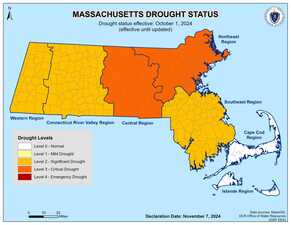 |
BOSTON — With precipitation at an unprecedented low over the last two months, Energy and Environmental Affairs (EEA) Secretary Rebecca Tepper declared the Western, Connecticut River Valley, and Southeast regions to be a Level 2- Significant Drought and elevated the Central and Northeast Regions to a Level 3- Significant Drought.
As outlined in the Massachusetts Drought Management Plan, Level 2 and 3 Droughts require detailed monitoring of drought conditions, close coordination among state and federal agencies, and technical outreach and assistance to the affected municipalities. The Drought Task Force will meet biweekly in the coming months to ensure responsive oversight of the drought.
"After more than a month of nearly no rain and devastating wildfires, Massachusetts is clearly experiencing significant drought conditions," said Energy and Environmental Affairs Secretary Rebecca Tepper. "This autumn has felt different for all of us. Climate change is bringing drier weather to our state at times and extreme precipitation at others. It is critical that we all practice water conservation methods, especially indoors, and adhere to local requirements to decrease the stress on our water systems and ensure essential needs, such as drinking water, habitats and fire suppression, are being met."
In the month of October, rainfall across the state mostly fell between 0.25 inch to 1.5 inches with a few areas a little higher. Overall, rainfall is trending well below average for the month of October, with many locations recording their lowest rainfall ever. The Northeast, Central, Connecticut River Valley, and Southeast regions are the most affected by the lack of precipitation. Additionally, since August, when dry conditions began, all regions, excluding the Cape and the Islands, have seen a rainfall deficit of 7 to 9 inches. Streamflow has also dropped significantly, resulting in dry brooks and streambeds, increased ponding, exposed beaches and sediments, and limited fish passage. Furthermore, groundwater levels are declining in all regions, with the Connecticut River Valley and Northeast regions showing levels well below normal.
Due to fire conditions, the Department of Conservation and Recreation (DCR) has implemented a
temporary ban of all open flame and charcoal fires within state park properties. Small portable propane grills are still allowed at campgrounds and recreation areas where grilling is permitted. Fire activity has increased across the state because of drought conditions, leading to wildfires that are burning deeper into the soil. This situation can make it harder to control fires and may prolong fire incidents. Residents are also encouraged to check for local fire bans in their area.
Currently, there are approximately 47 active wildfires across the state. This year's fire season has lasted longer because of dry conditions. Since the start of the fire season, there have been over 854 wildfires, burning approximately 1,365 acres of land. As firefighting efforts demand significant water resources, it's crucial for residents to practice aggressive indoor water conservation to maintain sufficient supply and pressure in public water systems.
Everyone is also urged to exercise caution with grills and open flames, ensuring that all fires are properly extinguished.
It is important to note that the Massachusetts Water Resources Authority (MWRA) water supply system is not experiencing drought conditions, as defined within its individual plan. Private wells, local streams, wetlands, vernal pools, and other water-dependent habitats located within MWRA-serviced areas are being impacted by drought conditions while water quality in ponds can deteriorate due to lowering of levels and stagnation.
Below are recommendations for communities and individuals living and working within a Level 3 – Critical Drought.
For Regions in Level 3 – Critical Drought
Residents and Businesses:
- Minimize overall water use
- Follow local water use restrictions
- Fix any toilet or faucet leaks immediately
- Aggressively reduce indoor water use by taking shorter showers, running dishwashers and washing machines only on a full load
Immediate Steps for Communities:
- Provide timely information on the drought and on water conservation tips to local residents and businesses taking advantage of the state's library of outreach materials
- Enforce water use restrictions with increasingly stringent penalties
- Strongly discourage or prohibit washing of hard surfaces (sidewalks, patios, driveways, siding); personal vehicle or boat washing
- Establish or enhance water-use reduction targets for all water users, identify top water users and conduct targeted outreach to help curb their use
Short- and Medium-Term Steps for Communities:
- Establish a year-round water conservation program that includes public education and communication, taking advantage of the state's library of outreach materials
- Implement or establish drought surcharge or seasonal water rates
- Prepare to activate emergency inter-connections for water supply
- Develop or refine your local drought management plan using guidance outlined in the state Drought Management Plan
State agencies will continue to closely monitor and assess conditions across the state, coordinate any needed dissemination of information to the public, and help federal, state, and local agencies prepare additional responses that may be needed in the future. The Drought Management Task Force will meet again on Monday, November 18, 2024, at 10:00 AM. For further information on water conservation and what residents can do, visit the EEA's drought and water
conservation pages.
Tags: drought,