Greylock Project Proponents, Opponents Getting Message Out
 |
NORTH ADAMS, Mass. — Proponents and opponents have been busy on social media and mailers in getting out their messages on which way to vote on the Greylock School project.
Voters will head to the polls on Tuesday, Oct. 8, to decide a debt exclusion for borrowing on the $65 million project that will include the demolition of the 70-year-old current Greylock School. The city will be responsible for just under $20 million over the next 30 years.
School officials have held a number of informational forums at both Brayton and Greylock schools and at smaller venues. Two groups have emerged on opposite sides of the question and have created Facebook pages and sent out mailers to voters. Both have filed with the city clerk's office as required by state law.
Save Brayton North Adams filed with the clerk on Sept. 22. It lists the chair as Joseph Smith and treasurer as Marie Harpin, a former city councilor. This group is campaigning against the project. The Committee for a New Greylock School Building with Chair Karen Bond and Treasurer David Bond, former School Committee and councilor, respectively, is a proponent of the project. They filed on July 12.
As of Wednesday, Save Brayton had raised $950 and spent $550, with outstanding liabilities of $2,388.61, all for printing. These expenditures are presumably for the lawn signs dotting properties around the city and for mailings.
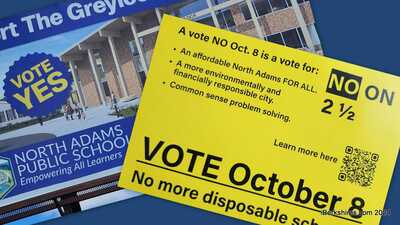
A recent mailing listed reasons to vote no as being against demolition of the now closed Greylock, the cost of the project and its effect on taxpayers, that Brayton can be maintained rather than decommissioned, and that the area's declining student enrollment makes the spending "reckless."
The Committee for a New Greylock has raised 10 times more at $9,525. It has spent $7,714.85 for a billboard, postage, lawn signs and mailers and has an outstanding liability of $1,095 for a second billboard.
The committee's largest donation is $5,000 from Suzy and John Wadsworth, owner of Porches Inn and a significant investor in the area; the second largest is $2,500 from the Tom Bernard Committee, Bernard's mayoral campaign fund. He was mayor when the project was initially developed.
This group's mailer points to the decade in work to get to this point and the endorsement of the Massachusetts School Building Authority, which will pick up $42 million of the cost. Renovating Brayton, they say, will cost more with no recompense from the state while the new school will provide a healthier, modern and more educationally appropriate facility.
Tags: brayton/greylock project, debt exclusion,