image description
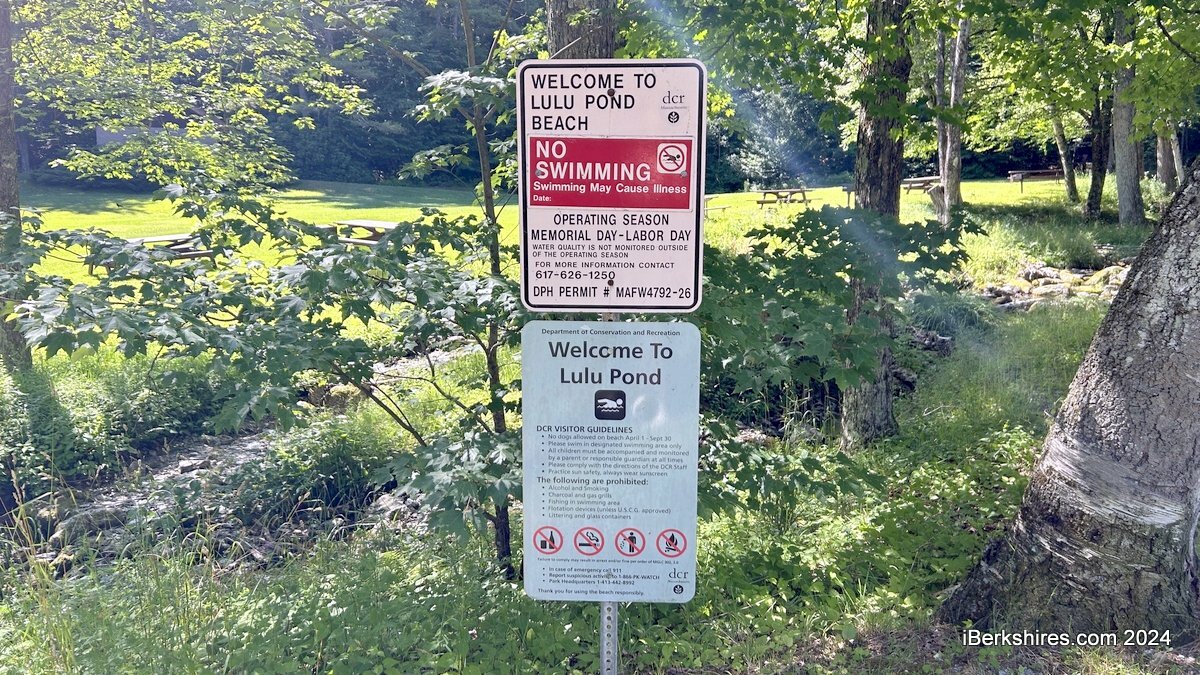
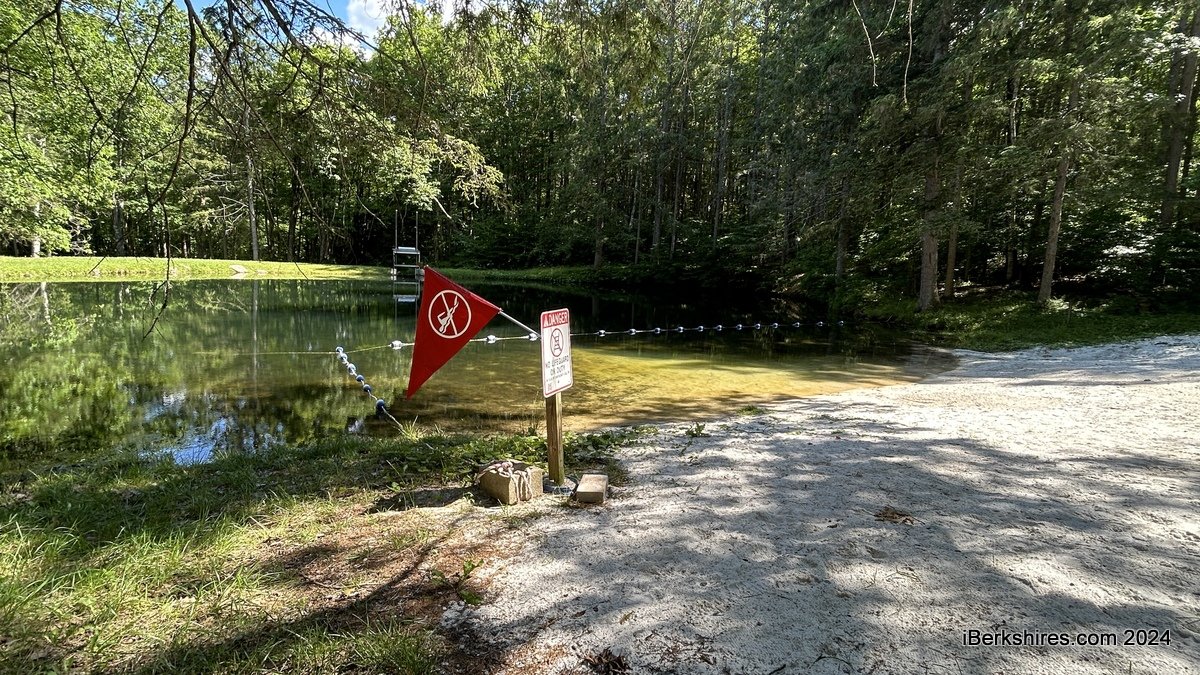
Lulu Pond is closed to swimming because of high concentration of bacteria.

Two Berkshire Beaches Closed, One for Bacterial Exceedance
By Brittany PolitoiBerkshires Staff
Print Story | Email Story

PITTSFIELD, Mass. — Two Berkshire beaches are closed for swimming ahead of the Fourth of July weekend.

Lulu Pond in the Pittsfield State Forest had a bacterial exceedance and Lake Mansfield in Great Barrington is closed for "other" reasons. While the waterbodies are closed for swimming, other recreational activities are allowed. 

On June 24, Lulu Pond had 488.4 colony-forming units per 100 milliliters of Enterococci bacteria, dramatically higher than the threshold of 61 cfu/100 ml for freshwater beaches. The number had risen from 2 cfu/100 ml on June 17, closing the beach.

On July 1, the pond had 204.6 cfu/100 ml.

"Enterococci bacteria are a type of indicator organism found in the intestines of warm-blooded animals and humans and are often associated with fecal contamination. Pathogens in the water are difficult to measure directly, so indicator organisms are used to predict the presence of pathogens associated with fecal contamination," a representative from the Massachusetts Department of Public Health wrote in a request for more information.

"The bacteria used as indicator organisms to test the waters at beaches are Enterococci and E. coli.  Marine beaches are tested for the presence of Enterococci. Freshwater beaches are tested either for the presence of E. coli or Enterococci."

A flag warning visitors not to enter the water sways at the shore in addition to signage warning that "swimming may cause illness."
 
Water is considered unsafe for swimming at a majority of beaches in Massachusetts when there are two consecutive exceedances and beaches with a history of multi-day exceedances are required to post after just one.

Lake Mansfield is closed for "other" reasons, which can include non-bacteria-related issues such as storm damage, water clarity/visibility issues, repairs, etc. This is determined by local authorities and can be unrelated to water testing.

"For the beaches currently closed due to 'other' reasons, these reasons include missed sampling/testing, flooding at the beach, road maintenance, and unstable access route to the beach," MDPH reported.

There are currently more than 30 closures statewide.

York Lake Beach in New Marlborough was closed for an exceedance of the Enterococci on June 24 at 209.8 cfu/100 ml, but opened on July 1 when that dropped to 11.9 cfu/100 ml.

"Beaches closed to swimming due to high bacterial levels can reopen once a test result shows bacteria levels below DPH standards," MDPH explained.

"While the testing frequency at swimming beaches in Massachusetts varies from beach to beach, beach operators often elect to test the water the day following a high bacterial result or beach closure, rather than wait for the next scheduled test."


The numbers and timing of beach closures can fluctuate dramatically based on rainfall and environmental conditions. On July 10, 2023, there were 53 beach closures in Massachusetts and at the same time in 2022, there were 40 beach closures. On July 2, there were 42 beach closures.

Swimming in unsafe waters can cause gastrointestinal symptoms (nausea, vomiting, diarrhea, and abdominal pain,) respiratory symptoms (sore throat, cough, runny nose, and sneezing,) dermatological symptoms (skin rash and itching,) eye and ear symptoms (irritation, earache, itching,) and flu-like symptoms (fever and chills.)

While most are minor, serious illnesses can occasionally occur and children, seniors, and those with compromised immune systems are at a greater risk. The public is encouraged to contact a health care provider if they swim at a closed beach and feel sick.

"A beach posting does not mean that a person cannot go to a beach, or that a posting prevents anyone from entering onto a beach. If a beach is posted, it simply means swimming is not allowed," MDPH clarified.

"There are plenty of safe recreational activities people can still do at the beach that don’t involve contact with the water, including walking along the shore; sunbathing; collecting seashells/sea glass; and playing sports such as paddleball, volleyball, football, frisbee, etc."
 
More on Enterococci:

At marine beaches, the accepted level of Enterococci for a single sample is 104 colony-forming units per 100 milliliters (cfu/100 ml) of water or below.
 
At freshwater beaches, the accepted level of Enterococci for a single sample is 61 cfu/100 ml or below. The freshwater limit is stricter because elevated levels of bacteria within a smaller body of water (such as a lake versus the open ocean) can pose higher risks of illness. Freshwater beaches can also be tested for E. coli instead of Enterococci. The accepted level of E. coli for a single sample is 235 cfu/100 ml of water or below.
 
MDPH also has a limit for the last 5 test results at a beach known as the geometric mean, or geomean for short. The geomean is intended to reflect water quality found during a previous time frame (typically a month). At marine beaches, the geomean for Enterococci is 35 cfu/100 ml. At freshwater beaches, the geomean for E. coli is 126 cfu/100 ml and the geomean for Enterococci is 33 cfu/100 ml.
 
The test results for individual beaches can be found on the MDPH's Interactive Beach Water Quality Dashboard.  DPH beach closures are updated daily and beach closure data from previous years are summarized in DPH's Annual Beach Reports.


Tags: contamination,   lakes, ponds,   
If you would like to contribute information on this article, contact us at info@iberkshires.com.

BRTA Focuses on a New Run Schedule

By Breanna SteeleiBerkshires Staff

PITTSFIELD, Mass. — The Berkshire Regional Transit Authority is still working on maintaining its run schedules after dropping the route realignment proposal.

Last Thursday's meeting was Administrator Kathleen Lambert's first official meeting taking over the reins; retiring director Robert Malnati stayed during a transition period that ended last month.

Lambert is trying to create a schedule that will lessen cancellations. There was a two-hour meeting the week before with the drivers union to negotiate run bids and Lambert is working with the new operating company Keolis, which is taking over from Transdev.

The board spoke about anonymous emails from drivers, which Lambert said she has not seen. iBerkshires was not able to see those letters, but has received some. 

"They were lengthy emails from someone describing themselves as concerning BRTA employee, and there was a signed letter from a whole group of employees basically stating their concerns. So, you know, to me, it was a set of whistleblowers, and that, what my understanding is that this really triggers a need for some type of process to review the merits of these whistleblowers, not going to call them accusations, but basically expressions of concern," said member Stephen Bannon.

A letter iBerkshires received spoke of unhappy drivers who were considering quitting because of decisions being made without "input from frontline staff," frustration and falling morale, and the removal of the former general manager shortly after Lambert came in.

Lambert said it's difficult to navigate a new change. She also noted many drivers don't want to do Saturday runs and it has been hard negotiating with drivers on the new runs.

"I would like you all to keep in mind that the process of change is super difficult. Transdev has been here for 20 years, and some of these drivers have never known any other operating company, the way some of the operations have been handled has been archaic," she said. "So getting folks up to speed on how a modern transit system works is going to be painful for them. So I don't want to say that I'm unsympathetic, because I am sympathetic, but I am trying to coax people along with a system that's going to seem very strange to them."

The board spoke about better communication between them and Lambert, citing cooperation will be best moving forward.

"There's just a lot of stuff in the air right now, and there are a lot of fires to put out to make this a coordinated effort. And if we don't keep our communications open and be straightforward, then you get blindsided about how you know the input that you could get from us about your position, and how you know what's going on in your direction, and we get blindsided. And I think that we have to make sure that this is a collaboration," said member Sherry Youngkin.

"Both sides have responsibilities, because in the long run, this advisory board is going to have to make decisions as to how we brought forward and if we've gone forward in a fair and helpful way. And I think that's hopefully what everybody is looking for also." 

Transdev and Keolis held a three-day recruiting event interviewing almost 40 candidates and offering jobs to eight, but only three stayed on to start training. Lambert said it was disappointing but she will keep trying to retain more people.

In her first report to the board, she noted that ridership dipped a little over 10 percent, but still remains higher than last year, adding that was because of cancellations of services because of the lack of drivers.

Like the last meeting, some of the advisory board members were torn over the start of the Link413 service, worried that the start of the service took drivers away and the numbers of riders are low.

Lambert, however, said the ridership has doubled from last month.

"As I've spoken before, we have, generally, a six-month adoption for brand-new service before you can really go in and evaluate, are you being successful based on the grant that my predecessor wrote along with the team for PBTA and RTA, we are ahead of schedule, which is pretty good, so I'm hoping that will continue to improve," she said.

Member Renee Wood said the board never approved the service, adding the only thing she could find in the minutes was a vote to accept the equipment. She said it was supposed to be put on the agenda to discuss.

"The Link413 service has been three years in the making. It's been a grant that was accepted and has been working with our partners, PVTA and FRTA, to put into place. So I don't have the entire history of how that process worked, but it's been three years in the making, and did we not understand that once we accept that grant that we were going to put in new service?" Lambert said.

The board discussed if Title VI, the Civil Rights Act, was followed with an accurate review and accurate amount of time for public comment period on the service changes and if its attorney should review if the  grant conditions were properly followed.

Lambert said changes had the 60-day comment period included in the proposed route realignment packet, giving the opportunity for the community to respond to that as well but will look into the legality of the situation with their attorney.

View Full Story

More Pittsfield Stories