Drury High's Myers Named North Adams Teacher of the Year
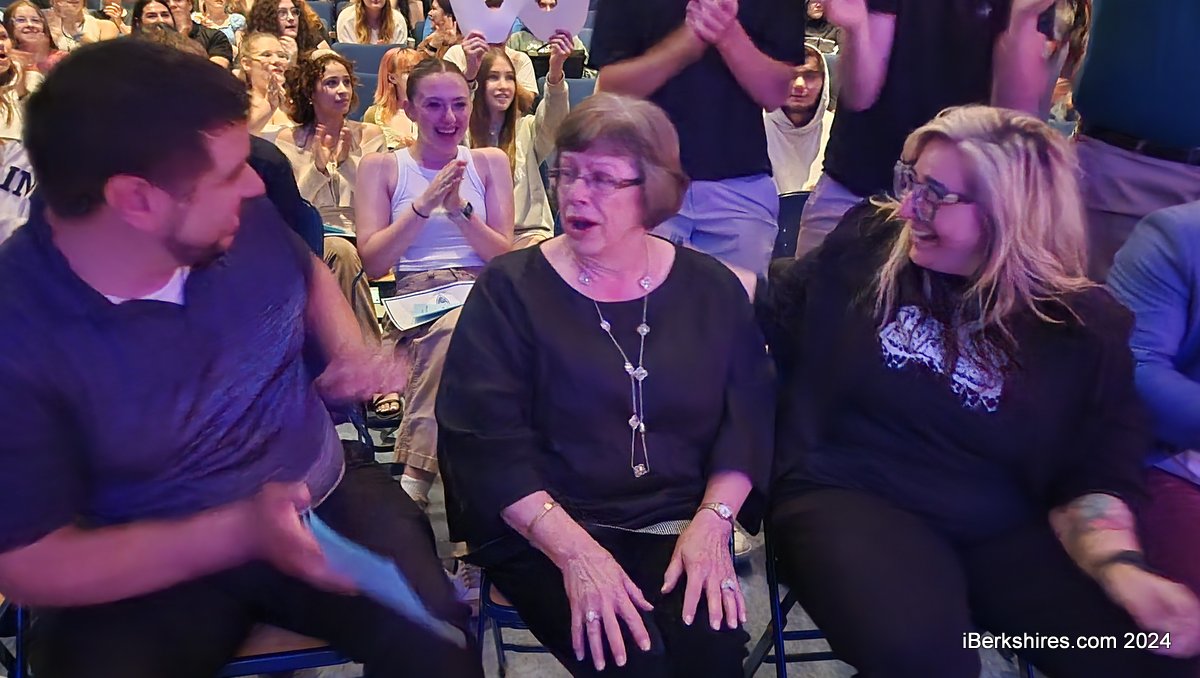
Donna Myers started at Drury as a student teacher before joining the history department full time in 1998.
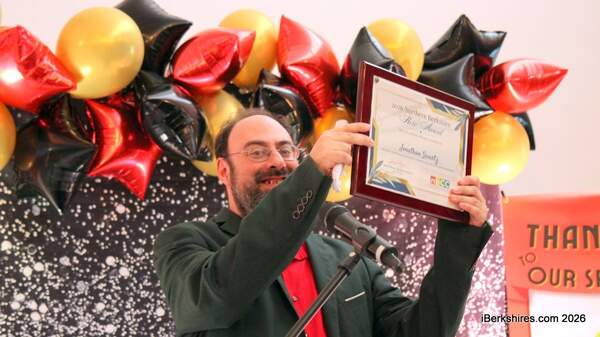
Donna Myers, sitting in the front row of the auditorium, was shocked when her named was called to applause and cheers.
Superintendent Barbara Malkas described her as the epitome of the Teacher of the Year award, named for the principal of the former Sarah Haskins and Johnson schools who worked in the public schools for a total of 40 years (with a nine-year gap when forced to leave her teaching job when she got married).
"She excels at building relationships with all of her students, many return year after year to visit her and check in. She also acts flabbergasted as to why not realizing the impact she has had on the community at Drury High School," said Malkas. "When she's not in her classroom. She is in the stands at most basketball games, chaperoning dances, even getting out on the dance floor. Getting involved in lip dub or other community-centered events."
The Pittsfield High School graduate attended Berkshire Community College and received her bachelor of arts in history degree from Massachusetts College of Liberal Arts (then North Adams State) in 1996. She began as a student teacher under history teacher Bonnie Rennell, was a substitute and then joined the history department in 1998, and later became its leader. She would mentor future educators, including Principal Stephanie Kopala, and earn her master's in education in 2000 from Cambridge College.
Myers had put her plans for retirement on hold when project-based learning courses were introduced and immediately began planning new courses to engage students and now has all of her courses completely booked for next year, said the superintendent. She's sought out for advice by students and staff and always quick to offer help.
The yearbook was dedicated to Myers two years ago, with then junior Rachel Barrows saying, "she never fails to inspire us to do our greatest at everything we do. She's a person you can always count on for a good laugh but at the same time, she always keeps everyone in line."
"Ms. Myers has a knack for teaching life lessons within the curriculum, often sharing the wisdom of her experience working in Philadelphia before teaching, traveling and growing up in Pittsfield, with her sisters and brother during an exciting time in history," said Malkas. "Many of her students and younger colleagues from all her life lessons calmly and others recalled being put on double secret probation."
Another student called her an "ideal teacher" who is "a kind of an empathetic friend who cares about each and every student that came through the door."
In the audience, students held up paper letters and a heart stating "We ?? Donna."
Myers was surprised with bouquet and her sister. She was presented with a commemorative certificate and a gift certificate for $100 for school classroom supplies.
The assembly also celebrated outstanding students in various categories, including academic excellence, leadership, and community service. Speakers highlighted the achievements of Leadership Award recipients, crew competition winners, and top academic performers.
Earlier in the gym, the end of the semester showcase featured class presentations ranging from financial math, to pottery, to the effects of disease on society, to creating apps, to researching cultural traditions, to elements of history, math, physics, psychology, athletics and literature.
Eighth-grader Cameron Stokes explained how used the MIT App Inventor to create apps, including pitching counter for baseball coaches.
"I'm more of a hands on person. So I like going out sore doors and stuff," he said. "But this is just like a fun little thing. It's an amazingly fun class."
Nearby, student Dakota Deschaine and science teacher George "Mr. Q" Quadrino were demonstrating physics and math through the construction of a box guitar.
"It covers all the electricity objectives in physics and the wave mechanics objectives," said Quadrino, who added he looks for interactive problem-solving builds to involve students. "As much as I can to build up the math because that's where they're hurting, you know, yeah, I mean, what is it every student avoids in math class. ... story problems."
When it comes down to it, life is a series of math story problems, he said, and you don't know how hard they're going to be because they aren't spelled out for you.
Dayton Waters explained a "Be the Change" presentation on addiction recovery and remedies those in recovery could take to stay on track; Rachel DeCoste and Eden Duval were overseeing a table full of handmade pottery for an Early College art class; Autumn Bentley and Lilly Bullett showed how their class had created their own "Divergent" factions.
Attendees were intrigued and grossed out at the "Disease & Society" presentation's actual tissue samples thanks to history teacher David Demary's wife, Nichole, who works in the lab at Berkshire Medical Center.
"I took the kids on a field trip where they got to see all the samples and all the different things and then in class we learned about them," he said.
Student Sam Moorman said, "we learned about how diseases affect governments spread and do stuff like that" and ticked off some facts from the Black Plague's impact on European society. "The field trip was fun," he added.
The event also included a cabaret show, a choreography performance and School of Rock.
Tags: Drury High, recognition event, teacher of the year,