Police Chief: Dalton Police Station in Dire Condition
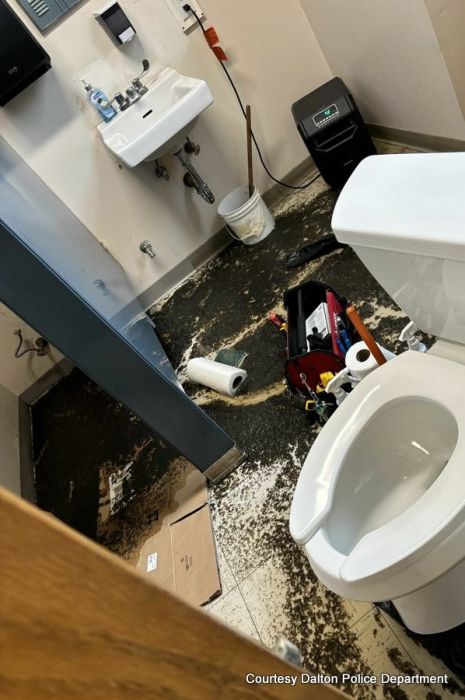
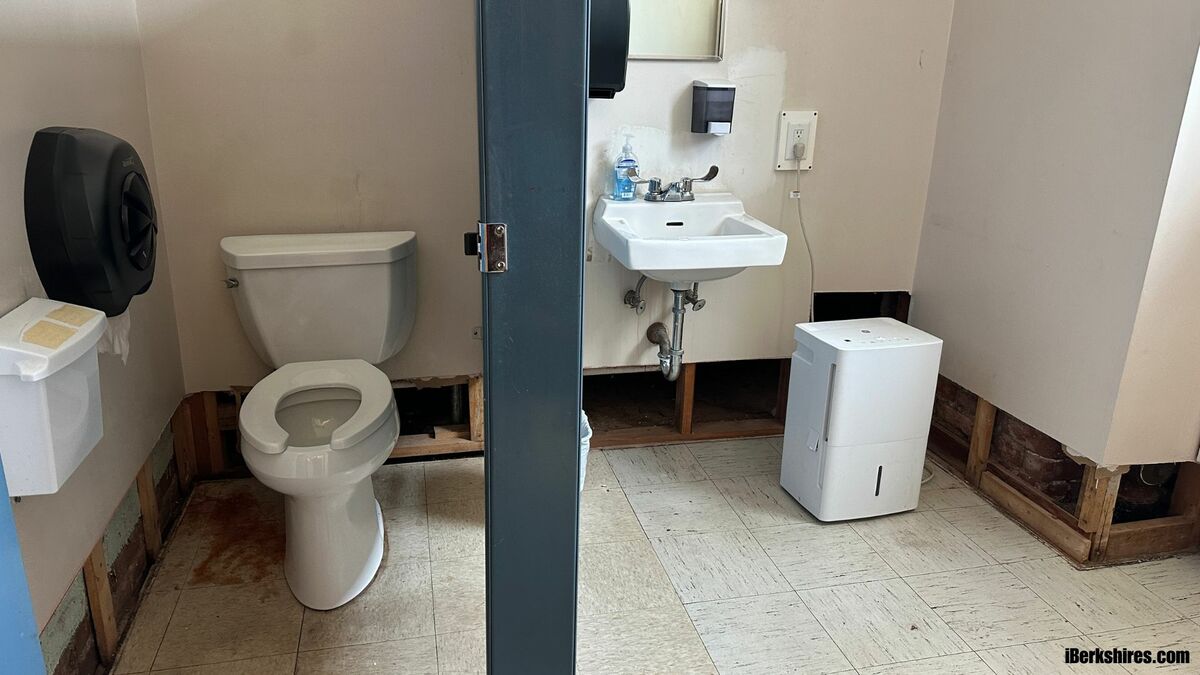
Raw sewage overflowed in the bathroom near dispatch and flooded the police station on April 17.
Select Board members voted to freeze American Rescue Plan Act fund spending until the next meeting when Building and Grounds Superintendent Jeff Burch will have a better idea of the cost of repairs.
They also voted to direct Town Manager Thomas Hutcheson to draft a formal letter to state representatives seeking funding from the state within the next legislative cycle to get ahead of this issue.
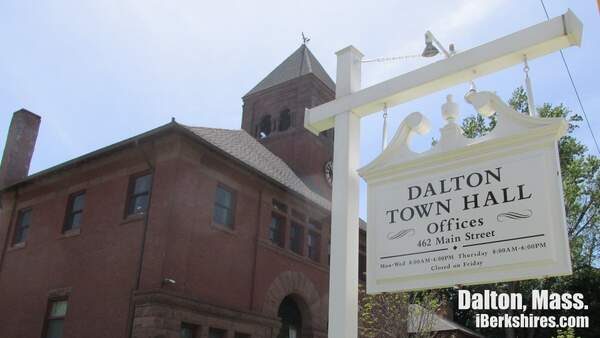
The Police Department is in the basement of Town Hall and houses 21 employees. According to the town GIS system, the building was constructed in 1890.
Plumbing has always been an issue, Strout said. "We actually call it Russian roulette when you have to use the bathroom whether you want to use the bathroom or not because the toilet overflows so frequently."
This is no longer just inconvenience and are now a safety concern, the chief said, adding despite numerous attempts to resolve the issue, the conditions worsening.
On April 17, raw sewage overflowed in the bathroom near dispatch and flooded the station.
"The smell was something I can only describe to you as horrific [and] employees have to work through that," Strout said.
Burch came in off-duty to clean it with a shop vacuum.
"It was disgusting. It was horrible," Strout said.
Burch notified the town's insurance company and cut out the affected drywall. However, mice now crawl out of the walls, and mouse droppings are all over the Police Department.
Orkin pest control has come a number of times, but cannot get to the bottom of the mice infestation, Strout said.
According to Burch, the former building superintendent said the plumbing seems to take a couple of funky turns, and the problem could be a pitch issue that's causing the backup. There's really no easy solution so far, he said.
The plumbing is under concrete and the access on the street has been paved over, so there isn't street access to the sewer lines at all, Strout said.
On May 9, when the department was in the middle of a shooting investigation, the toilet overflowed again with about 15 officers in the building.
"We had to stop what we were doing, shut the water valve off to stop the flowing of water. [Burch] again had to come in, bring plumbers in, while we're in the midst of a major investigation," Strout said.
The station's "horrific odor" started around March. After numerous attempts to find the cause and resolve the issue, Strout called the state Department of Public Health's indoor air quality program.
"We had rodents dead in the wall for months. I used to have to, over the last few months, I had to open the door to my office and leave for a minimum of half an hour to an hour just to let the smell dissipate," Strout said.
The state DPH inspected the station a couple of weeks after her call on May 17 to identify the cause, and what they found alarmed them, Strout said.
DPH inspected the exterior and interior of the building and took moisture samplings of the floor in the adjacent restroom.
"The odor experienced in this area is likely due to the repeated accumulation of black water in the space between the wood flooring and basement cement floor, which in turn has caused mold growth on flooring material," Michael Feeney, indoor air quality director, wrote in an email to Strout.
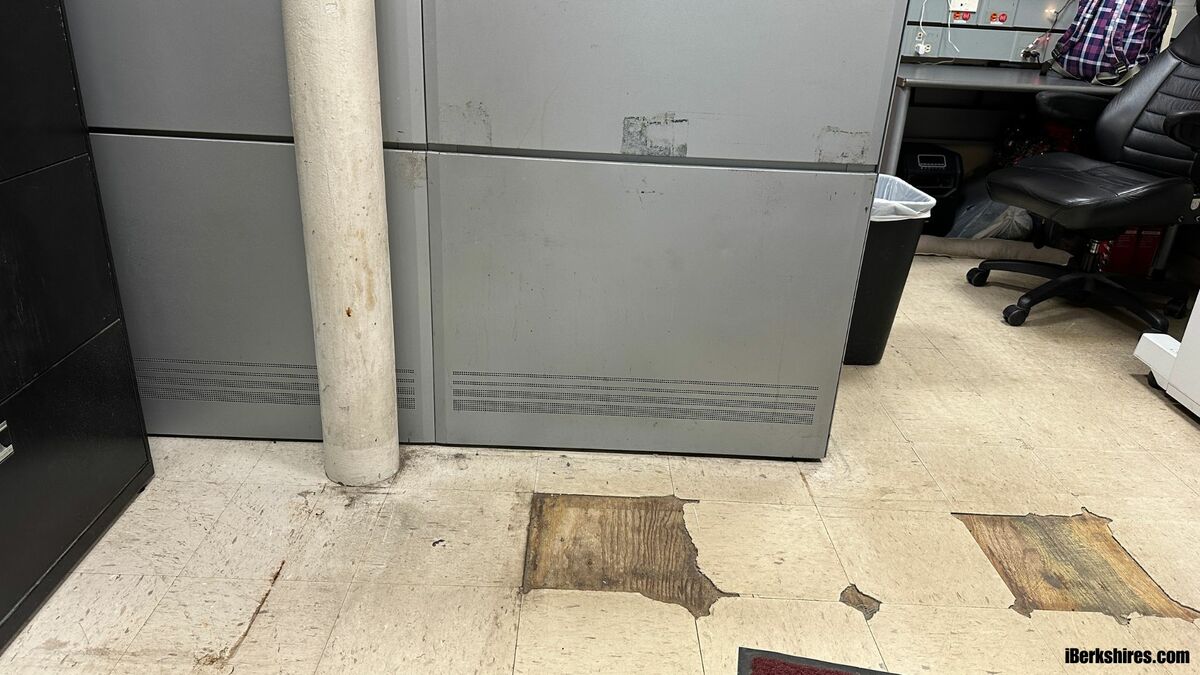
The moisture measurements indicated that the underlying flooring had been wet for more than 11 days since the last flooding incident, and blackwater likely remains in the space between the flooring and cement floor of the basement, Feeney said.
The underflooring is likely not natural wood but plywood, particle, or chipboard, which are engineered, manufactured wood products.
These are porous, so can grow mold if wet for more than 48 hours, Feeney said.
If contaminated by blackwater, porous materials can not be cleaned appropriately, and removal is recommended.
"His major, concerns, obviously besides the plumbing and the moisture, was the lack of ventilation in the building and that the boiler does vent right into the building without any ventilation," Strout said.
It was reported that the last time a renovation occurred in this section of the Town Hall was in 1976, Feeney said. If this is the case, the floor tile may contain asbestos and remediation would be required to be in compliance with all federal and state asbestos laws and regulations.
According to the DPH, the police station does not have ventilation, and there isn't a heating, ventilation, and air conditioning system, Strout said.
The CO2 levels were very high in the her office, but they were lower in the sergeant's and officer's rooms, she said.
"I'd like to clarify that the furnace does not vent into the sergeant's room. There are two automated louvers that open to allow fresh air into the boiler room when the boilers are running," Burch said in his report.
"The gas water heater exhaust may benefit from a powered exhaust but this is not a critical situation."
Burch has installed CO2 detectors, which the department didn't have previously. He is doing "everything he can with a horrible situation that we have all inherited," Strout said.
The station would benefit from some type of heat-recovery ventilation or energy-recovery ventilation system which brings in fresh air and pulls out stale air, Burch said in his report.
"This would also help maintain better humidity levels. I have contacted [Don Davis Heating Cooling & Plumbing] for pricing but have not been able to meet with them yet," Burch said in his report.
"I'd guess the remaining ARPA funds that were allocated for the Town Hall renovations would be more than enough to cover this type of project."
Strout also noted other concerning issues with the building that the Department of Public Works pointed out, including the "not surprising" fact that the station is not Americans with Disabilities Act compliant.
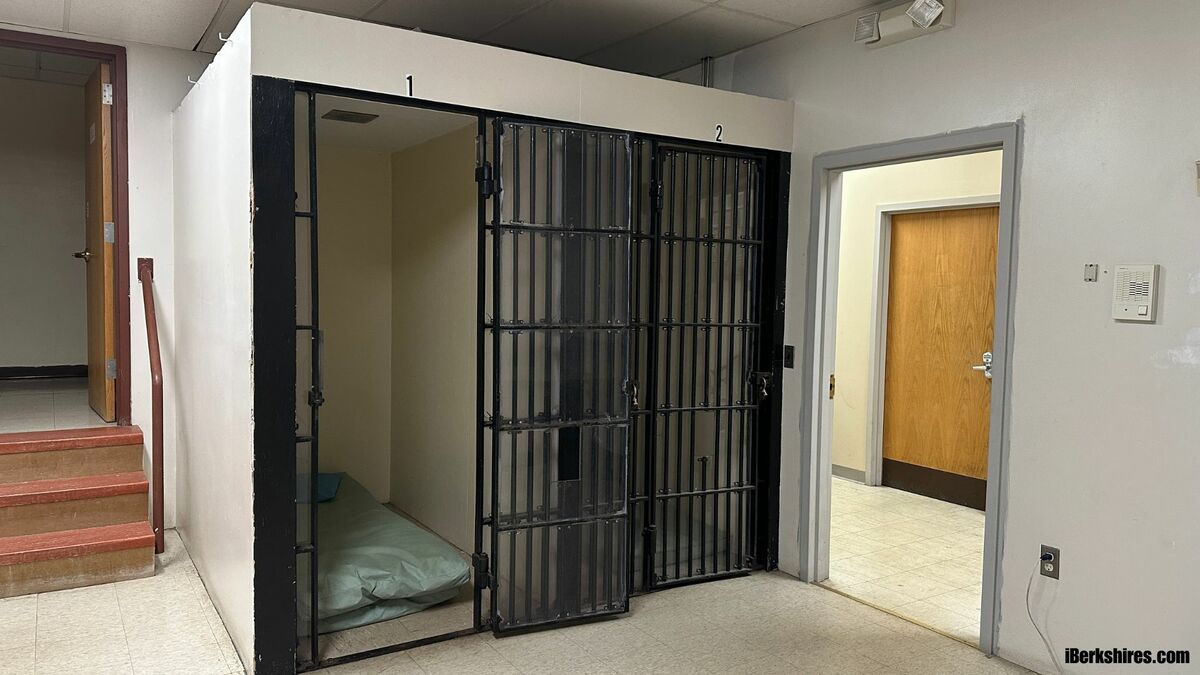
In addition, the station's cells are half the size they are legally required to be and do not have plumbing or a bed structure, which is also a legal requirement.
They are also built like boxes with plaster walls, a 2-foot space between the top and ceiling, and a vent that goes nowhere.
The condition of the cell is also a safety concern because it is not secure for prisoners. There is a quarter-inch gap caused by a prisoner who almost kicked his way out, and officers have to take the prisoners to use the bathroom because there isn't a toilet in the cell, Strout said.
The department is seeking accreditation but is not able to because of the building's condition.
The town will receive two reports. One will describe the sewerage, also called blackwater, back up, and the second will describe the general indoor air quality.
It is clear without looking at the DPH reports that this is a serious problem, Select Board member Joseph Diver said.
This situation has the potential to create numerous problems, including health, union and liability issues, he said. He questioned what would be the contingency plan if the station is no longer operational.
"That would include relocation, I believe. I don't think we have the infrastructure in place, so this might be a giddy-up situation, too," he said.
Strout said his points were fair and that the union has been very patient, but when the reports come out, they have a right to request copies because they work in there.
"I think they're being very patient and appreciative of the [Hutcheson] and the Select Board's time and thought process on this," Strout said.
"I think they all know it's an issue, just like you all do. It's just getting the process started of what the best outcome is for the town and the employees."
Board members agreed and said initial remedies, short-term solutions, and long-term solutions need to be determined.
It is likely that the police station will need to be relocated, Chair Robert Bishop said.
This is a twofold problem because the town needs short-term solutions to stabilize the situation so the department has decent working conditions, and long-term solutions need to be developed due to the building's condition.
The relocation of the station would be a long process with numerous steps that would also involve the state because of department and dispatch requirements, Strout said.
She also mentioned the area's lack of infrastructure and the need to move radio towers for relocation to happen.
The town will create a building committee to develop long-term solutions. Diver recommended that, for now, the Select Board act as the current building committee so they can easily access the ARPA funds as quickly as possible.
The town does not have a clear picture of what the repairs will be, but "thankfully," there is a pretty healthy balance in the ARPA funds that the board can allocate, Vice Chair Dan Esko said.
Hutcheson said there is about $200,000 available in ARPA funds, but more may become available as more ongoing projects finish under budget.
The possibility of an emergency complex that combines the police, fire, and ambulance on one property was also raised as a potential long-term solution. This would be a multi-year process.
Strout said if the town considers that in the future, a person with working knowledge of the accreditation process would be needed.
Fire Chief Chris Tobin also said he would be willing to collaborate with the town on any project like that in the future.
Tags: Dalton Police, police station,