image description
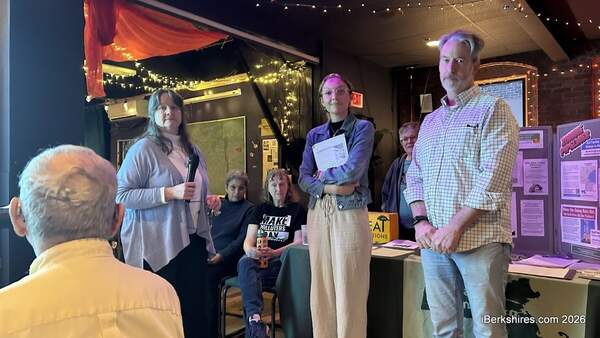
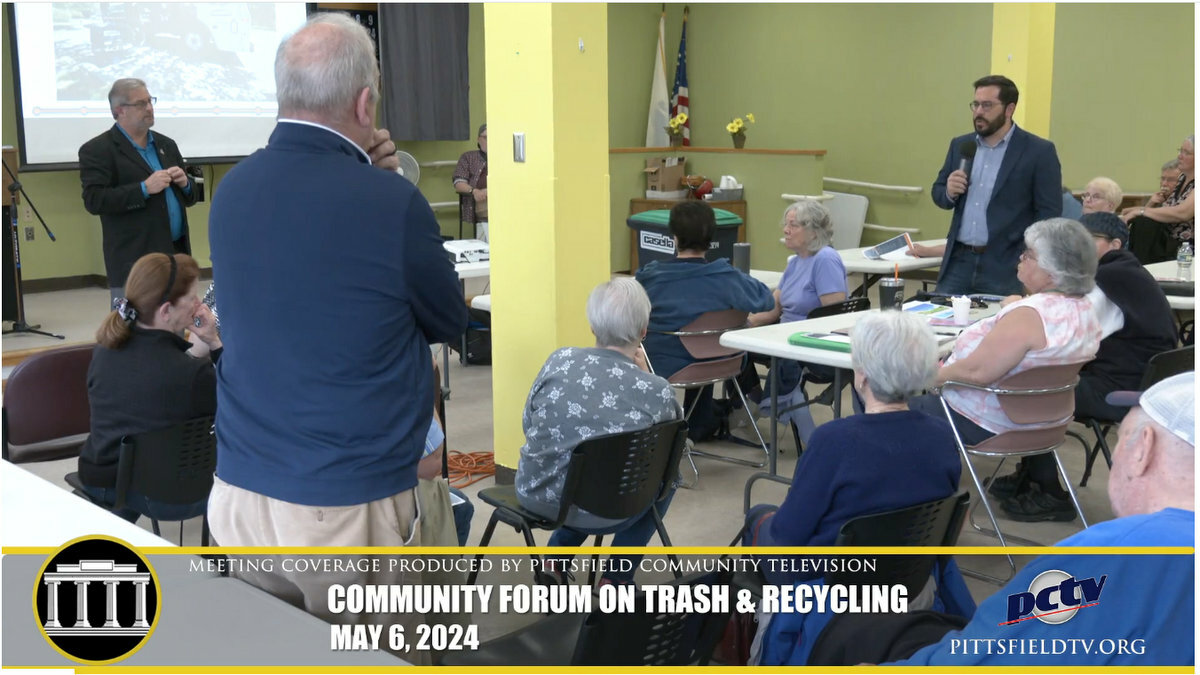
Mayor Peter Marchetti, left, and Commissioner of Public Services and Utilities Ricardo Morales explain the proposed toter system at the Froio Senior Center on Monday in this PCTV screenshot. The next community meeting is May 21 at 7 p.m. at Herberg Middle School.

Pittsfield Officials: Unlimited Trash Not Sustainable, Toters Offer Cost-Savings

By Brittany PolitoiBerkshires Staff
Print Story | Email Story

PITTSFIELD, Mass. — Unlimited trash pickup is not sustainable and will lead to higher taxes, city officials say.

Mayor Peter Marchetti began public outreach on Monday on the proposed five-year contract with Casella Waste Management for solid waste and recyclables. Older residents packed into the Ralph J. Froio Senior Center for the first of three community meetings.

On the table is a move to automated pickup utilizing 48-gallon toters, which would be at no cost to residents unless they require additional toters and would save the city $80,000 per year.

The goal is to execute a contract by July 1, the start of the fiscal year.

"Trash collection is not free. You're already paying for it as part of your taxes that you pay. In this administration, in this proposal there is no 'I'm looking to create a trash tax,''' Marchetti said, explaining that trash pickup for fiscal year 2025 is around $5.1 million and has doubled since he first served on the council in 2002.

"So we need to find a way to stem the cost of trash."

Some of the seniors praised the new plan while others had concerns, asking questions like "What is going to happen to the trash cans we have now?" "What if I live in rural Pittsfield and have a long driveway?" and "What happens if my toter is stolen?"

"I've lived in a lot of other places and know this is a big innovation that is taking place over the last 20,30 years," one resident said. "It's worked in most places. It's much better than throwing bags of garbage on the side of the road."

Marchetti said he was "strongly advised" toward the toter system and that the draft contract is still up for conversation.

"I know one of the questions that we'll hear is 'Why can't we choose the size of toter we want?' It's automated so that truck is calibrated to pick up to a certain size container and so if you have a 32-gallon container and it says to pick up a 64-gallon container, your container could potentially end up in the back of the truck because the machine isn't happening," he said.

"And I think that the haulers are making this decision because they don't need to put multiple people on a truck. It's one person on a truck. They don't have to worry about people really getting hurt lifting up the 50- or 60-pound trash containers and throwing them into the back so this is the way that the industry is working."

Whether it is this year or three years from now, he said, automation will be a thing unless the city wants to discontinue trash services and have all residents hire private haulers. Additionally, if the city continues to allow trash costs to skyrocket, he said taxes will increase.

In 2021, the City Council kicked a pay-as-you-throw proposal to the curb.


Commissioner of Public Services and Utilities Ricardo Morales explained that the city's nearly 17,400 households produce about 1,800 pounds of trash per household annually, collectively generating close to 20 tons as a community. Of that trash, only ten percent of it is recycled.

He emphasized that the more the city throws away, the more it will cost.

"We need to do something about this," he said.

The proposal aims to reduce each household's waste to 1,370 pounds annually.

Every household would receive two 48-gallon containers at no cost, one for trash and one for recycling.  Apartment buildings up to four units will receive a set of toters per unit and those who would like additional trash toters can pay about $40 quarterly.

Every container is labeled with the resident's address, making them returnable if they are misplaced.  The toters stand 38 inches tall, 24 inches wide, and 29 inches deep.

"We're not mandating a 32-gallon toter, we're not mandating a 65-gallon toter," Morales said. "We're meeting you in the middle with someone that wants more with someone that wants less."

The dual-stream recycling schedule would remain the same, alternating weekly between cans/plastics and paper. The city is negotiating with Casella to have yard waste, mattress, and electronic drop-off recycling at the Hubbard Avenue facility as well as regular trash.

It was pointed out that the city offers and will continue to offer backyard collection for those who need assistance with trash and forms were provided at the meeting. With this, Casella retrieves the bin from the person's yard and brings it to the curb.

Marchetti said he hears concerns about illegal dumping in city parks and asked why if the city has unlimited pickup. He feels that illegal dumping is not a talking point in the conversation because it happens with the current system.

"We already have that problem, right? You can get to put anything you want to curbside and we have to go clean our parks," he said.

A community meeting was held on May 9; the next is Tuesday, May 21, at 7 p.m. at Herberg Middle School. The council will debate the contract in early June.

"We're not going to be able to come up with a solution for all 17,400 houses but we want to hear the problems, we want to hear the other concerns. We want to be able to try to find a solution," Marchetti said.


Tags: trash,   
If you would like to contribute information on this article, contact us at info@iberkshires.com.

BRTA Focuses on a New Run Schedule

By Breanna SteeleiBerkshires Staff

PITTSFIELD, Mass. — The Berkshire Regional Transit Authority is still working on maintaining its run schedules after dropping the route realignment proposal.

Last Thursday's meeting was Administrator Kathleen Lambert's first official meeting taking over the reins; retiring director Robert Malnati stayed during a transition period that ended last month.

Lambert is trying to create a schedule that will lessen cancellations. There was a two-hour meeting the week before with the drivers union to negotiate run bids and Lambert is working with the new operating company Keolis, which is taking over from Transdev.

The board spoke about anonymous emails from drivers, which Lambert said she has not seen. iBerkshires was not able to see those letters, but has received some. 

"They were lengthy emails from someone describing themselves as concerning BRTA employee, and there was a signed letter from a whole group of employees basically stating their concerns. So, you know, to me, it was a set of whistleblowers, and that, what my understanding is that this really triggers a need for some type of process to review the merits of these whistleblowers, not going to call them accusations, but basically expressions of concern," said member Stephen Bannon.

A letter iBerkshires received spoke of unhappy drivers who were considering quitting because of decisions being made without "input from frontline staff," frustration and falling morale, and the removal of the former general manager shortly after Lambert came in.

Lambert said it's difficult to navigate a new change. She also noted many drivers don't want to do Saturday runs and it has been hard negotiating with drivers on the new runs.

"I would like you all to keep in mind that the process of change is super difficult. Transdev has been here for 20 years, and some of these drivers have never known any other operating company, the way some of the operations have been handled has been archaic," she said. "So getting folks up to speed on how a modern transit system works is going to be painful for them. So I don't want to say that I'm unsympathetic, because I am sympathetic, but I am trying to coax people along with a system that's going to seem very strange to them."

The board spoke about better communication between them and Lambert, citing cooperation will be best moving forward.

"There's just a lot of stuff in the air right now, and there are a lot of fires to put out to make this a coordinated effort. And if we don't keep our communications open and be straightforward, then you get blindsided about how you know the input that you could get from us about your position, and how you know what's going on in your direction, and we get blindsided. And I think that we have to make sure that this is a collaboration," said member Sherry Youngkin.

"Both sides have responsibilities, because in the long run, this advisory board is going to have to make decisions as to how we brought forward and if we've gone forward in a fair and helpful way. And I think that's hopefully what everybody is looking for also." 

Transdev and Keolis held a three-day recruiting event interviewing almost 40 candidates and offering jobs to eight, but only three stayed on to start training. Lambert said it was disappointing but she will keep trying to retain more people.

In her first report to the board, she noted that ridership dipped a little over 10 percent, but still remains higher than last year, adding that was because of cancellations of services because of the lack of drivers.

Like the last meeting, some of the advisory board members were torn over the start of the Link413 service, worried that the start of the service took drivers away and the numbers of riders are low.

Lambert, however, said the ridership has doubled from last month.

"As I've spoken before, we have, generally, a six-month adoption for brand-new service before you can really go in and evaluate, are you being successful based on the grant that my predecessor wrote along with the team for PBTA and RTA, we are ahead of schedule, which is pretty good, so I'm hoping that will continue to improve," she said.

Member Renee Wood said the board never approved the service, adding the only thing she could find in the minutes was a vote to accept the equipment. She said it was supposed to be put on the agenda to discuss.

"The Link413 service has been three years in the making. It's been a grant that was accepted and has been working with our partners, PVTA and FRTA, to put into place. So I don't have the entire history of how that process worked, but it's been three years in the making, and did we not understand that once we accept that grant that we were going to put in new service?" Lambert said.

The board discussed if Title VI, the Civil Rights Act, was followed with an accurate review and accurate amount of time for public comment period on the service changes and if its attorney should review if the  grant conditions were properly followed.

Lambert said changes had the 60-day comment period included in the proposed route realignment packet, giving the opportunity for the community to respond to that as well but will look into the legality of the situation with their attorney.

View Full Story

More Pittsfield Stories