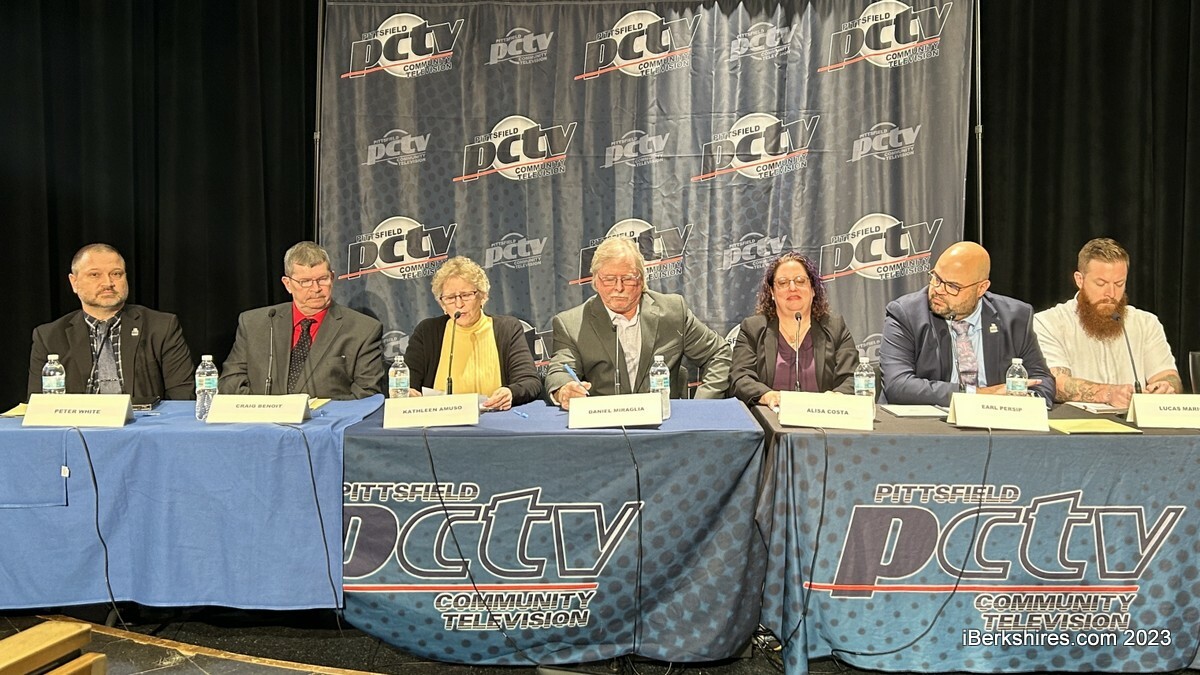
Pittsfield Councilors at Large Candidates Debate Blight, Mosquitos, Policing
PITTSFIELD, Mass. — Monday's debate between the seven candidates for the four councilor at large seats offered some substantive dialogue and disagreements that were largely in degree.
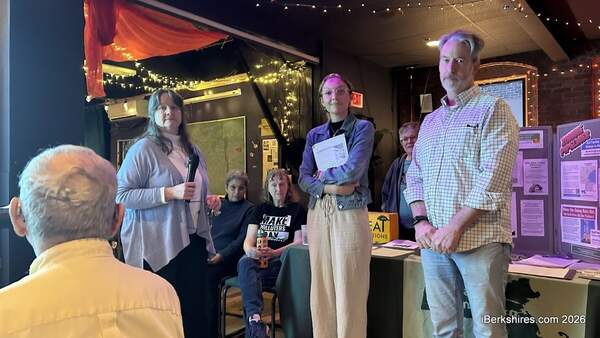
Incumbents Peter White and Earl Persip III and challengers Craig Benoit, Kathy Amuso, Daniel Miraglia, Alisa Costa and Lucas Marion spent 90 minutes taking questions from moderator Shawn Serre at Berkshire Community College.
The debate was the third that night, after Wards 2 and 3, sponsored by Pittsfield Community Television in collaboration with iBerkshires.
The candidates took turns selecting a numbered envelope with a random question that three candidates then answered. Each was also allowed a follow-up time to address questions they didn't get — Wahconah Park, tax incentives, mosquito spraying and panhandling were hot topics.
And they answered six lightning round questions.
All the candidates were for restructuring the bike lanes on North Street, with several following up on the lightning question afterwards "Everyone has complained," said Persip. "Ricard Morales, please, please fix North Street.
Later in the debate, Amuso, Miraglia and Costa were asked if the council's authority should be superseded by referendum on the bike lanes. Amuso and Miraglia repeated their frustration with the North Street configuration but Costa rejected the idea of a referendum.
"I don't believe that we should be dealing with traffic safety, public safety by referendum," she said. "I think we need experts to help us with that."
This was more about government and residents not communicating, Costa continued, saying she was dedicated to holding monthly community meetings where residents could question department heads.
The candidates were generally in agreement on the need to invest in historic Wahconah Park and also find funding for a new police station and other capital needs; to keep the charter objection but alter it, with White suggesting three rather than one vote; that cell towers could cause physical issues for some people, with Benoit and Amuso saying they weren't sure; that roundabouts were good, with Amuso and Miraglia saying no; with all but Costa saying civil service was no longer needed; and that an outside auditor was needed — with incumbents White and Earl saying the city already has one.
They split somewhat on mosquito spraying, with Benoit and Amuso saying they would have voted for it and White wanting time for it to go to subcommittee for debate before voting. He thought spraying was inefficient but if used, there should be an opt-in program.
"One of my biggest thing is public safety in the city and I think that the mosquito spraying would be a good thing to keep our children, our pets, ourselves from getting sick," said Benoit.
Amuso said her vote would have been based on what she's heard from residents. Miraglia said residents "should have the right whether they want pesticides sprayed in their yard or not."
Blight prompted another debate with candidates Benoit, Marion and White answering that there needs to be more consequences for property owners who don't maintain their land and buildings. White said the city's health inspectors don't have the tools to force people to clean up outside of court.
"Instead of just fining and fining and fining we should be able to hire a landscaper to go in, do the work and then send the bill to the homeowner," he said, and follow up with lien.
Benoit disagreed, saying "I don't think that we should, as a city, put out an expense to clean somebody else's yard. I think that should be put the burden on them."
Marion argued that if the homeowner isn't paying the fines, "then there needs to be some kind of reciprocity for that." He pointed to a mechanism similar to not being able to register your vehicle if you don't pay your parking fine.
The council is debating an ordinance that would prohibit people in the medians that most have seen as a way to stop panhandling.
There seemed general support for the idea as a public safety issue from the candidates as long as the city also paid attention to the systemic issues that may be causing panhandling.
"In my work with Working Cities, I have walked alongside so many people struggling like the folks that we see on the street," said Costa. "We need to bring people with lived experience to the table to help solve these problems."
Marion did not support the ordinance on the grounds that the American Civil Liberties Union could take the city to court.
"The only idea I've heard so far that I really like is to disincentivize giving to panhandlers whether that's a sign or a campaign that says please don't give panhandlers money," he said.
White pointed out that the ordinance would apply to everyone — including sign holders for campaigns and firefighters' boot drives.
People should be encouraged not to give to panhandlers, he agreed. "We should be encouraging people to give to organizations like ServiceNet that can help out in a larger way."
As for downtown safety, Benoit said he'd support police patroling North Street after having spoken to people at the Senior Center: "they are scared to death to be downtown."
Miraglia also supported more police presence.
"We have a lot of things that we have to address and I think getting more businesses and filling some of these storefronts will help push a lot of those people out of areas where they're just milling around, hanging around because they got nothing better to do," he said.
Marion, who owns Otto's on First Street, said he spends a lot of time downtown and that foot patrols will be a waste of money.
"The Police Department doesn't have the resources," he said, adding that traffic enforcement would bring in more revenue.
But Persip said the downtown's "pretty safe" and that foot patrols are a pipe dream."
"I do think anybody that tells you that foot patrols are going to happen hasn't talked to the police chief," he said. "It's not possible. We are not even nowhere near the number of people we need to have foot patrols right now. We are years away from having a foot patrol."
Amuso said it was important to for the city to attract quality candidates for the force and all the candidates indicated a willingness to support the police budget.
Miraglia, Persip and Costa said they would support the continuation of the Diversity, Equity and Inclusion Office, a new department that had something of a battle at first.
Persip, noting he was the only person of color at the table, said he was happy to vote for it and fight for it, despite some councilors trying to do "weird things."
"We deserve a city where everyone feels welcome not just our staff at City Hall, in our School Department, but every resident of Pittsfield deserves to feel like they belong when they're at a meeting, when they're walking into City Hall or getting any city services," said Costa.
The candidates were widely split on whether the heads of police, fire and public works should live within the city but generally agreed that any decisions relating to school consolidation should come from the School Committee with input from faculty, students and parents. Amuso, a current School Committee member, encouraged residents and councilors to attend the School Building Needs Committee meetings to keep up to date.
"There is a strategic plan that is being reviewed right now, for facilities and the structure study. And it's important that we get involved," she said. "What I found in the past as co chair of the school building needs is we do have community meetings and people don't get involved and then sometimes they don't like the decisions that were made. But these are significant changes that may come to our school. System and affect our families and our children."
There also was agreement on tax incentives for businesses but with Marion cautioning they have to be targeted since they can "wreak havoc and marginalized communities" and Benoit "under the condition that we don't forget the other small businesses or larger employees in the city ... we need to help them all too."
Costa, Persip and Marion got a question on trash collections with Costa supporting a flexible toter system as long as the city did not foot the bill for Casella; Persip also backs a toter plan but noted the city could be saving if it raised its recycling rate, which is a third that of the state average; and Marion would vote for pay as you throw, noting the city's shelling out $2.6 million a year for trash.
Debates for Wards 6 and 7 and for mayor will be held Wednesday, Nov. 1, also at Berkshire Community College. Look for the full debates on PCTV.
Tags: debate, election 2023,