Grasshopper and Spider: One jump too Many Into Oblivion
WILLIAMSTOWN, Mass. — Curiosity can lure a biologist into the field, leaving the secure footpath to engage in actual research on the life of grasshoppers that thrive in a maze of grasses, and forage among vivid wild flowers burgeoning in benign weedy neglect.
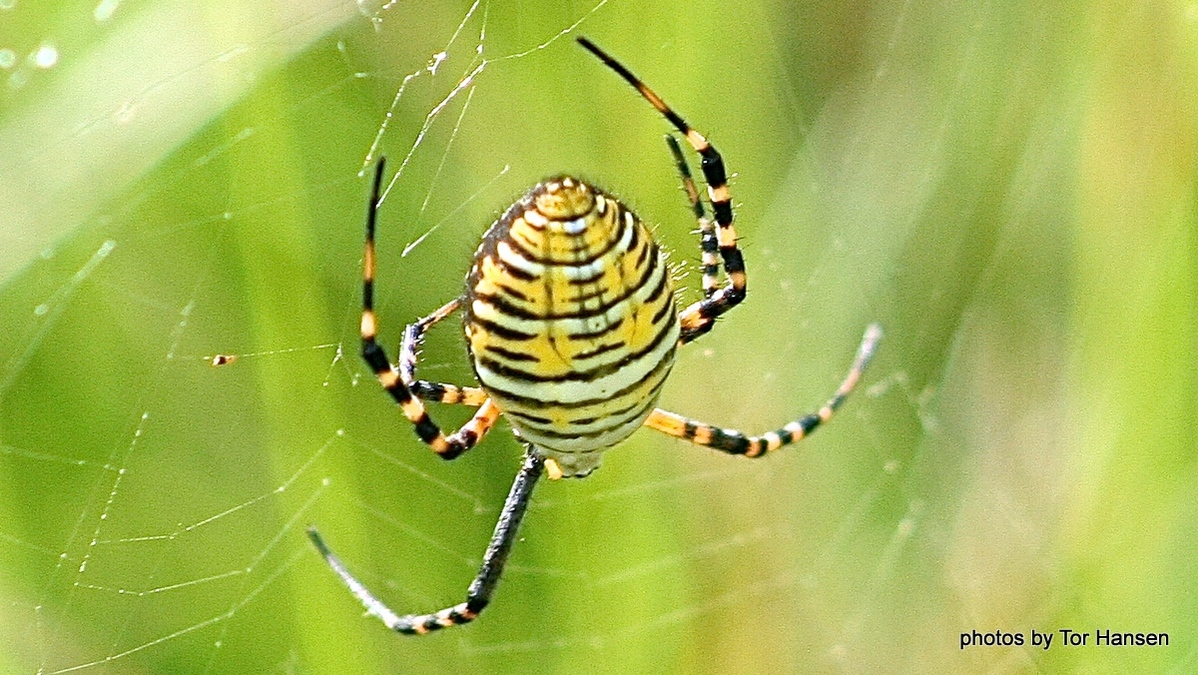
Therein lurk in floral disguise their natural predators, the spiders. Many species garner bold arresting colors that in contrast may deter predators by announcing their yellow and black warning colors of hidden toxicity.
They spin elaborate silken webs remarkably crafted, as orb web weavers do, that intent upon capturing flying insects, exhibit their ingenious methods of wrapping prey in volleys of intrinsic silk before injecting venom prior to sucking up life-sustaining proteins.
Take a stroll amid the many intersecting roadways that criss-cross the Spruces park in Williamstown during late summer when goldenrods and asters complement the weedy fields, now overgrown before the mowing cycle razes the bountiful oases that attract assorted butterflies, and a myriad of jumping grasshoppers.
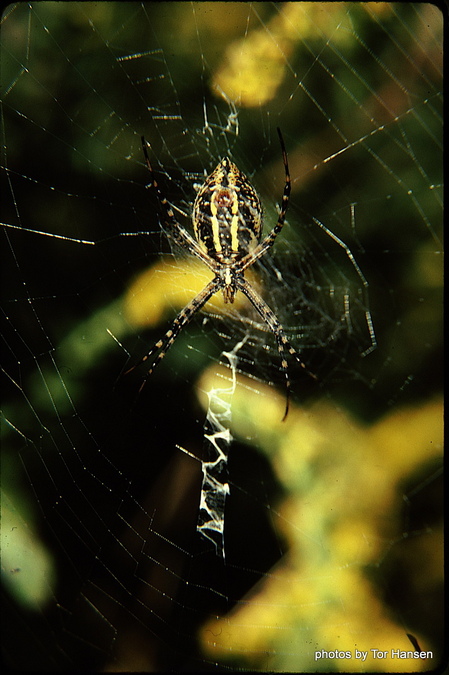
What looks like a budding flower turns out to be our most common garden spider (Argiope trifasciata) smack in the middle of its amazing web woven with a bolder white ladder-like fortified silk.
This zigzag ladder bears an Italian name, Stablimentum, spun to warn incoming larger insects, bats, and birds to veer away before impact, thus avoiding spider the trouble of rebuilding whole web!
With all due respect given to our spiders, regard these essential fields as moist meadows given there is ample rainfall. Today's binoculars with short focal length enable the explorer to magnify insects that harbor the vital check on potentially huge numbers of grasshoppers known to devour and devastate a farmland's cash crops down to the last shoot, the grains we foster and depend upon for breads and cereals. And fear not, for the orb web weavers herein are not venomous to humans, with exception to those people with allergies, and the infamous recluse spider, known to inhabit dusty places.
More than a handful of grasshopper species exist here. Equipt with stout chitinous mandibles, when increasing in numbers unchecked by predators, they can reduce the grasses to stubble. Wandering slowly through these Elysian fields whereafter death, animal remains add nourishing elements to procuring topsoil.
Grasshoppers eagerly advance their next generations, females laying underground or in rotting wood some 20 to 100 eggs that become mature grasshoppers in two to three months on average. They can jump 10 fold their own body length as your footfall stirs the tall grasses. Some are migrants, and some residents. With amazing kicking or jumping power, they can defy the expected laws of gravity.
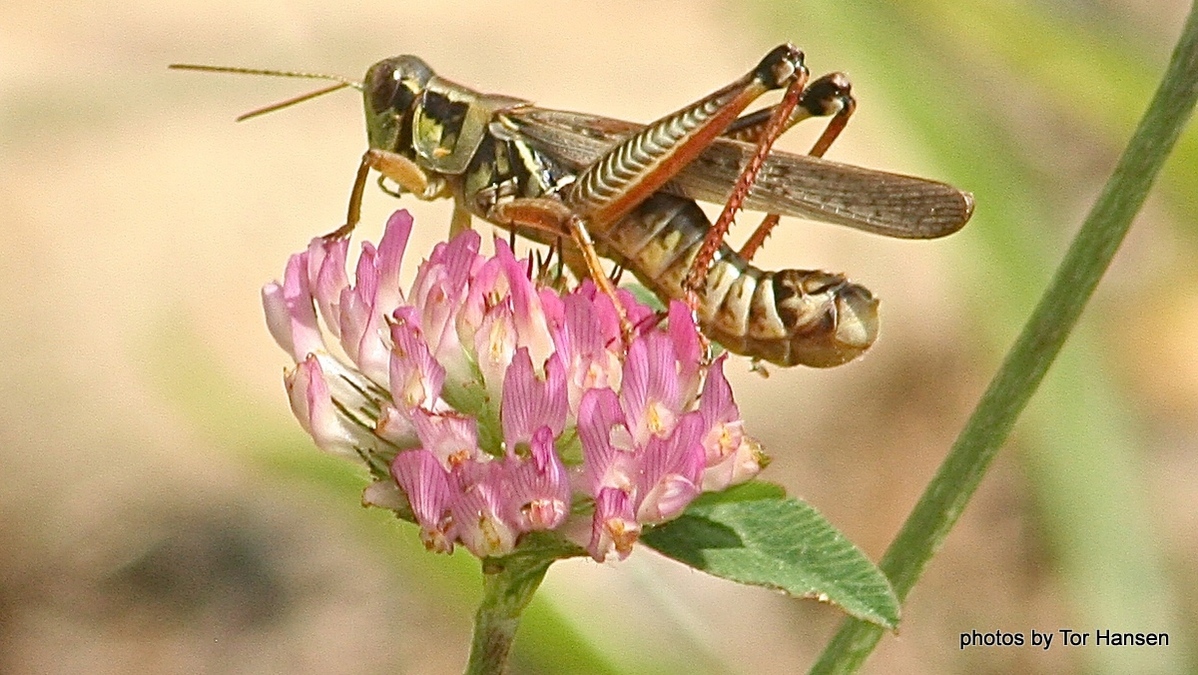
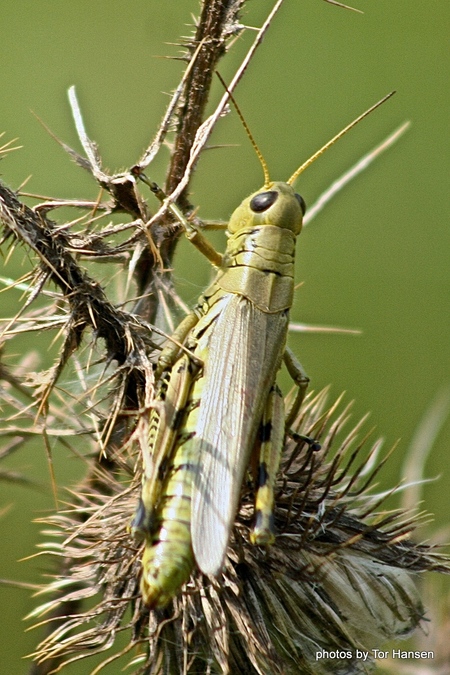
The heavy-set lubber species, most likely Melanoplus differentials, here show uniform olivaceous green colors, house astounding potential energy, as their strong hind legs with a sudden kick launch the grasshopper at least a yard so to escape we the huge intruders. Captured by my camera Canon XTi, a smaller migratory species appears to kick away a noisome fly, quick to flee from the terrible scarlet spikes on their jumping legs, or become impaled by those bloody thorns!
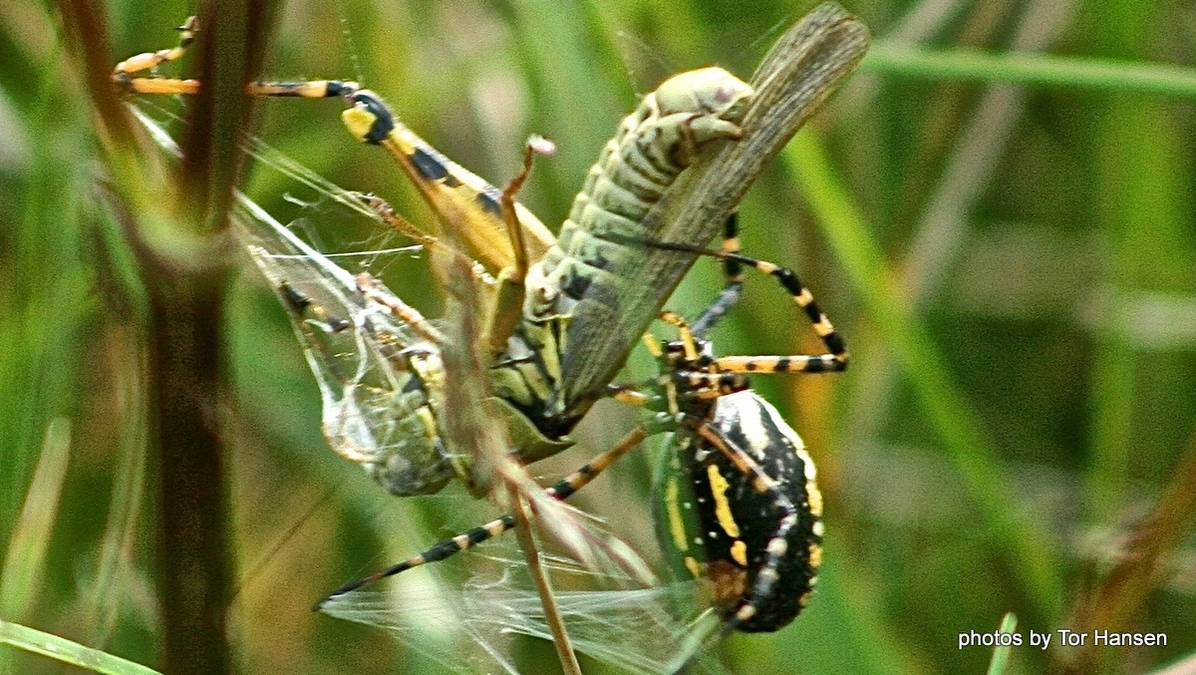
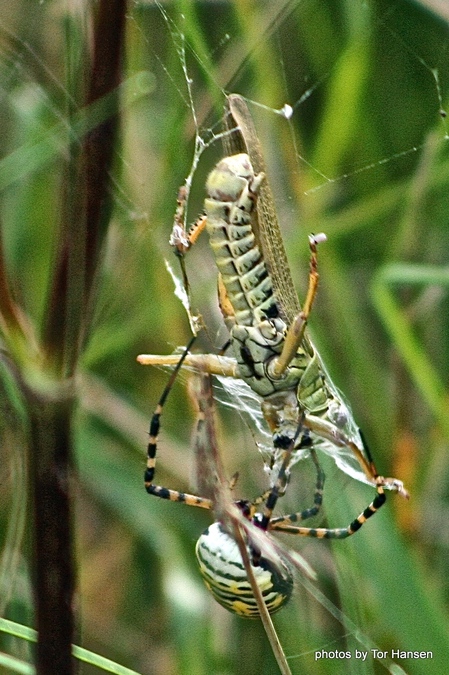
Their goggle-like compound eyes especially sensitive to approaching movement may have caused the fatal leap. Suddenly there was a oscillating motion in the neighboring tall grass, where the unlucky grasshopper had strayed into an orb weaver's web, now struggling to escape the enwrapping silk.
Our second most abundant orb web weaver species is: genus Argiope and species perhaps trifasciata. With a strong surge to capture and subdue the prey, this yellow, black and white banded spider attacked the lubber with amazing speed and agile leg utility, with fatal bite after encircling in silk threads and sheets. Arresting to say the least!
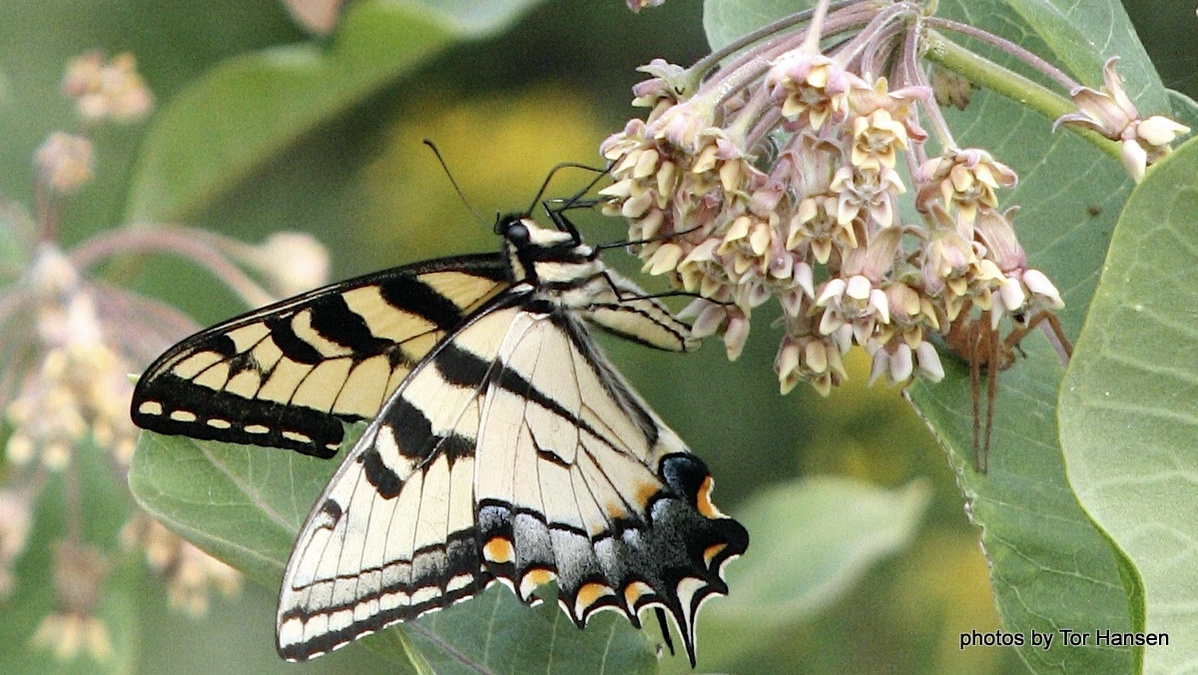
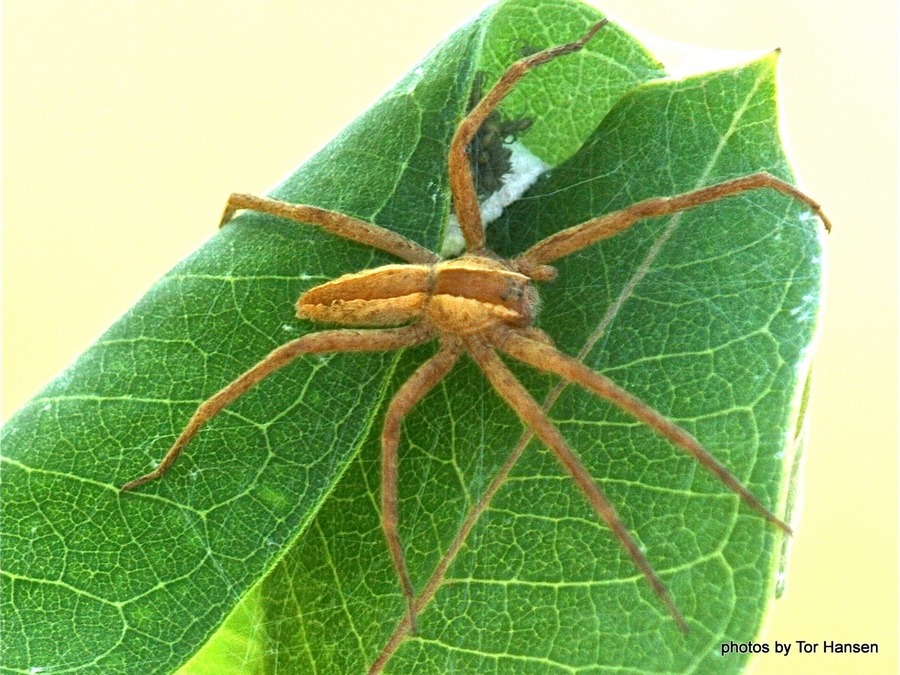
In contrast another large spider greets me with a sudden rush, a cautionary halt! I had walked to a milkweed patch at Mountain Meadow to follow a great spangled fritillary that was flitting from pink cluster to cluster, when I spotted a grotesque long-legged Pisaurina mira perched on a succulent green milkweed leaf, very close to an imbibing tiger swallowtail. On closer inspection I noticed a silken web tucked under the same down curled leaf, and surmised correctly that this is the nursery for the Pisaurids' manifold baby spiders, all remaining suspended by silken threads, still as a circus trapeze artist before he begins his first swing.
She guards a huge egg sac hidden in the nursery, and young leave the nest in about one week.
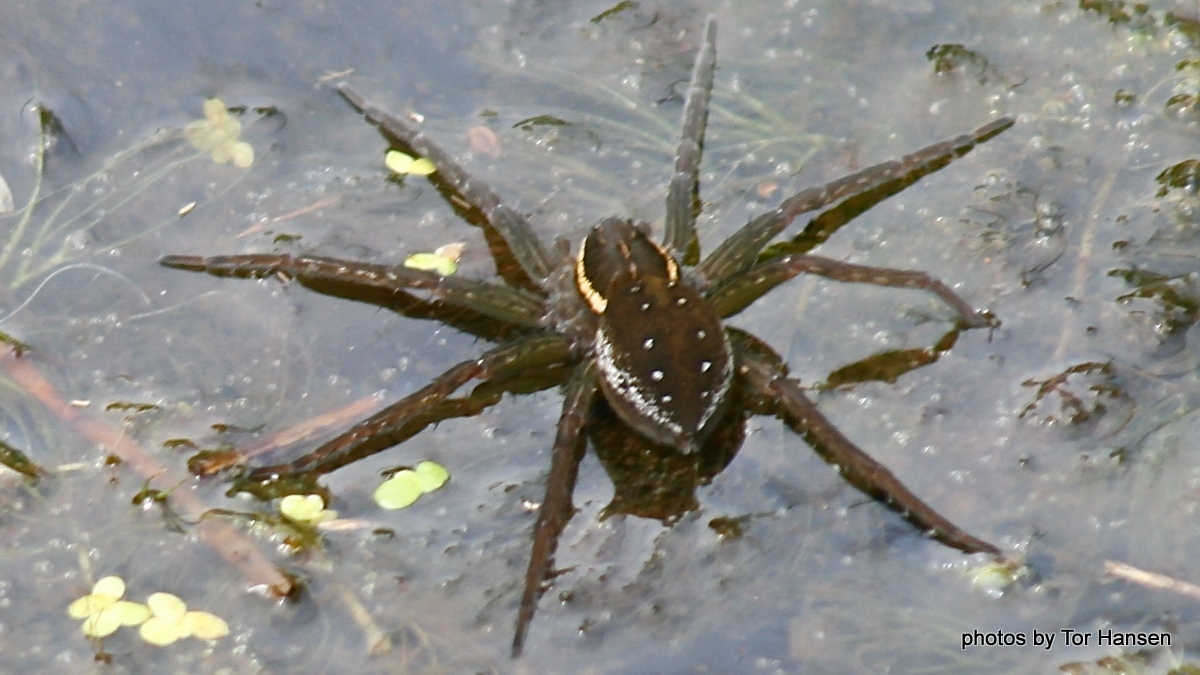
They are imposing at first, but Wikipedia confirms its bite is harmless. How glad am I they are not aggressive to humans. Perhaps they might attack the swallowtail or smaller pollinating insects, but nonetheless they fulfill an important role in curtailing otherwise higher numbers of insects, earwigs, and other arthropods that frequent milkweed for nectar, and possibly including young monarch larvae. This spider can run on water, so if you search old cranberry bogs for a fish-eating spider (Dolomedes) that shares same habitat, this Pisaurid may scoot away and dive underwater remaining submerged for some time.
Dolomedes triton, our most likely species east of the Rocky Mountains, known as the six-spotted fishing spider, does inhabit slow water including overgrown cranberry bogs, especially Cape Cod and coastal Massachusetts. It is a treat to see, and proceeds to remain still so to attract insects, minnows, tadpoles, and small fish lured to the surface. Standing water often develops a thin meniscus becoming a rich zone for microbes and protozoans, minute animals that may be a source of nutritious life-sustaining energy.
Has anyone here seen Dolomedes in our Berkshires? And further clarification of exact genus and species is welcome and respected.
Tor Hansen is a naturalist writer, photographer, and musician. His column Berkshire Wild looks at especially butterflies, birds and other small creatures at home in the Berkshires and Massachusetts. He does talks and presentations and can be contacted at torhansen46@gmail.com,
Tags: berkshire wild, grasshoppers, spiders, wild animals,