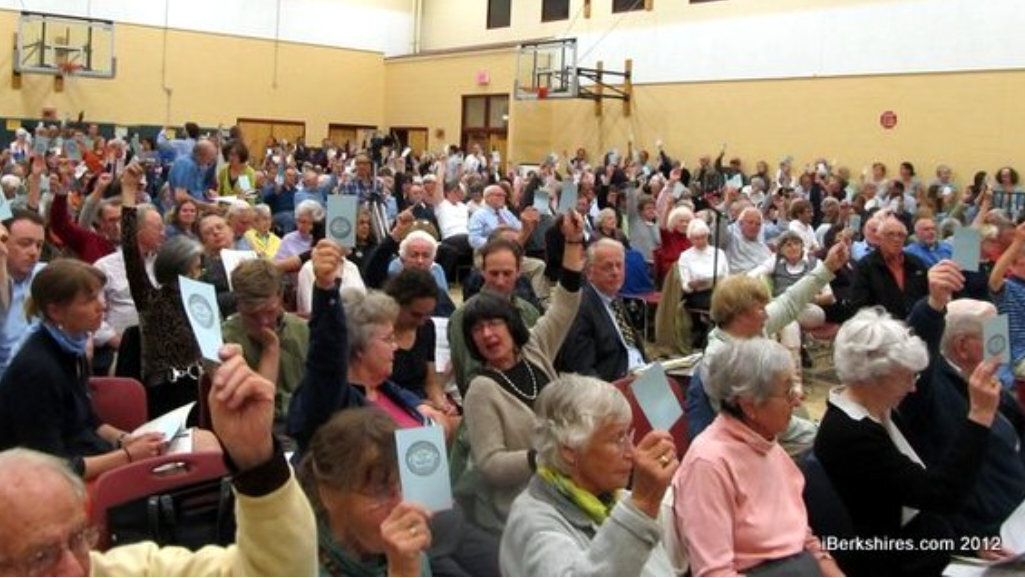
School Budget, Environment, Recreation Highlight Williamstown Town Meeting
WILLIAMSTOWN, Mass. — This month's annual town meeting returns to a familiar venue.
What goes on in that building the rest of the year could be a major topic of discussion at the Tuesday, May 19, gathering.
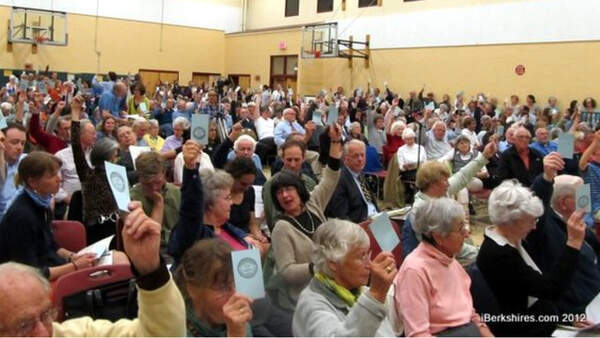
After two years (2020 and '21) on Williams College's football field and four years ('22 through '25) at Mount Greylock Regional School, the town's legislative body will be back at Williamstown Elementary School for a 7 p.m. meeting to decide on municipal spending and other town business.
The largest segment of the municipal budget goes to the public schools, and the spending plan for PreK-12 education likely will see a floor amendment intended to add an additional $120,000 to fund a math interventionist at Williamstown Elementary School.
The elected seven-member School Committee that governs the Mount Greylock Regional School District has proposed a $30.9 million operating budget for the fiscal year that begins on July 1. The local share of that budget is meted out in assessments to the member towns of Lanesborough and Williamstown, which each vote whether to approve its assessment at town meeting.
Williamstown's share of the operating and capital expenditures for the regional school district is $16.8 million under the budget approved by the School Committee, an increase of a little more than $2 million, or 13.65 percent, from the budget for the current fiscal/school year.
A group of WES parents concerned about the mathematics instruction at the Grade prekindergarten-6 school plans to bring an amendment to town meeting to add the additional $120,000 — about 0.7 percent of the proposed assessment — to fund the interventionist position.
If amended and then passed, the assessment would go up by $2.14 million, or 14.5 percent year to year, not the 13.65 percent increase in what the administration has termed a "level services" budget.
Members of the School Committee were supportive of the request by the School Council to add an interventionist when the council's budget requests were presented this winter. But, given mounting fixed costs and an absence of reserves to cushion the impact on the bottom line, the School Committee decided not to recommend the administration add the new math position into the budget.
Jenna Hasenkampf, a member of the School Council, addressed the School Committee and, later, the town's Finance Committee, to discuss why the interventionist position is so critical.
"The [math] MCAS scores, which I believe are for third grade and up have been going down in every grade, except for one, since 2021," Hasenkampf said at the May 25 Fin Comm meeting. "I think one of them started to slip in 2022."
Advocates for the planned budget increase amendment also point to state data that shows the average funding per pupil at WES, $21,355, is below the commonwealth's average of $23,198, and the local school would still spend less per pupil after a $120,000 increase to the bottom line.
And, it is a bottom line budget. Town meeting does not direct the school district how to allocate the funds it receives from local property taxes. Rather, the district presents an omnibus budget to the meeting for an up or down vote; a down vote likely would result in a special town meeting between May 19 and July 1 with, in all probability, a revised school budget.
"An amendment [to the school budget] is possible, but they can't compel the School Committee to actually spend the additional funds," Town Manager Robert Menicocci told iBerkshires last month. "It will be up to the proposers to do additional work to get the School Committee on board and to act."
Of note, because of the way the regional agreement between Lanesborough and Williamstown is written, the elementary school in each town is funded by each town separately. The local burden of the operating budget at the middle/high school is shared proportionately between the two towns.
The Mount Greylock Regional School District assessment is Article 16 on 32-article town meeting warrant and the penultimate of 15 fiscal articles that the meeting needs to address to maintain municipal services in fiscal year 2027.
It is far from the only part of the budget that has seen sizable increases from the FY26 spending plan. The Finance Committee combed through the town and school portions of the budget this winter and advanced a general government spending plan (Article 13) that shows a 2.53 percent increase year to year ($10.6 million in FY26 to $10.9 million in FY27).
"I just want to say the team here [at town hall] put a ton of effort into putting together a meaningful budget that we think is cost effective and frugal," Menicocci said at the April 3 Select Board meeting. "On the town side, we came in with a rate of increase that is below inflation, which, I think, if you look around, that's a rare thing to happen.
"We did add one position to the Police Department to the budget. That's our one main expansion area. Otherwise, what you're seeing are cost pressures."
If all the budget articles are passed as printed in the warrant, the tax bill for a median single family home in town ($462,500) would be $7,067.91 in FY27, an increase of $627,91, or 9.75 percent, from FY26, according to town documents. That bill does not include the taxes from the fire district, a separate taxing entity, which will consider its budget at an open meeting on Tuesday, May. The tax bill from the district is slated for a slight decrease from FY26 to FY27.
The final fiscal article on the warrant cleans up a 2007 town meeting vote authorizing borrowing for the town's contribution toward the renovation of the Cable Mills factory as a housing project. Town meeting authorized up to $1.5 million in borrowing; the town ended up issuing just more than $1.1 million in debt. Now town meeting needs to rescind the remaining $422,039 in borrowing authority.
After that, the remainder of the warrant can broadly be categorized into three areas: citizens petitions, town business, and the Community Preservation Act.
Citizens Petitions
Three articles go before town meeting by way of citizens petition, and each seeks to improve the environment in town.
Article 18 would ban the use of second generation anticoagulant rodenticides (SGARs) in town. The proposal mimics an existing ban on using SGARs on municipal property and would do so for the same reason: The poisonous vermin control agents end up being consumed by predators (birds, foxes, etc.) who are, in turn, poisoned."
"There are viable alternatives to SGARs that are both effective and safer for the Community," the petitioner wrote in explanatory text accompanying the warrant article. "For example, Concord [Mass.] Public Works uses RatX which does not make its way up the food chain. Integrated pest management strategies, such as rodent-proofing buildings, maintaining a clean environment, and setting snap traps, also can control rodent populations without resorting to dangerous poisons."
Article 19 seeks to ban the use of soil amendments derived from human waste (sewerage) for agricultural purposes in town. The local farming community supports the measure through the town's Agricultural Commission, which wrote a letter of support. The proposed bylaw also would impact backyard gardeners, who would need to more carefully read labels to make sure they are not buying fertilizer that includes biosolids.
Those biosolids are a known source of per- and polyflouroalkyl substances (PFAS), the so-called "forever chemicals" that have been linked to cancer. The article follows on the heels of last year's townwide conversation about the composting practices at the Hoosac Water Quality District.
Article 20 seeks to amend the 2015 bylaw on plastic bags. Author Susan Abrams has characterized the proposed change as small but important to close potential loopholes in the 2015 measure.
While all three of the articles would, of course, only impact what goes on in the town of 7,500, proponents argue that these local actions can help move the needle by applying pressure to major corporations and state governments.
"Because there is already such a patchwork of regulations, most chains have had to transition to different packaging in communities with stricter regulations," Abrams said in an email discussing her bag bylaw amendment. "What we see from chain businesses is that they have no problem with this and eventually reach a 'tipping point,' at which time they choose to transition to the more environmental option in all stores.
"Case in point: Dunkin Donuts stopped using styrofoam in Williamstown in 2016 after we passed our ban but the North Adams DD continued to give out styrofoam cups. The chain claims to have stopped using styrofoam in 2020."
Likewise, Stephanie Boyd, in arguing for the local biosolids ban, pointed to another Williamstown town meeting action that was, eventually, echoed in Boston.
"Several years ago, when I was on the Planning Board, [town meeting] adopted regulations on accessory dwelling units, saying, 'Hey, this is a way we can get more affordable housing in our community,' " Boyd said. "Seven, eight years later, the state has now mandated all communities to [allow] accessory dwelling units. Hopefully, we're leading the way on this one as well."
Town Business
• Articles 21 through 25 are generated either by an elected board or by town staff.
• Article 21 would petition the state Legislature to allow Williamstown to publicize notices of certain public hearings through electronic means instead of requiring the town to purchase ad space in a local newspaper.
• Article 22 would increase the income limit and asset limit for residents 60 and over to participate in the 41C property tax exemption program.
• Article 23 would adopt the provisions of the commonwealth's Seasonal Communities program, which opens the door to state grants and would require some zoning law changes (at a future town meeting) to allow denser development.
• Article 24 modifies the town's 2019 accessory dwelling unit bylaw to bring it into full compliance with the 2024 state law Boyd referenced in her discussion of the bag bylaw (above).
• Article 25 would authorize the Select Board to acquire 8.25 privately owned acres in South Williamstown that formerly was used as a town landfill so that the town can maintain the site.
Community Preservation Act
Unlike the main fiscal articles, which are funded directly through property taxes and user fees (like at the transfer station), the CPA articles deal with grants generated by the 2 percent CPA surcharge on local property tax bills.
That surcharge is applied after $100,000 of a property's value is deducted. So, that $462,500 median priced home, would be charged a surcharge as if it was a $362,500 home with a $5,539 tax bill, and the surcharge is $110.79.
That local surcharge money, plus a state match, generates the money available for grants under the CPA program in a given year. This year, the Community Preservation Committee, which vets all applications for CPA grants, is recommending eight to town meeting, which appear in Articles 27 through 32 on the meeting warrant (some of the requests are combined in a single article).
The largest are a grant of $350,000 to Purple Valley Trails for construction of a new skate park on a town-owned parcel on Stetson Road and $145,000 to the town's Affordable Housing Trust to support the body's continued efforts to increase availability of housing to residents of different economic levels.
This winter, PVT's Bill MacEwan told the CPC that, if the town meeting approves the grant, the project can get underway on June 1. This month, he told iBerkshires.com that is still the case, although rising costs have necessitated a modification.
"The builder is scheduled to arrive on June 1 pending approval at town meeting," MacEwan wrote in response to an email asking for updates. "[The town's Department of Public Works] has already begun site prep.
"We have done some design adjustments in the past few months to account for inflation, so the footprint is about 15 percent smaller than originally planned. We will still have the last 10 percent of funds to raise, and we can reduce or increase the size of the park based on final funding."
Speaking of funding, about $100,000 in pledges toward the $750,000 project are contingent on a successful town meeting vote on the CPA grant, MacEwan said.
Child Care
Town meeting is open to all registered voters in Williamstown. The New England institution is, arguably, the strongest example of direct democracy in a nation that largely operates on various levels of representative democracy.
The 7 p.m. start time on a Tuesday evening frequently has been cited as a potential obstacle to participation by residents with young children in the home.
This year, volunteers are providing child care for the children of meeting members in the auditorium on the second floor at WES while the meeting is conducted in the school's gymnasium.
Tags: annual town meeting, fiscal 2027,