Lanesborough Planning Deliberates Sign & STR Bylaws

By Breanna SteeleiBerkshires Staff
Print Story | Email Story

LANESBOROUGH, Mass. — The Planning Board is a step closer to finishing draft bylaws for short-term rentals (STR) and signage to be voted at the annual town meeting.

The planners took up the bylaws  after contentious interpretations by the town of the existing signage bylaw and over the lack of STR regulations. 

They started work on the drafts in February but some elements were tabled for this month's meeting, held last week. 

They first rewrote the parking at a rental to three or more rooms must have three spaces and two or fewer rooms having two spots.

The board debated on the definition section, which was tabled last month. After some deliberation, members decided to remove a requirement for all short-term rentals to prominently display signage containing the owners' name, property address, 24-hour contact information for the property manager, and legal occupancy limit of the building.

Member Joe Trybus argued that the enforcer, Building Commissioner Brian Duval, should be the contact and that owners shouldn't have their information out there for anyone to contact.

They also discussed the registration and inspection sections, rewording and adding some language to state: All operators of short-term rentals shall register with the town clerk, who shall maintain a registry of all approved STRs in the town of Lanesborough, and may set reasonable fees for maintenance of registry applications for registrations shall include the following, owner name and property address, local property management and contact information, copy of currently valid STR certificate of registration with Massachusetts Department of Revenue, copy of current valid certificate of inspection from the building commissioner.

Chair Courtney Dondi said she agreed the town should be the one to decide on the fees.

The members debated how they should write the ownership and entity limits. Trybus argued that non-owner occupied buildings would be limited to one STR in a residential zone while Leanne Yinger thought it should be based on units, not the building.

The board determined an owner-occupied property in a residential zone could rent all units on that property short-term, though there were  couple no votes on this.

It also finished the purpose and intent section stating: This section regulates short-term rentals, STRs of residential properties in a way that clarifies where these uses are allowed in Lanesborough and regulates them in a manner that retains the character and safety of neighborhoods and the community while preserving an important resource for the local tourism dependent business community. 

Members plan to review these new changes with the expectation of finalizing them on April 13.

The board had also discussed signage bylaws at the last meeting and completed language on the sizes and limits.

There will be one banner per business that must be attached to the building. The total banner area must not exceed 25 percent of the street-facing façade. 

Open, closed, and  menu signs will be explicitly allowed as part of normal business signage and businesses can only have one sandwich board (A-frame) sign. These will be a max of 36 inches high and a max 12 square foot of the total area.

One feather flag would be allowed per business with a maximum size of 12-feet high and 3-feet wide. Inflatable tube men will not be allowed.


Tags: bylaws,   short-term rentals,   signage,   
If you would like to contribute information on this article, contact us at info@iberkshires.com.

Pittsfield Man Creates Device to Clear Lakes of Algae Blooms

By Breanna SteeleiBerkshires Staff

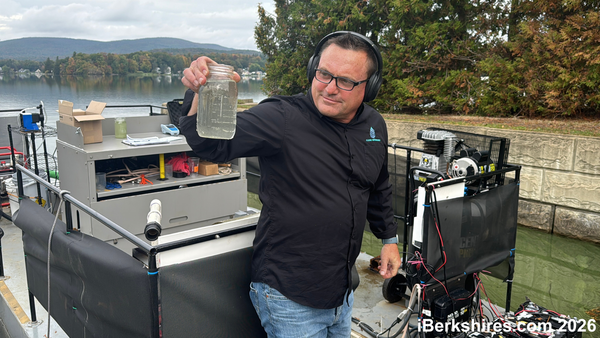
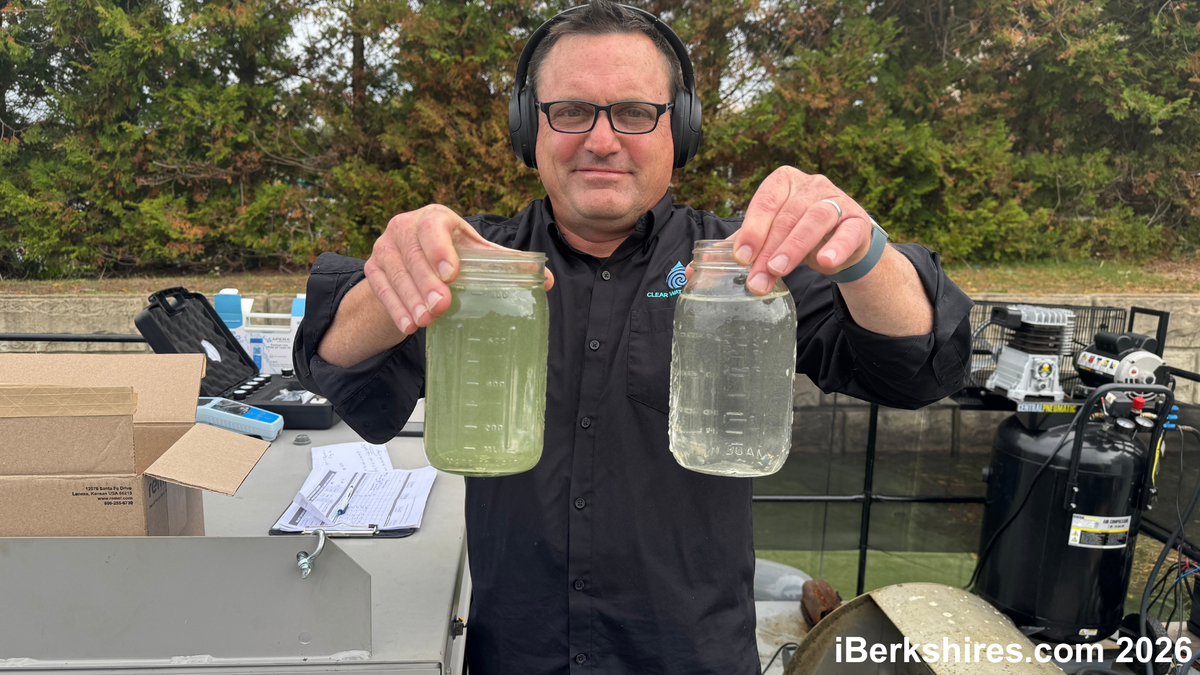
Marc Bellora holds a jar of lake water, left, to compare to water cleaned by his Aqua Clarifier Water System.

PITTSFIELD, Mass. — Marc Bellora has high hopes for a device he's created to treat lakes from harmful algae blooms.

His patented water clarifier can physically remove captured material rather than letting the nutrient-rich material settle back into the lake, which occurs when herbicides are used.

"It's a long-term lake management tool that can be used to reduce legacy nutrients in lakes and ponds over time," he explained. "We built the prototype, this is a prototype. It does approximately 65 to 70 gallons per minute. It's very environmentally friendly. Can be used with air only, or we can use a low-dose potable polyaluminum chloride (PACL) or chemical on board that can help improve results."

The water clarifier barge is based on well-proven technology for water treatment, he said. "It's a self-contained, portable, mobile unit that removes algae blooms, nitrogen, phosphorus, and the associated nitrogen and phosphorus within lakes."

Bellora founded Clear Waterways Group with business partner Mark Simon. They built a prototype mobile unit and are still working out the kinks. It's taken Bellora about five years to bring the project to fruition as he is also a full-time Realtor.

He says the repurposed barge they use has a device that uses air to filter the water to separate harmful bacteria or uses a chemical at low doses. They are testing both to see how well each does at cleaning the water.

"They would do the same thing here, except they would spray it, and it blocks all that stuff together," Bellora said of the use of herbicides. "But then it drops to the bottom. So now all the nutrients that are attached in that plot go to the bottom and contribute to the legacy nutrients only to fuel next year's bloom. Ours removes it."

He said just using air alone has removed 70 to 90 percent of harmful algae where he has been operating on the south end of Pontoosuc Lake.

"Essentially, we take in the bad stuff, we take in the lake water. We separate the good stuff from the bad stuff. Clean water goes back into the lake, and the bad stuff can either be composted, or it can be taken to the wastewater treatment plant, which is what we're doing here," he said. 

Bellora explained that tiny air bubbles attach to particles in the water, making them buoyant so they rise and can be removed. The unit can operate with air alone, or with a low dose of potable polyaluminum chloride.

PACL helps through flocculation: it gathers small particles into larger clumps that are easier for air bubbles to capture. He said this can help remove dissolved nutrients that air alone may not capture as effectively. 

Bellora said he was inspired to build something like this after noticing the lakes he enjoys being shut down because of algae blooms. 

The city issued a health advisory for Pontoosuc in August, warning residents not to swim or come in contact with the lake water because of an algae bloom. The cyanobacteria can cause skin irritations, vomiting and diarrhea and nerve or liver problems. 

Bellora previously worked for a company that used traditional dissolved air flotation (DAF) systems to treat water. In that role, he traveled around the country to work at paper mills and food-processing plants.

That experience gave him a practical understanding of DAF, and while flying between jobs, he would see green ponds and wonder whether the technology could be adapted to treat lakes. 

View Full Story

More Pittsfield Stories