Hoosac Valley Seeks to Prevent 'Volatile' Assessments

By Sabrina DammsiBerkshires Staff
Print Story | Email Story
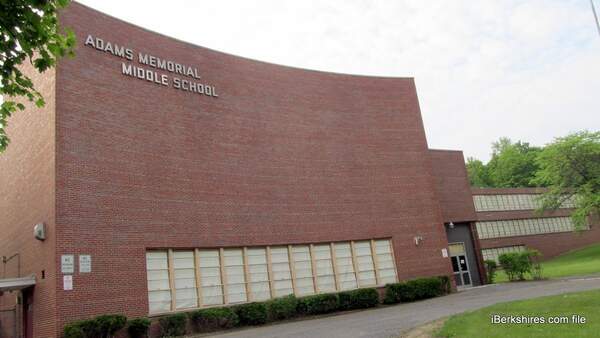
ADAMS, Mass.— The "volatile" shifts in Hoosac Valley Regional School District's town assessments year to year is hard for smaller towns to absorb; however, a proposed change to the regional agreement would fix that. 
 
During the Select Board meeting last week, Superintendent Aaron Dean presented the proposed change to the regional agreement that would set assessments based on a five-year rolling average rather than the annual student enrollment.
 
"The long-term goal is to make the assessment process a little bit more viable for people from year-to-year," he said. 
 
An ad hoc committee was convened to review the district's agreement, during which concerns arose about the rapid fluctuations in assessments.
 
"I think you have to look short term, and you have to look long term. The goal is to kind of level it off and make planning easier and flatten that curve in terms of how it's going to impact both communities," Dean said. 
 
Every year, it is a little more difficult for one community because they are feeling disproportionately impacted compared to the other, he said. 
 
"The transient nature of this population right now is like nothing I've ever seen," Dean said. 
 
The district had hoped to move this forward last spring, but it was delayed for about six months because of ongoing correspondence with the state regarding the proposed language change.
 
"The pros for doing something like this for our budgeting sake is being able to predict a little bit better as to what the numbers are going to be … it makes it so that we're not as much of a sticker shock when we get the budget," one ad hoc committee member said. 
 
Hoosac Valley uses the enrollment figure submitted to the state Department of Elementary and Secondary Education to calculate its assessments.
 
In fiscal 2026, for example, some $15,719 would have shifted to the Adams side using a five-year average; although in prior years, Cheshire would have paid more because averaging would have raised its percentage. This is based on calculations provided to the board. 
 
For FY2027, Adams' average percentage would be 76.11 compared to 74.6 for enrollment, and Cheshire's average would be 23.89 percent, compared to 25.4. 
 
Other communities use the rolling average method; Hoosac Valley Regional School District is an outlier, the member said. 
 
Getting this approved would be a tough sell for Adams because if approved, that town's assessment would be more than it would under the current system.
 
The first year was expected to be a big jump and then it will level it out. 
 
"It doesn't seem like much, but it really drives the percentage points you have those jumps, that jump back and forth, which kind of brought us to that discussion of it's probably time to do the five-year average," Dean said. "So the communities have a little better idea of what's coming their way."

Tags: assessment,   HVRSD_budget,   
If you would like to contribute information on this article, contact us at info@iberkshires.com.

State, Local Leaders Celebrate Funding Boost For Ashuwillticook Rail Trail Extension

By Sabrina DammsiBerkshires Staff

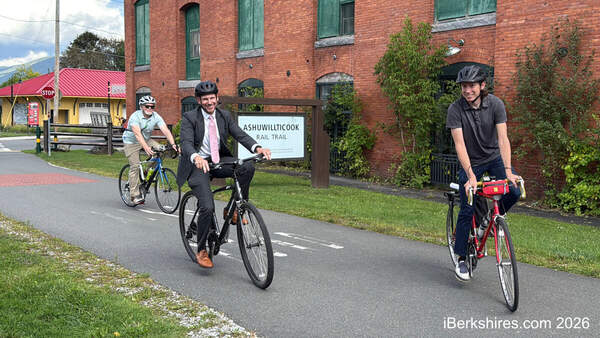
ADAMS, Mass. — State officials and local leaders kicked up their kickstands and took a ride along the final stretch of the Ashuwillticook Rail Trail on Thursday to celebrate new investments in rural communities.

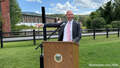
Federal Funds and Infrastructure Office (FFIO) Director Quentin Palfrey joined local leaders, including State Rep. John Barrett III and Berkshire Regional Planning Commission (BRPC) Executive Director Laura Brennan, in Adams to highlight the newest round of FFIO funding. The grant will provide BRPC with $64,700 in state funds to help advance the Ashuwillticook Rail Trail expansion.

"When Governor Healey came into office, one of her big day-one commitments was to make sure that Massachusetts was fighting for every dollar possible coming out of Washington," Palfrey said, speaking about FFIO, a program created in 2023 to help the state aggressively pursue and coordinate federal funding opportunities.

This builds on a $17.3 million federal award secured last year for the project, dubbed the A2A project, which supports the design of a 9.3-mile shared-use path connecting the existing Ashuwillticook Rail Trail to the Williamstown Mohican Path.

"One of the things that she emphasized to me when we set up the Federal Funds and Infrastructure Office was that we need to make sure that these resources not only come into Massachusetts, but benefit all of Massachusetts," Palfrey added.

The additional $64,700 will allow BRPC to gather information about transportation needs in northern Berkshire County to help inform the design of the trail expansion. BRPC will partner with Williams College and Luminary Evaluation, LLC to use the University of Michigan's Transportation Security Index (TSI).

Brennan said BRPC will deploy a 16-question survey that will allow them "to research local and regional perspectives and surface the needs of our neighbors when it comes to transportation in the Berkshires."

"The best-case scenario would be if the survey turned up results that all needs are met and that everyone has access to the places and the things that they need to travel to – but we know that is not true," Brennan said. "We know that folks in Berkshire struggle to get to their place of employment, to be able to access important medical appointments, [and] other engagements. So, the transportation security index is going to help us really hone in on those specific needs, identify pockets of needs or areas where there is a strong concentration or depth of need."

She said FFIO's investment offers a "wonderful augmentation" to BRPC's current plans for the bike trail extension. It's also an investment that will make the region more competitive for other transportation opportunities.

"This is an incredibly multifaceted and valuable investment, and we deeply appreciate it," she said.

Barrett said these investments drive growth in the Berkshires.

"I've always found that if you're going to grow an area, you grow with what you have here to grow. You don't bring something in. We have a natural beauty. We have an environment that's second to none, and that's what we are going to grow on," he said.

Barrett said that in the First Berkshire District alone, 4,000 new people moved to the area.

"We're seeing that migration here. They're going to have activities. They're going to have jobs, and we're going to have a great educational system that goes with it with our two colleges that are here," he said.

Palfrey said it was clear during the initial creation of FFIO that federal funding often went to wealthier and more urban communities with larger planning departments and greater access to consultants. He added that FFIO helps reverse this trend and get projects in rural communities off the ground.

View Full Story

More Adams Stories