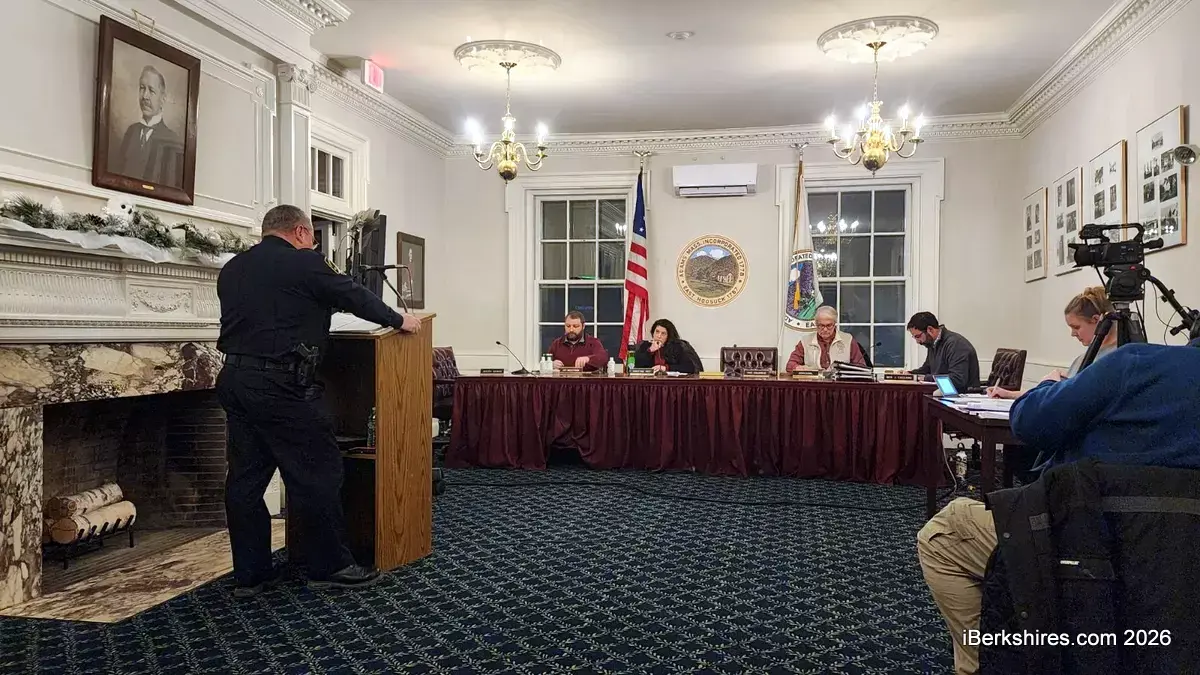
Adams Police Bringing Dated Policies Up to Standard
ADAMS, Mass. — The Board of Selectmen approved a raft of Police Department policy changes on Wednesday.
Acting Police Chief Timothy Sorrell presented the updates, noting that some hadn't been touched in 20 years. These new policies are in line with the standards of the Massachusetts Police Accreditation Commission and changes made by the state Peace Officer Standards and Training (POST) Commission.
"What we did is, instead of reinventing the wheel, I think when I first stood me before you, when I came on as the acting chief, we talked about getting policies from other departments, and there was a town in South County who became accredited, and they were more than willing to share with us their accredited policies," he said.
Detective Michael Wandrei, Officer Travis Cunningham and the chief reviewed the policies and brought them to officers with specialized training in those areas.
"We discussed, how does this fit into Adams? And some of it was just changing that town's name to the Adams name," he said. "So we just had to tweak it to what fit Adams is what we ended up doing ... It doesn't make us accredited, but we're a step closer, maybe when we get all these policies in line."
Policies reviewed included use of force; vehicular pursuits; detainee processing; protective custody; police media relations; body-worn cameras; collection and preservation of evidence; and property and evidence control.
More than a few of the updates related to new techniques, equipment and methods that have changed in the 15 or 20 years.
In use of force, he said, "new technology, less lethal weapons, pepper spray, stun tasers, electronic control weapons, or the tasers, less lethal shotguns. And Massachusetts is now going back when it comes to the ECW that can dry stun (direct contact) instead of just shooting the projectile (darts)."
The policy also covers de-escalation and what is reasonal force.
"It's dependent upon the totality of the circumstances, perceived circumstances, perceived subject actions and reasonable officers' responses," Sorrell said. "It's time, after 21 years, we had to get the use of force policies. I think the previous one was nine pages, we went to upwards of 37 or 38 pages."
For car chases, the chief said pursuit would be based on the seriousness of the offense.
"Motor vehicle pursuits are scary things. They endanger a lot of people involved. It's a big liability of the town. So pretty much, in a nutshell, there's no more pursuits for solely motor vehicle violations," he said.
"We're not doing an 80 mph pursuit for that guy whose only offense at the time is speeding or operating with a suspended license."
Supervisors can call off pursuits and after action reports would have to be filed. Also, if a K9 officer is on duty, they would take the lead in case the suspect abandons the vehicle.
"Chances are we're not going to be pursuing," the chief said. "Nobody can outrun a radio, and we don't want to endanger the lives of everybody."
There are two new policies: one covering the body-worn cameras that came online last fall and one on police media relations.
The police media relations covers distribution of information. It lays out various scenarios for who is in charge releasing information: the public information officer, police chief, town administrator, Selectmen chair or the district attorney's office.
"We just had to have a policy in place because we didn't want everybody talking to the media, and we wanted to make sure that the only ones who can are going to be the chief of police and those designated to do it," Sorrell said, adding that the department doesn't have funding for PIO so it would likely fall to him or help from the DA's office.
Selectman Jay Meczywor said he liked that the policy stated "the information which may be released, information which may not be released, and defining those criteria."
The department has to give the media something," Sorrell said. "We got to be transparent, but to a point where we don't jeopardize the investigation or the situation."
The camera policy allows the officers to review footage prior to making reports and footage is saved. There have been numerous requests for footage, especially the DA's office for trial preparation.
"They've been a saving grace, as we all know based off the incident we had over a week ago," he said, referring to an incident in which an officer discharged his weapon. "It's great. It's a great tool for everybody."
The policies also call for proper preservation of evidence, including rape kits, and Sorrell said there will be an inventory of the evidence room and regular audits.
This is the first round of policies, which Sorrell felt the most important. More will be coming to the Selectmen but he noted, that while they approved them, policies fall under the control of the police chief.
They will be available in the town administrator's office and the ones endorsed Wednesday will be included in the minutes. Sorrell said some policies will be redacted or not published as they refer to police tactics regarding events like bank robberies and active shooters.
Officers will also have an app where they can call up policies on the fly through Blue Voice, an artificial intelligence application.
In closing the chief invited any of the Selectmen and the town administrator to do a ride-along.
"And we also have a policy that if general public wants to go out there, they can, too, just to see what it's like," said Sorrell. "One of the other things I want to do is I want to get ourselves the shooting simulator so we can kind of run people through a scenario, what it's like to be on a call."
Tags: Adams Police, policies,