Gov. Maura Healey's State of the Commonwealth 2026
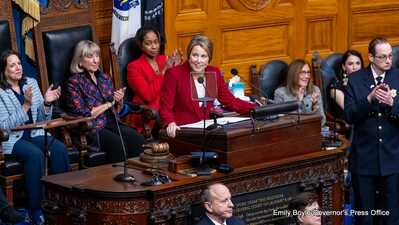 |
Gov. Maura Healey's State of the Commonwealth address as prepared for delivery on Jan. 22, 2026, at the State House.
Good evening, Massachusetts! Senate President Spilka, Speaker Mariano, who I know is watching from home, Leader Tarr, Leader Jones, and everyone in the Legislature: Thank you for our work together.
We also have empty seats in the Chamber tonight, members of this body who we lost this year. Senator Edward Kennedy and Representative Ann-Margaret Ferrante: Great public servants who served with passion and dedication and will be deeply missed.
Thank you to our Constitutional officers, members of the judiciary, and Governor's Councilors. Thank you to the former governors joining us tonight, Governor Bill Weld and Governor Mike Dukakis. Mayor Wu, and all our mayors and local officials: You'll always have a partner in the Healey-Driscoll administration.
And speaking of Driscoll, let's hear it for our lieutenant governor. Kim, you're the best teammate in government and on the pickleball court, too.
Let's hear it for our friends from labor and all the workers who keep Massachusetts running every single day. Let's hear it for members of the business community, the innovators, researchers, and entrepreneurs who are creating those jobs. Thank you to our faith community who offer support and guidance in a time when people are feeling a lot of anxiety, fear, and uncertainty. Joanna, and our families, thank you for your love and support. Members of our military, veterans and Gold Star Families: everything we have, we owe to you. Thank you.
This year, America celebrates a milestone: 250 years since our founding. Massachusetts, that story began here. That's because people of Massachusetts put everything on the line to fight for what they believed in. Farmers, carpenters, shopkeepers, tavern owners — they stood up with fear and uncertainty, but also with courage and resolve. They set in motion a Revolution that gave us our country and changed the world.
Today, all across Massachusetts, we walk in their footsteps. We gather on town greens where militia drilled. We vote in meeting houses where democracy found its voice. Massachusetts has led the way for freedom and progress in this country. It's more than our history; it's who we are. It's our DNA.
That's why I am so proud to be your governor. It's because of the people and spirit of this state. I see it everywhere I go — at schools and senior centers, food pantries and hospitals. The people of Massachusetts are tough, smart and care about each other. And in this moment, who we are in Massachusetts has never been more important.
Let me start with what's happening. The reality is that these are tough times. People are feeling it. Everything is more expensive. Groceries, a cup of coffee, the new coat or boots you want, or the water heater you need. Sports fees for your kids, dinner out once in a while. It's all harder now. I get it. I watched my grandmother cutting coupons. I saw mom at the kitchen table, up late with a stack of bills, worried sick about how to pay them. But even then, we believed if you work hard, you're going to be OK.
Right now, it doesn't feel that way. Fixing that, and lowering costs, should be the focus of every elected official in America. It's certainly mine. But Washington is only making it worse. We have a president who throws tantrums like a 2-year-old. And I'm sorry to all the 2-year-olds out there. He's driving prices up with his tariffs. He's cutting trillions of dollars out of health care. And Congress can't seem to do anything. Meanwhile, seniors have to worry about food and heat getting cut off. Veterans have their services cut. LGBT families are worried about their kids being targeted or losing their rights.
And let me say something about ICE. The Trump administration, right now, is sending masked agents by the thousands into cities and states. A woman is dead, others have been shot, innocent people detained, mothers and fathers ripped out of their cars with young children crying, pulling at their sides.
Here in Massachusetts, we've seen a high school student arrested on his way to volleyball practice. A college student on the way home for Thanksgiving, deported to Honduras where she hadn't been since she was a child. Children being used as bait to lure their parents out of their homes. Now we have parents afraid to send their kids to school or to go to church or see their doctor.
I was a prosecutor and attorney general, and I can tell you: none of this makes us safer. It shouldn't be this way, and it needs to stop. Enough is enough. People are feeling fear, anxiety, and anguish. They're seeing the chaos coming from Washington every day. They're worried about their family, their job, their health care, their rights.
But I have a message tonight: This is Massachusetts. We don't back down. We look out for each other. We stand for what we believe, and we will not change who we are — ever. Let me tell you what we do, Massachusetts. When the federal government tried to deny people vaccines? We wrote a vaccine prescription for everyone in this state. And we made sure insurance covers it. In Massachusetts, if you want a vaccine, you'll get it.
When they cut research and blocked cures to cancer, diabetes, and Alzheimer's? I said, we're going to put more dollars into science and research. People across the world have been saved by Massachusetts science and that will not stop.
While the president is raising costs on everything with tariffs? We cut taxes for middleclass families, made community college cost-free, and made school meals free for every student.
We're focused every day on lowering the costs of housing, energy and health care. When they took away abortion care? We stepped up and made sure Planned Parenthood could keep going. And we passed the strongest protections in the country for the doctors and nurses who provide that care. I'll never back down on your right to make your own health-care decisions.
And when Donald Trump froze SNAP benefits, taking food from children and seniors? That is when all of Massachusetts rallied. We raised $7 million dollars for food pantries. And people and businesses across the state stepped in to help. Max and Chelsea Ritcey are here; they run a restaurant in Watertown. They opened their hearts and their kitchen, and provided free dinners. Thank you, Max and Chelsea and all who support our neighbors. This year, my budget will increase funding for local food banks — and we are making sure that people in the SNAP program get the benefits they need. We're not going to let anyone go hungry in Massachusetts.
That is what we did, because this is who we are. Two hundred and fifty years ago, we started a Revolution. Today, while some turn their backs on liberty, Massachusetts stays free. In the face of efforts to divide us, Massachusetts stands united. And because we stay true to who we are, the state of our commonwealth is strong.
Look, we don't agree on everything. I see people in this room who don't agree with me on some things. But I know there are things we all believe, and things we all want to see happen. And we can work together to get them done. In this moment, my job as governor is to provide what this federal government hasn't: stability, security — and how about a little common sense?
My focus is you and what matters in your life. It starts with lowering costs and making life more affordable. Making our schools even better for our kids. Driving a strong economy that creates good jobs in every part of the state. Making sure you have safe neighborhoods, transportation you can count on, and health care you can afford.
Tonight, I want to share the next steps in our "Affordability Agenda." It starts with housing. We have to be a state where teachers, nurses, and recent grads can actually afford to live. The problem is, we haven't been building homes since the '90s. That's why prices and rents are so high; there aren't enough homes to go around. So here's the plan: we're going to build more and build faster. Here's how we're doing it. We're speeding things up. It used to take over a year to get environmental approvals. We took that down to 30 days.
We've got hundreds of acres of state property sitting empty and unused for years. Former courthouses, hospitals, state offices. We're taking that land and turning it into homes. Since COVID, remote work is happening and cities have empty offices downtown. So we're turning them into apartments. One of the quickest ways we're building homes is this: You can take your garage, or extra space in your back yard, and go ahead and build a place for your parents or your kid who just graduated. They're called Accessory Dwelling Units.
And if you go online, you'll be able to get low-cost financing and download free designs for the project that works for you. Experts said we had to build 220,000 homes by 2035. We're not just going to meet that, we're going to beat it. We've got 100,000 new homes already going, and more are on the way. We've got to be quick with this, all of us. People are counting on it; our economy is counting on it. We'll get it done. While we build more homes, we are also helping people afford their mortgages and rents right now.
For renters, we banned broker fees, saving thousands of dollars every time you move. We doubled the support we give seniors to help them with housing costs. And for families: we all know buying that first home is one of the toughest challenges you face. So we're doing more to help.
Tonight we are expanding the program that gives families $25,000 toward your down payment, nd another program that lowers your interest rates and can save you a ton of money over the life of your loan. That's real money that makes a real difference.
For the thousands of families out there right now looking to get into that first home — help is on the way.
Now let's talk energy. Bills are too high, and people are hurting. I want you to know I am focused on this. And here's our plan. First, I'll oppose any big rate hike the utilities ask for. Next, I filed energy affordability legislation to get us more power, get costs down and save you $13 billion. Our strategy on supply is "all of the above" — wind, solar, hydro, gas, nuclear — whatever it takes to power our homes and businesses and cut your costs.
Last week, we flipped the switch on a new hydroelectric line that is running right now and lowering bills by $50 million. And we're going to do more. This year, we're going after more solar, more transmission, more battery storage so we have the energy we need. Let's thank the workers who build these projects: The electricians, carpenters, iron workers, painters, engineers, teamsters, and more.
My legislation not only gets us more power, it gets it cheaper. Did you know that the utilities aren't required to buy energy at the lowest price? That's crazy, and I'm changing it. We'll make it so they can buy power at lower costs and pass those savings on to us through lower bills.
Now about those extra fees on your bills: they got added, piece by piece, over many years; we're the administration that's taking them off. I have directed the utilities to justify every single line on your bill. Anything that's not helping you, we'll strike it.
In the meantime, we're going to get you money back. Tonight, I am announcing that in February and March, we will cut your electric bills by 25 percent and your gas bills by 10 percent. We're in the coldest and most expensive time of the year. Middle-class families need breathing room — and they're going to get it. Now on healthcare: We have the best care and most coverage in America. But premiums are up everywhere. It's hard to afford, and it's hard to get appointments, too. So we're taking action.
Last year, I capped what insurance companies can charge people in deductibles and copays — first time that's been done in our state. Then Donald Trump and the Republicans in Washington made premiums skyrocket and threatened their coverage. Imagine, you're in the middle of cancer treatment, and you lose your health insurance? But we were ready.
We made the biggest commitment in the country to keep people's costs down and keep them covered. This means 270,000 families and small business owners who won't see a major spike in their bills. And we're not done.
How many of you have had this experience? Your doctor prescribes medicine or orders a procedure. Instead of getting that treatment, you wait. You wait for an insurance company to sign off. You lose weeks or months. You make new appointments. Take more time off work. It costs you money and delays your care.
If you're a diabetic, you shouldn't need an insurance company's OK to get insulin. And that's just one example. So we're changing that. Starting this year, you won't need prior authorization from any insurance company to get the care you need. No more paperwork, no more waiting. If your doctor says you need it, you'll get it.
Next, we're going to ban medical debt from being reported to credit agencies. It's bad enough to get a huge bill, when you're dealing with an illness. It shouldn't wreck your credit too, so we're not going to let that happen.
Finally: I am directing leaders from across all the key sectors to come together in a Health Care Affordability Working Group. Health care in America is broken, and we can't wait for Washington to act. We're the state with the best health care, we're going to be the state that fixes it.
High costs don't just come from inflation; we're getting hit from all sides. Here's one: we're all using streaming services and apps. I don't know if you're like me: I look at my bank statement, it's $2.99 here, $5.99 there, another $11.99 there … it adds up! They make it so easy to sign up, but nearly impossible to cancel. I say cancelling a subscription should be just as easy as signing up for it. Let's make that a law in Massachusetts. AG Campbell has done great work on the regulations, we're going to build on that.
Speaking of fixing things, let's talk about transportation. When I took office, the T was a disaster. And we are turning it around. That started when I appointed someone to run it who actually knew what he was doing. With Phil Eng on the job, the service — and the vibes — have never been better. We've gone from 220 slow zones to zero. That's saving commuters time and money. We also made regional buses free, added new ferry routes and opened two new lines on the Commuter Rail. And we're just getting started.
This year, we've got more trains running, later at night, and on the weekends. Then there's traffic. You're sick of it, I'm sick of it. How many of us sit on 93, 128, the Pike, or drive miles out of our way because a local bridge is closed. We fixed the slow zones on the T, we can fix the pinch points in our traffic.
We have an $8 billion plan to fix our broken transportation system. This year, we are accelerating bridge construction that will open up closed bridges and make repairs faster. I've challenged my team to move faster than ever, fix your roads and bridges, and get you moving again.
And here's something cool: last year, we unveiled the brand-new Bill Russell Bridge in Boston. This year, we'll honor another Celtics legend, when we dedicate the new Bob Cousy Pass in his hometown of Worcester. Cooz, I know you're watching at home. I can't wait to see you and take a ride together.
Let's talk about our economy. It's true we're facing headwinds, and we're addressing them. But we also have assets that any other state would trade for in a heartbeat. We lead in education, health care, innovation, science. Championship sports teams! And arts and culture. We're joined tonight by Ken Casey, Massachusetts Storyteller of the Year and Dropkick Murphys legend.
Ultimately, our greatest strength is the resource that matters most: our talent. That's why, when it comes to competing for jobs — my bet's always on Massachusetts. Hasbro and Lego agreed — they moved their headquarters here. So did Alnylam, a global leader in life-saving gene therapies. They started at UMass Chan Medical School. Now, they just built a brand-new manufacturing plant in Norton, all built with good union jobs.
Then there's Transmedics — a company saving lives for people who need organ transplants. They turned down New Hampshire and decided to grow right here in Massachusetts. You know Kim and I are competitive. I'm grateful to all of our employers, and we are working as partners every day to compete for jobs. We're going toe-to-toe with other states, and other countries.
We're not backing down — we're investing in the economic engines of our state. Research and science, through the DRIVE Act. Defense technology. Quantum and AI partnerships. Climate tech. We're supporting all of our entrepreneurs, who we depend on for our leadership in innovation. We're supporting our small businesses. We cut 25 percent of our regulations to lower their costs and let them do what they do best. And this year we'll cut more!
And we're making sure everyone's able to benefit. These aren't just jobs in labs and offices. They are on construction sites, in classrooms, on factory floors. And we are opening the doors to these jobs through apprenticeships. This is paid, hands-on training and a direct path to a great career. Thanks, by the way, to the Labor Movement, for creating this. We're investing in it.
Over the next 10 years, we're going to have 100,000 apprentices. They are in the Building Trades — and also in nursing, early ed, technology — wherever talent is needed. We'll get more people into great careers — and a workforce that meets the needs of our businesses. For me, growth starts with education, and no state is doing more.
Massachusetts schools — for the first time in eight years — are now ranked Number One in our Nation's Report Card in every single category. And we're not resting. Two years ago, I said we would have Universal Pre-K funding in every Gateway City. We are going to reach that goal ahead of schedule. We've also added over 20,000 child-care seats. That means more kids are getting care and more parents able to work. We know our kids struggled through COVID. Learning loss is real, and we're addressing it. We're making big investments in literacy and high-dose tutoring that will close learning gaps.
This year, we're also going to have the best statewide high school graduation standard in the country — including financial literacy. We'll make sure every student is ready to succeed — whether in college, career, a trade, or the military. Thanks to our investments, thousands of students took advantage of college or vocational pathways this school year. We also know that Early College and dual enrollment are incredible opportunities for our kids.
Here's what I'm talking about. You're in high school, and you take college courses that give you college credit. I have been to graduations where some students are getting their high school diploma and their associates degree at the same time. That's fantastic — and it's an opportunity I want for as many young people as possible.
Tonight, I am setting another target. I want 100,000 students in Early College within 10 years. We're going to help our kids reach their goals and save them money.
Now, let me speak to you as someone who's got two kids at home. Something we all worry about is social media. Look, scrolling TikTok or Instagram, it's fun! But there's a time and a place. And especially for our kids, it's driving so much anxiety and impacting their selfesteem. These platforms are built with addictive algorithms and they exploit insecurities, especially in our young people.
So I am proposing strict new requirements to protect kids and teens on social media. We will require parental consent and age verification on all of these platforms. We're going to prevent social media companies from targeting kids for profit. Parents are trying to protect their kids, and we're going to help them do it.
Speaking of safety. There is no greater priority than keeping our people and communities safe. In Massachusetts, we know how to do that. It's by supporting our state and local police. It's by partnering with them and building trust in our communities.
There is no question that we have the best police and first responders in the country. Let me give you an example. One night in December, a Massachusetts State Police Trooper responded to a difficult call. A man in crisis had climbed to the top of the Tobin Bridge. Chelsea firefighters used a bucket truck to lift the trooper up to him. For two hours in the freezing cold, this trooper let him know he wasn't alone. He stayed with him, he talked with him, and ultimately he pulled him to safety.
Trooper Rassan Charles is here tonight, and he saved that man's life. Let's show him, and our entire law enforcement community, how grateful we are. Also joining us tonight is Fall River Fire Chief Jeffrey Bacon.
In July, our state suffered a terrible tragedy: the Gabriel House assisted living facility caught fire. We pray for all those lost that day and their families. We don't want anything like that to happen, ever again. So we will implement new protections at all assisted living homes in our state. And we thank Chief Bacon, his firefighters, the police officers, and EMTs who gave so much that night — and saved many lives. Thank you to all of the firefighters who keep us safe every day.
Speaking of heroes, we have a responsibility to our veterans. I took office after the terrible COVID tragedy at the Holyoke Soldiers Home. Seventy-six veterans lost their lives. As AG, I investigated and prosecuted the people responsible for that tragedy. And when I became governor, I made it our mission to turn our veterans' homes around. And we have.
Now, both Chelsea and Holyoke are rebuilt, fully accredited, and world-class. And I'm proud to say Holyoke has achieved a perfect rating from the VA, and is now one of the best veterans homes in America.
On the wall in my office, I have a portrait of a former governor: Samuel Adams. He and Paul Revere laid the cornerstone of this building. But 20 years before that, none of this was assured. January 24, 1776, was 250 years ago this Saturday. With Boston under armed siege and morale in some quarters wavering, on that day Sam Adams wrote to a friend. "Never Despair," he wrote. "That is a motto for you and me. All are not dead; and where there is a spark of patriotic fire, we will rekindle it."
And that's what they did, town by town, across Massachusetts, lighting the way to a new nation. "Never despair", that's a good message for this moment.
The year ahead will bring more challenges, no doubt. But we will stand strong. We're going to do the right things and make the right decisions. We'll do what we have to do to make it better. And it will get better.
We're going to lead the celebrations of America's 250th with the biggest ever July 4 fireworks. The World Cup will be here. The Tall Ships are coming back! People from around the world will come and be inspired by Massachusetts. They won't be looking at Sam Adams and Paul Revere, they'll be looking at you … at us. Our nation faces new tests — and Massachusetts will lead again.
As a place where everyone can be safe and have their rights protected; where if you work hard, you can afford to live; and where people from around the world look to us for learning, innovation, opportunity, and freedom.
That's what we work for. That's what America needs in this moment. So once again, let it begin here, in Massachusetts. Let's kindle those sparks of patriotic fire, light the beacon and show the way forward. God bless you, God bless this great Commonwealth, God bless America.
Tags: healey, state of commonwealth, state of state,