Dalton Chief: Budget Cuts Would Affect Staffing, Response Times
DALTON, Mass. —
Police Chief Deanna Strout warned Monday night that significant cuts to her budget would mean losing officers, K-9s and community policing programs.
The chief defended her department at Monday's Select Board meeting after town meeting rejected the Police Department budget two weeks ago.
Voters will reconvene on June 9 for a special town meeting at Wahconah Regional High School to decide on four articles, including the Police Department budget.
During the annual town meeting, which garnered 277 registered voters, it was decided to separate the police budget from the rest of the operating budget with an eye to making more cuts.
That line was pulled from the operating budget on a secret ballot and failed to pass 162-117. Finance Committee Chair William Drosehn made a motion to level fund the police budget, which also failed.
During Monday board meeting, Strout expressed her belief that the rejection of the police budget was a targeted attack.
The board had voted to support the original police budget of $1,664,924 at the upcoming special town meeting. Select Board member Marc Strout, the chief's husband, was not present for that vote.
Chief Strout provided a comprehensive overview of the proposed budget [See above] detailing each line item and illustrating how the funds are necessary to fulfill the department's needs.
She emphasized what was said during previous budget meetings — that the increases within the budget are mostly contractual, as it is the first year of a three-year police officer contract negotiated by Town Manager Thomas Hutcheson.
Wages account for $1,473,586 of the budget, a $124,4438 or 9.22 percent increase. The department's expenses only make up $191,338 of the budget, a requested increase of 2.81 percent or $5,230.
"I had no input on this contract. What I will tell you is [that] I very, very much support this contract. I think that these officers are top notch," Strout said.
She highlighted how, at the Emergency Medical Services banquet this past Friday, a Dalton officer was the recipient of the officer of the year for the second year in a row, and the communications director, Gabrielle Taglieri, was named dispatcher of the year.
"We have good people. It's very important that we invest in the people we have and keep them employed, because otherwise we are hemorrhaging money. We are just replacing people, and we lose their knowledge, their experience, their rapport with our community, the things they do," she said.
"And it's just to me, it makes no sense to deliberately attack the morale of this Police Department."
Strout said the police budget being singled out and failing had a significant impact on the force's morale, especially since no other budgets were questioned during the town meeting.
"I'm concerned at the viciousness that I've seen, that this is going to damage them and their morale and their want to stay in a community here," she said.
"I'm very, very disappointed. I'm very disappointed in some of the just meanness that I've seen. It's just unnecessary if you have questions, ask, but spreading misinformation and saying things that are just not accurate is just wildly inappropriate."
The Dalton department's pay scale is among the lowest compared to other departments. It is fifth from the bottom in pay compared to 15 local police departments.
"Every one of those departments are going up. I don't know exactly what they're going up, but we are fifth from the bottom in pay, fifth from the bottom," Strout said.
"I don't want people to think that our officers are overpaid in this community. They are actually very low. Hinsdale makes more than us, [along with] Beckett, Stockbridge, Great Barrington, Williamstown, Lanesborough, and Lee all make substantially more than the town of Dalton."
When comparing the budget for the town's Police Department to others in the area, it is "all relative."
"I put out a survey to all the comparable departments. So, Williamstown, for example, is the exact same size department as us. Their budget is $1.9 million and change. So they're about $300,000 higher than us," Strout said.
"Lee and Lenox, their departments are just a little bit smaller than us, so they're a little bit lower, like 1.5, so we're all relative. There's nobody that's out of order or spending far more money than others. It's just all pay scale, and we're right kind of towards the bottom. So it's just where we are."
Prior to presenting the budget to the Select Board and Finance Committee in April, Strout highlighted how she had made several cuts, adding up to a total of $14,494 between salaries and expenses.
Then, after some discussion with the Finance Committee, an additional $15,000 was cut by reducing one maternity/paternity leave and shift differential, as well as some court overtime.
This amended budget was approved by the Finance Committee. However, at town meeting, Drosehn voted down the budget and then motioned to level fund it.
"My vote at the town meeting is my vote. My vote in the Finance Committee is the vote for the people; what I hope that the people can tolerate. It strikes me that the people were unwilling to tolerate what we presented them that night," Drosehn said on Monday.
"But at the town meeting, whether anyone likes it or not, that's my vote. I get to vote how I like to vote. I advocated for $20,000 to be taken off the budget, but the rest of the committee didn't agree."
Strout strongly cautioned against level-funding the Police Department budget because it would have significant consequences.
Level funding the budget would mean a reduction of $129,668 or 12.8 percent, which would result in a loss of community policing, staff, specific services, and more.
In the presentation, she foreshadowed the impact by showing where some of the cuts would be made:
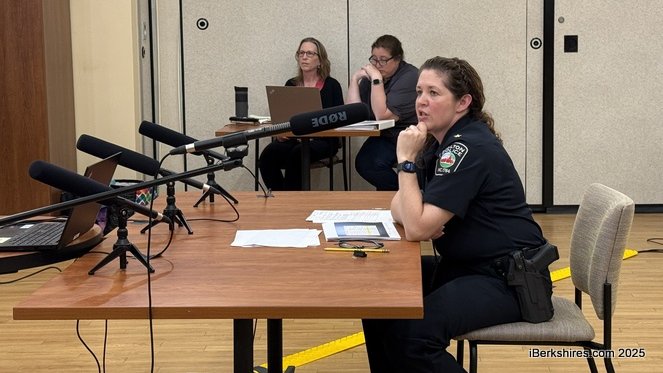
Police Chief Deanna Strout says level funding her department would mean losing officers, K-9s and community policing programs.
"Many of you guys are familiar with our comfort dog, Wendell. Wendell is the most amazing addition to this Police Department. He goes all over to the schools, to events, he takes part in Special Olympics. He's the first dog in the state to be DARE certified. That gets cut because I can't afford to pay for him any longer," Strout said.
"Our K-9 unit, the thousands of dollars we have invested into our K-9 unit, gets cut. K-9 Zander was a grant that we got the dog, but we put thousands of dollars into his training and certification."
The department would lose one full-time officer, one part-time officer and the crossing guard at Craneville, who has been employed by the town for more than 30 years.
"You think that will not have an impact on police response, think again. Think again. We are already at bare-bones staffing right now," Strout said.
After two decades, the department got a detective position back. However, that would also need to be cut back if the department's budget gets level-funded, Strout said.
"He is now completing his detective school this week. He's certified in sexual assault and forensics. The amount of time, money, and training we have just put into this position to put it back on patrol. We have many investigations that require specific training," she said.
"We have moved this department so far forward for a targeted attack to take us backwards. So, Detective Bradley will have to go back to patrol, and then when people come in and need a specific service, it's not going to be available to them any longer."
The little money saved in overtime by having a matron would be lost because the department would be unable to afford the matron position, Strout said.
Despite those cuts, the department would still need to find an additional $10,100 in cuts to achieve a total reduction of $129,668.
Tags: Dalton Police, Dalton_budget, fiscal 2026,