Pittsfield School Officials Want Summary of PHS Investigation
PITTSFIELD, Mass. — While it is unclear how much information will be released, School Committee members want some executive summary of the Pittsfield High School investigation into alleged staff misconduct.
On Wednesday, they requested a capsulation of the process and, if possible, the findings of Bulkley Richardson & Gelinas' investigation triggered by allegations against Dean of Students Molly West and Vice Principal Alison Shepard that surfaced in December.
"Right now, the public has the seven of us sitting up here saying nothing was substantiated," said Mayor Peter Marchetti, who motioned for an executive summary.
"And quite frankly, part of the argument may be its cost, but how much money have we already spent and how much time have we gone down this rabbit hole to still have this black cloud hanging over our head without the public buying into anything that happened?"
As far as he is concerned, the city is "in for a penny in for a pound." The lead investigator, Judge Mary-Lou Rup, was hired at a rate of $275 per hour and paralegal services for $110 per hour.
"And whatever legal counsel can produce, I think that we have to live with it, but to just say we're not doing it at this stage in the game I think is a mistake," he said.
Committee member William Garrity requested that discussion about the investigation's reports be put on the agenda. The district's legal counsel has reportedly advised against releasing the report even though officials pledged transparency when the scandal arose.
"I feel there is at least some balancing act that we need to figure out between protecting the privacy of the report and people being investigated and people who are part of the investigation while still maintaining the public's right to know," he said.
At the beginning of the conversation, Chair William Cameron read a six-page written explanation of the committee's choice to follow legal advice and not release the report, citing legal and prudential reasons.
"The core issue is not one merely of avoiding defamation or shielding the identities of minors. It is, to repeat, one of privacy," he said.
"BRG investigators have structured their reports in such a manner that no amount of editing, short of rendering much of the reports' substantive aspects largely unintelligible, will protect the legitimate privacy rights of anyone mentioned or quoted there."
He told Marchetti that the district's attorney, Russell Dupere, saw no issue in releasing a description of the process.
"Nobody's really interested in the process, though, what people want is red meat," Cameron said, adding that once they get into those issues, it becomes a matter of privacy.
He said the issue that personnel actions aren't matters of public record "so if, in fact, the outcome of an investigation is it entails some kind of action that only the superintendent can take, we don't broadcast that" and finds it getting "perilously close to violating what is a pretty obvious right that employees have not to have their personnel records become public."
Marchetti did note that after reading the documents, they would be hard to redact in a way that people wouldn't be able to figure out who they are about.
"No matter what we put out, I don't know that that's going to be good enough, but I do know the public is entitled to some executive summary that doesn't broach any of the legal advice that our legal counsel gave us," he said.
During pubic comment, resident Valerie Anderson urged the report's release with as few redactions as possible.
"We deserve to know who knew what when. At a minimum, a timeline should be released. A timeline is not privileged nor defamatory," she said.
"People have told me that the alleged picture that was widely disseminated was first sent a long time ago, well before the dean [Lavante Wiggins] was arrested for alleged cocaine trafficking. If this is true, it demonstrates that administrators did know, even though we were told no one knew anything. The public needs to know when the picture was first allegedly sent to whom and if any action was taken at the time."
Cameron was taken aback when unionized teachers in the audience applauded the request to release personnel records.
"I should have thought that would have raised the hair on the backs of their necks. This is a legal right they have. It is a protection that they have, and yet people were applauding for it," he said.
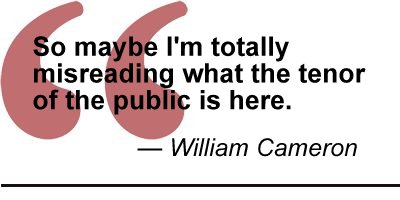
"So maybe I'm totally misreading what the tenor of the public is here."
Committee member Sara Hathaway is concerned that people will start pointing fingers if the entire report is released.
"Who started the rumor, who fabricated something that was attributed to somebody else, and the finger pointing that would occur would involve minors, people who were minors at the time, or who are still," she said.
"And for all the discussion of doing what's in the best interest of the students, releasing information that would cause a new round of accusations, very likely false accusations, and mistaken identities. It would serve no one."
Having read the reports, she feels the findings were extensive, reliable, and fair, adding, "I know people don't want to take my word for it, but that's all I can say."
"We all want children to be safe, but we have to follow the law and the law, in this case, comes down in favor of privacy, as it should," Hathaway said.
Vice-Chair Daniel Elias is not confident when it comes to this issue. On one hand, he wants the public to read what he read, but on the other hand, he understands that there are legal ramifications, "and having been here so long, when we don't follow the advice."
"Because I don't know, I have to adhere to what legal counsel is telling us and what we're paying them to do," he said.
Marchetti admitted that if he could go back to the moment when officials agreed to release the report during a Zoom meeting, he would have voted against.
"With all due respect, Mr. Chairman, the answer of whether or not we would release this publicly was it would depend on legal counsel, so we already had an out built in on how we didn't or didn't have to release this," he said.
"And so hindsight is 2020. There was a lot of pressure from the City Council, a lot of pressure from the members of the community, and we all jumped at something, again, being reactionary."
He recognized that it is "pretty clear that what we've done isn't satisfying the public."
In separate investigations, the state Department of Children and Families has cleared both administrators, and West has returned to work. Cameron has confirmed that West was also investigated and cleared in the past.
Angel Breault, who aired the allegations over social media in December, called in to public comment on the phone and reported that no investigators had spoken to her. She also indicated a wish to speak to the investigators.
"None of them have any of the evidence, nor do they have any of the witness statements that I have," she said. "They actually, from what I've been told, are refusing to speak with me, specifically the investigator that was hired by the School Committee."
She said the committee's approach to concerns around the situation has made students not want to speak up.
"All I've been trying to do is be an advocate for these students, and it makes it very hard when we have other people that are actually present in the city making these students, these same students, feel uncomfortable," Breault asserted.
"These people have opened up to me, and none of them want to speak up and are scared because unfortunately, I'm not there to protect them and they feel as though nobody else is protecting them."
In his statement, Cameron recognized that at the onset of the investigation, he and the School Committee stated an intent to make everything public that could legally be released. Since the public has learned that the full report won't be released, he said it has been characterized as a "significant about-face from December."
"That conclusion is easy to understand. It's also mistaken," Cameron asserted.
He explained that the School Committee's idea that the public might have access to at least part of the report came from the Massachusetts Public Records Law. He pointed out that there are exceptions in the law for material such as "personnel and medical files and any other materials or data relating to a specifically named individual, the disclosure of which may constitute an unwarranted invasion of personal privacy" and "records related to a law enforcement misconduct investigation."
He added that MGL c. 214 § 1B establishes that "[a] person shall have a right against unreasonable, substantial or serious interference with his privacy," and said that based in the statute's plain language, those protected by this provision include someone who is the subject of BRG's investigation, those who spoke with BRG investigators, and people named and quoted in the report.
Cameron feels that releasing the report would violate the privacy of the accused individuals, those interviewed in the investigation, and the loss of privacy would have adverse effects on any subsequent investigations.
"Where allegations of wrongdoing have been found to be unsubstantiated, those accused would still be subjected to a subsequent second round of accusations of what they were wrongly accused of initially, this time wholly in the Roman arena of Instagram, X, and Facebook, where no malicious rumor gets discredited and lack of substantiation is often taken as evidence of a cover-up," he said.
Tags: investigation, PHS,