Willamstown Community Preservation Committee Ups Recommended Funding Levels
WILLIAMSTOWN, Mass. — Non-profits seeking Community Preservation Act funds in fiscal year 2026 will receive a little bit more than expected if town meeting agrees with the recommendations from the Community Preservation Committee.
Last month, the committee voted to forward all nine grant requests to the May meeting with each funded at 50 percent of the level requested by applicants.
That decision allowed the CPC to support each of the applications on the table and stay within a budget that would not allow all to be fully funded.
Last week, the committee members got some good news.
While anticipated FY26 CPA revenues still are expected to be lower than demand, the committee does not have to hold back 10 percent of those revenues as the panel planned at its Jan. 22 meeting.
That night, Chair Philip McKnight told the group that since none of the FY26 applicants fell under the "open space" purpose of CPA funding, the town had to reserve at least 10 percent of its CPA revenue in the coming year for future open space projects.
By law, towns are required to devote at least 10 percent of the funds to each of three categories — open space, historic preservation and community housing — in any given fiscal year. For FY26, that meant reserving $42,754 off the top before any other projects were funded.
After the Jan. 22 meeting, the executive director of the Community Preservation Coalition in Boston clarified that point.
"Stuart Saginor's message to us, which I forwarded to the committee, suggested that [$42,754] could be used for recreation under the definition of open space," McKnight said.
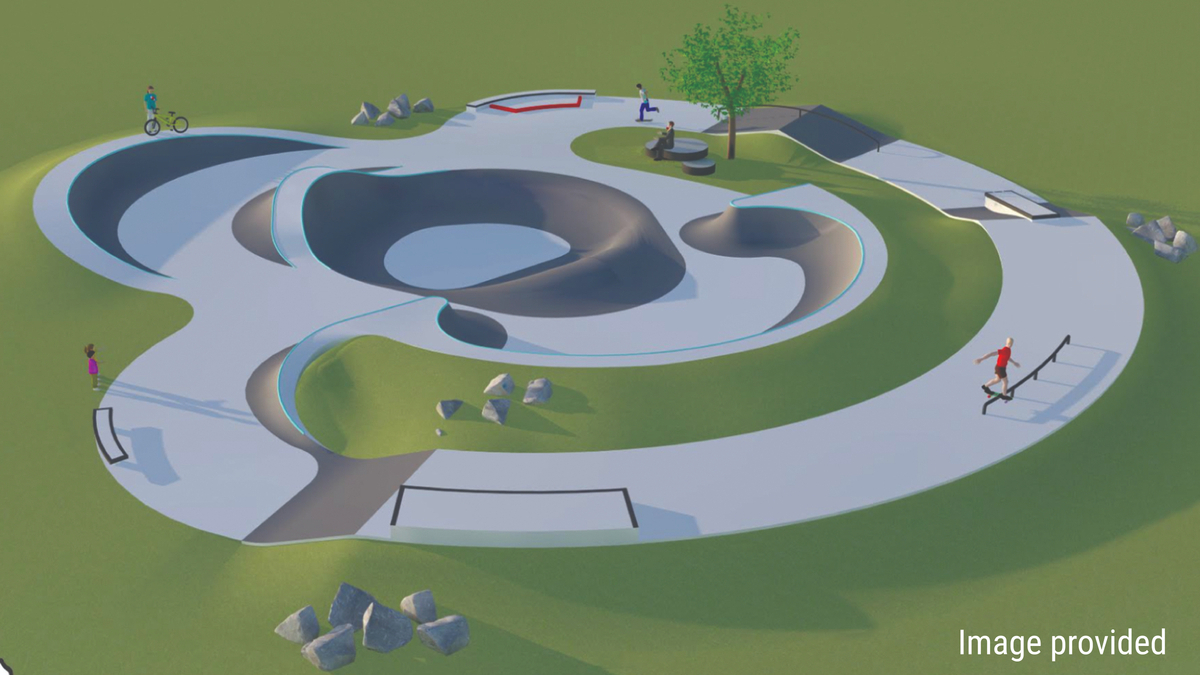
That meant the $52,000 the committee voted to recommend town meeting award to four "recreation" projects (a skate park, a mountain bike trail, a walking trail and a scholarship fund at the Sand Springs Recreation Center) took care of the mandatory 10 percent for open space.
"So we've got $43,000 we can do whatever we want with," Molly McGovern said. "We can save it for open space, we can save it for next year [for any other applications] or we can give it all to the Affordable Housing Trust because we know that taxes are going up this year. … We know there will be a heavy tax burden this year, so we can give it to the Affordable Housing Trust to alleviate that."
Among the housing trust's initiatives is an emergency mortgage assistance program to help suddenly cash-strapped residents remain in their homes.
McGovern argued against holding the $42,754 in reserve for future applicants.
"Based on what we heard at the joint meeting of the Finance Committee and Select Board, we are going to see an increase in taxes, and it's a little hard to justify sitting on taxpayers' money in that climate," said McGovern, who fills the Fin Comm's seat on the CPC.
Randal Fippinger, who represents the Select Board on the panel, said he loved the notion of adding the entire $42,754 to the warrant article for the housing trust to raise its funding from $50,000 closer to the $100,000 it requested for FY26.
Nate Budington, who represents the Historical Commission on the committee, disagreed.
"The housing proposal was not attached to any specific housing project, it was to replenish their coffers, and it's a completely legitimate use of [Community Preservation Act] dollars," Budington said. "We've done it in the past, and we should continue doing it. But their request was for $100,000, which was two-thirds of our entire budget. That was an untenable request.
"If we had gone through project-by-project to evaluate these [instead of giving each applicant half], we never would have approved that. There's no way we would have approved two-thirds of our budget going to replenish housing funds."
Budington suggested the Jan. 22 vote already favored the housing trust.
"At the end of the day, they wound up with a third of the budget and everybody else, who I think had taken the time to calculate how much money they needed for each specific project, a couple of which were shovel ready, saw their grants cut in half," Budington said.
Town meeting established an Affordable Housing Trust in 2012 specifically so that a public body would have funds on hand to support housing projects that did not have to wait for an annual funding cycle like that of the CPC. The flexibility of having unrestricted funds in the AHT's coffers allowed the trustees to create an emergency rental assistance program and an emergency mortgage assistance program when the need arose during the COVID-19 pandemic, for example.
At least one municipality that has adopted the Community Preservation Act, the city of Cambridge, has adopted a policy of devoting 80 percent of its CPA revenue each year to community housing, restricting the historic preservation and open space and recreation components to 10 percent apiece.
Kenneth Kuttner, who occupies the Planning Board's seat on the CPC, suggested that it simply add the $42,754 back into the available total funding for FY26 and recalculate a proportional distribution to each of the nine applicants the committee already voted to recommend town town meeting.
"Add $42,000 to the available $144,781 we had before, that gives us a total of $186,781 to play with," Kuttner said. "The total ask was $293,800. Divide those, and you get 63.57 percent. That means give everybody 63.5 percent of the ask."
He later refined that percentage to 63.8 percent after factoring in the more precise number of $42,754.
Fippinger agreed that Kuttner's approach made sense.
"While I am personally much more in favor of giving it all to the Affordable Housing Trust, in the [Jan. 22] public hearing, the consensus of this group was to evenly divide the funds," Fippinger said. "What Ken is proposing is in that spirit."
The committee voted 6-0-1 (two members were absent), with McGovern abstaining, to proceed on that basis and ultimately revoted on all nine applicants based on funding at 63.8 percent of their requests.
In other business at its Jan. 29 meeting, the CPC agreed to form a working group of Kuttner, Fippinger and community representative Polly McPherson to draft changes to the town's application for CPA funds.
The need for changes arises from the discussion at the Jan. 22 meeting, where the lack of funding to support all applicants fully led members to speculate on what criteria the committee might use to judge the relative worthiness of different applications — the type of "project-by-project" evaluation that Budington referenced on Jan. 29.
McKnight shared that he had talked to a representative of the grant-giving Berkshire Taconic Foundation to talk about the methods that body uses to distribute scarce resources.
"Her final conclusion was you need to come up with a set of criteria the committee generally agrees to," McKnight said. "You can't expect nine people to agree to everything. But there should be criteria the committee generally agrees to and that inform the primary — but not only — basis for their decisions.
"The application should allow the applicant to reflect on those criteria and cast their application with regard to them but know the committee may very well ask for something in addition or suggest that if it doesn't address one of the criteria there's no penalty for that because your project is worthy on the first two or the first three."
Two weeks ago, the CPC members present suggested some of the criteria that should be included. It was agreed that all members should feel free to reach out to McPherson with more ideas. The plan is to have new application language to consider by the committee's Feb. 18 meeting.
Tags: CPA, open space,