CBRSD District Improvement Plan Prioritizes Equitable Learning
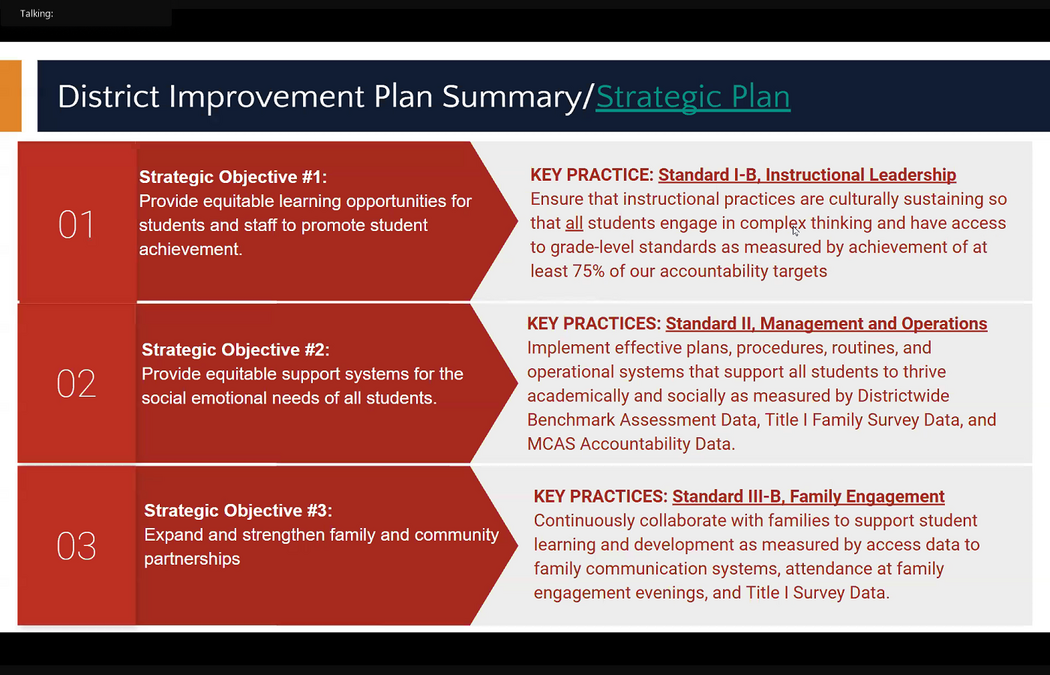
DALTON, Mass. — The Central Berkshire Regional School District is focusing on equitable learning, social-emotional support, and family engagement in its district improvement plan.
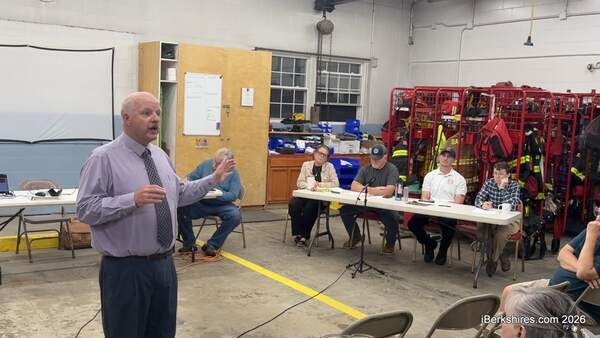
"The district improvement plan takes certain priorities from the strategic plan, lays out a yearly plan, and then from there, our schools formulate their own school improvement plans to really identify priorities," Superintendent Leslie Blake-Davis said at the School Committee's recent meeting.
To set its objectives the district pulls information from its strategic plan, the goals set by the state Department of Elementary and Secondary Education, input from families, and data from sources including Massachusetts Comprehensive Assessment System results and chronic absenteeism rates.
The district aims to reach at least 75 percent of its state-identified targets for student achievement.
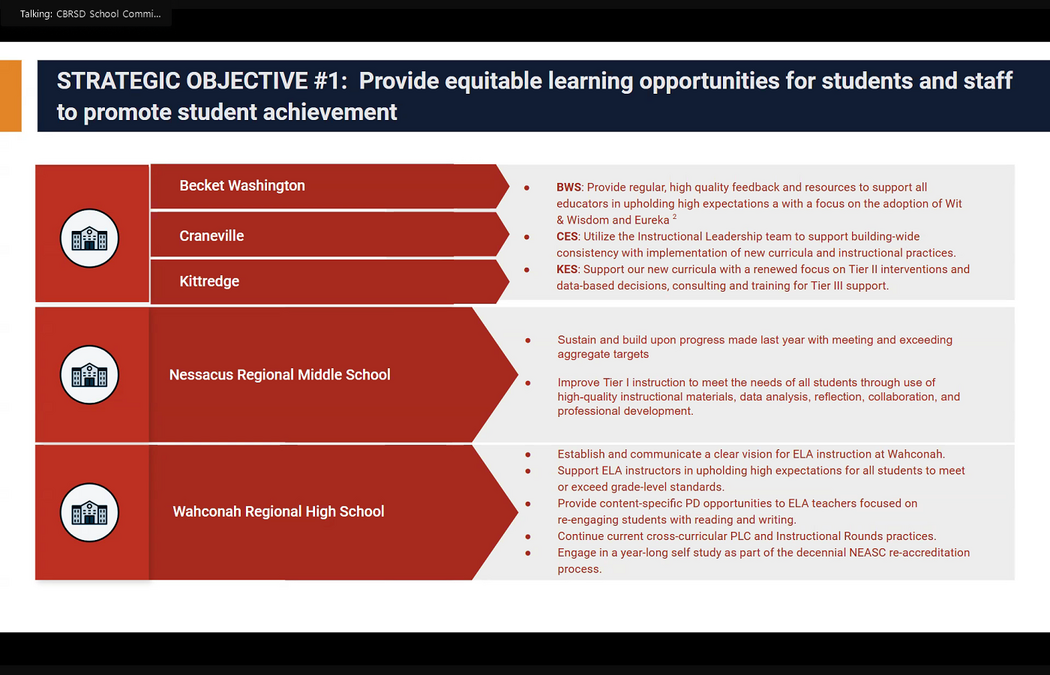
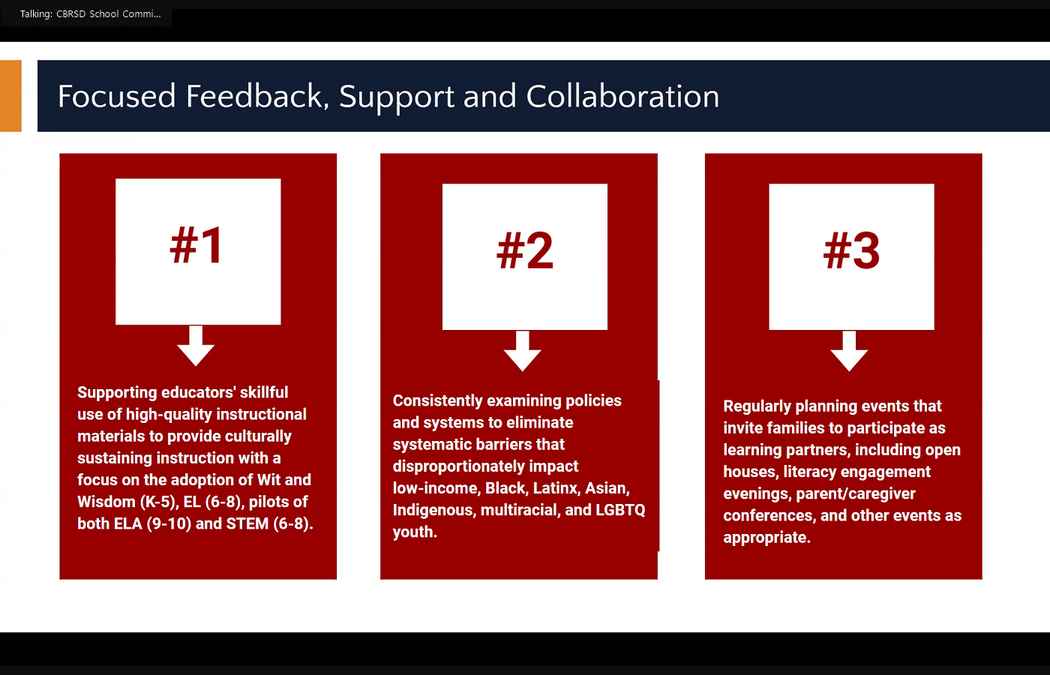
In an effort to support high-quality instruction, the district has implemented new curriculum programs such as Wit and Wisdom for kindergarten through fifth grade English Language Arts, a reading program for its sixth through eighth graders called Expeditionary Learning, and an upgraded math program called Eureka Squared.
"There are a lot of support systems that we are implementing to help teachers really feel like they can implement these programs successfully," Blake-Davis said.
Becket-Washington Elementary School is focused on the two new curriculum programs, Wit and Wisdom and Eureka Squared, and providing "regular, high quality feedback to staff and students, because it is all new and it's overwhelming," the school's Principal Mary Kay McCloskey said.
Similarly, Craneville Elementary School is concentrating on leveraging instructional leadership team made up of strong teachers, Principal Rebecca Sawyer said.
This team guides the administrative staff on providing support, particularly with new curricula and communicate the needs of their fellow teachers to ensure consistent instructional practices and support for the new programs, she said.
Kittredge Elementary School Principal Howard Marshall also expressed what was said by McCloskey and Sawyer.
"Our teachers are really on board with it, but it's a huge lift, especially the ELA curriculum, it does a lot of work to transition from what they've been doing for several years to this new program, but the kids and the students are really embracing it," Marshall said.
They have also restructured some of their Tier 2 supports, putting in a lot of effort and targeted support where they can.
"If you remember, from our MCAS discussion, we will never have enough support, but we are trying to very smartly use the support we have, both with teacher feedback, the work of the Student Support Team, and the data from both benchmark and progress monitoring assessments," he said.
Similar to the elementary schools, Nessacus Regional Middle School is working on integrating the curriculum program. This year, teachers are working on becoming more grounded in using Eureka Squared, said Kelly Flynn, the school's assistant principal of teaching and learning.
Additionally, they are working on the new EL Visionary learning program and are in the beginning stages of a new science curriculum.
The district's Director of Student Services Nathan Loux also highlighted how the school implemented a new program for eighth-grade students identified as below grade level in literacy.
According to early benchmark data and anecdotal evidence, including absenteeism and behavior issues, Loux said the program has been successful over several months.
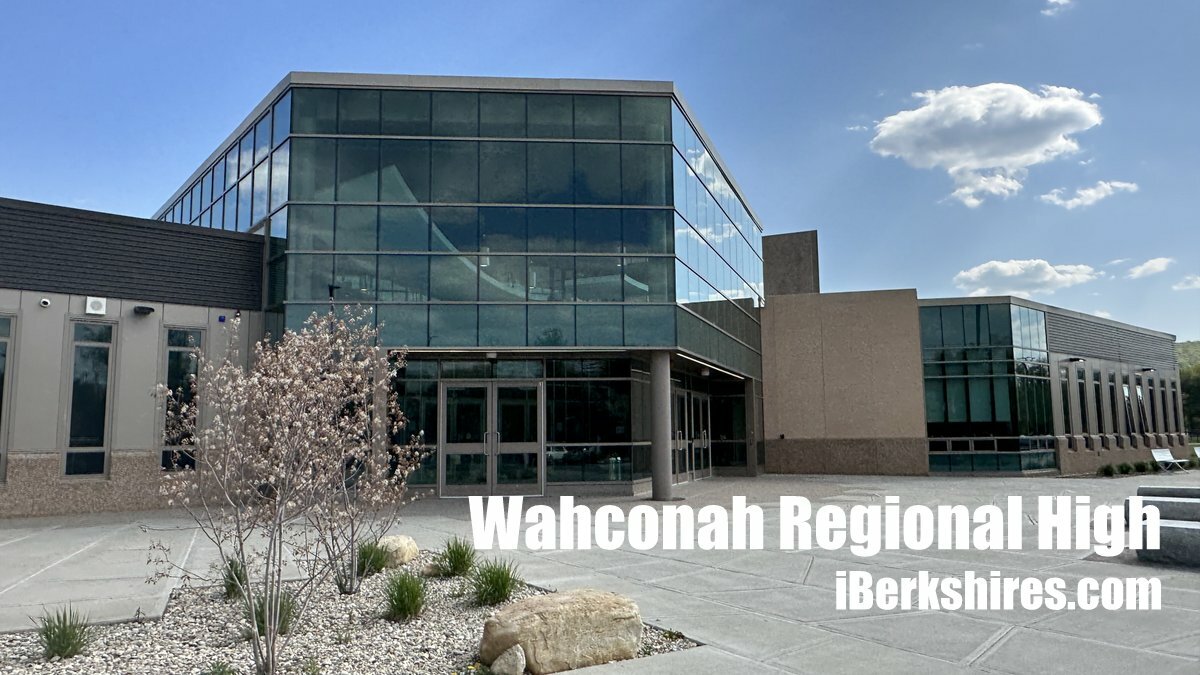
Wahconah Regional High School Principal Aaron Robb said the school is starting a two-year process to address ELA performance, including revising the ninth and 10th grade ELA curriculum.
A curriculum council will be established to examine possible changes to the ELA curriculum.
The school's ELA teachers have taken part in a content specific professional development focused on reengaging students with reading and writing, Robb said.
"It's becoming a challenge to get students to engage in some of that work. So they've got some creative strategies that they learned at a workshop last month to help deal with that," he said.
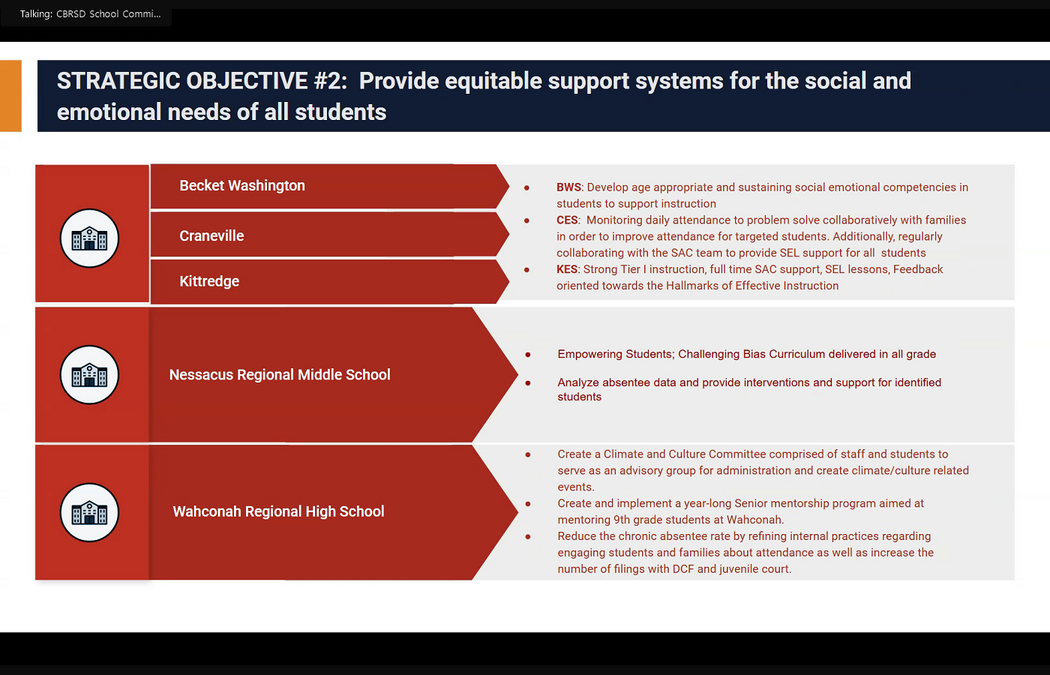
In an attempt to provide support systems for social-emotional well-being the district is examining its policies and systems to eliminate any barriers that disproportionately affect its low-income students, multiracial students, and LGBTQ-plus students, Blake-Davis said.
The district is actively preparing to establish student support centers at Nessacus and Wahconah with the aim of providing students who are struggling academically a dedicated space, she said.
The district wants to provide students tools and support to help them succeed and avoid suspensions, whether in-school or out-of-school suspension.
"We're looking very closely at how we've been redistributing resources within the district to make sure that we're putting the supports in the right places where they're most needed, and just really focusing on how we support the students that need us the most, the best we can," Assistant Superintendent Michael Henault said.
McCloskey highlighted Becket-Washington's mentoring program where staff meet with students daily to build connections in an attempt to meet this objective.
Craneville is closely tracking attendance and creating attendance plans for chronically absent students to make sure they feel supported in school, Sawyer said.
"Students are chronically absent due to some social emotional challenges that they're facing. So we're really taking sort of that path in making sure that they feel supported at school, forming some good relationships, making connections and creating really solid attendance plans for students who are chronically absent," she said.
Kittredge is leveraging its full-time school adjustment counselor to provide more targeted social-emotional support, this is the first year they have this resource.
"We have a large number of high need students, especially social emotional so having a full-time school adjustment counselor has been tremendous," Marshall said.
The counselor provides classroom lessons, conducts pull-out groups, and holds lunch and recess support groups, fostering relationship-building.
Nessacus is in its third year of a curriculum aimed at empowering students and challenging bias, covering important topics like bullying and cyber safety at each grade level. It is also working on improving chronic absenteeism. Wahconah is establishing a climate and culture committee to focus on planning events and initiatives to engage students.
They are also refining internal practices and engaging students and families to address chronic absenteeism.
In addition, the high school is working on and implementing a year-long senior mentorship program, with the aim of mentoring the ninth grade students.
District leadership also reported that during budget discussions with the principals, the need for additional school adjustment counselors emerged as a consistent priority.
They are actively exploring ways to allocate resources to increase mental health and social-emotional support staff across the district.
The district and its schools is also working on expanding and strengthening family and community partnerships.
Based on a family survey, more than 90 percent of families feel welcome in the district's schools, Blake-Davis said.
"So that is something that was great to hear and see. Other things that we need to work on a little bit is making sure they feel very connected to the curriculum, and they know exactly what their students are expected to know and do by the end of the year they're in," she said.
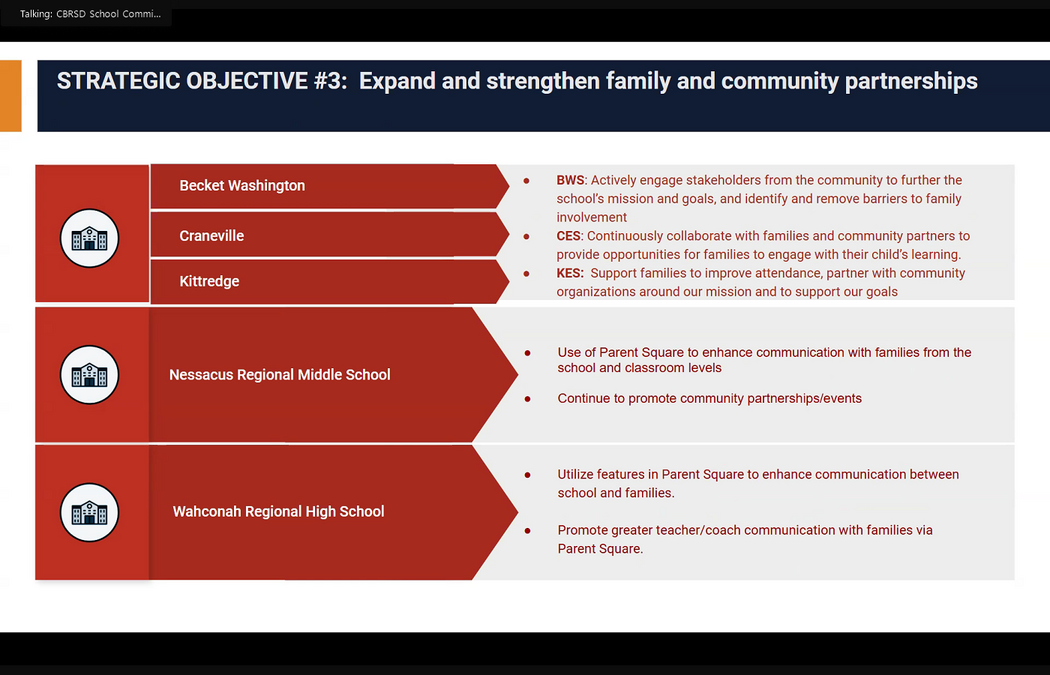
Becket-Washington is continuing to collaborate with local organizations like Jacob's Pillow, the library, and art center to provide enrichment opportunities for students and has been hosting family literacy nights and other events to encourage engagement from families, McCloskey said.
Craneville has been collaborating with the parent-teacher organization and has been partnering with community members like Dalton Police Sgt. Tyler Miller and comfort dog Wendell to engage with students.
Similarly, Kittredge is work with the parent-teacher group on ways to bring families and the community into the school and are exploring new community partnerships.
Nessacus and Wahconah are encouraging its families and staff to use ParentSquare, which is a component of the district effort to strengthen family and community partnerships by providing a centralized communication platform.
The program allows for two-way communication, with families able to message administrators and teachers directly.
It also provides options for families to receive digest versions of messages, consolidating information from multiple schools, and includes links to various district websites and resources.
Tags: CBRSD, school improvement,