Wild Oats Hosts Composting Workshop for Earth Day
|
|
|
.jpg) |
Cynthia Grippaldi of the Center for EcoTechnology shows the 'black gold' backyard gardeners can create with a compost pile. The workshop was held at Wild Oats. Left, a simple fence composter. |
 |
|

WILLIAMSTOWN, Mass. — Backyard composting is economical, environmentally friendly and, perhaps best of all, easy.
"I have never taken the temperature of my compost pile," Cynthia Grippaldi of Pittsfield's Center for EcoTechnology said Monday. "I'm a lazy composter.
"But things are breaking down."
Grippaldi broke down the basics of composting for a crowd of about 20 behind Wild Oats Market on Monday afternoon for an Earth Day workshop.
Backyard composters put the natural process of decomposition to work for them — disposing their kitchen and backyard waste without paying the transfer station and producing fertile soil for their garden without paying the garden shop.
And they can accomplish those ends with minimal startup cost or labor, Grippaldi said.
"Composting is nature's recycling system," she said. "It goes on with us or without us. What we're trying to do is manage it."
There are things you can do to speed up the process of turning your waste into the rich, dark compost material that gardeners call "black gold."
Chief among those tasks is making sure your compost pile has approximately the correct proportion of carbon-rich "brown" material to nitrogen-rich "green" materials.
The browns (which come from leaves, dried grass, straw or cornstalks) should outnumber the greens (kitchen waste or fresh garden clippings, for example) by a ratio of about three-to-one, Grippaldi said.
But she does not recommend that practioners get too hung up on measurement — either when it comes to those proportions or, obviously, monitoring the optimal 140-degree temperature needed for a productive compost pile.
And while she touched on some of the compost bins on the market, she said her own setup consists of several wooden pallets stood on end and screwed together to form a box in her the back of her yard.
Other than feeding the compost pile with new material — largely byproducts from daily life in her kitchen — the other time commitment is occasionally turning the pile to keep it properly aerated.
"If your compost bin starts to smell, it's gone anaerobic," Grippaldi said. "The critters (worms and bugs) have moved out. Commercial bins will have holes on the side to let in air. To turn [the pile], you can use a pitchfork. If it's too wet or too compacted, that will keep air out."
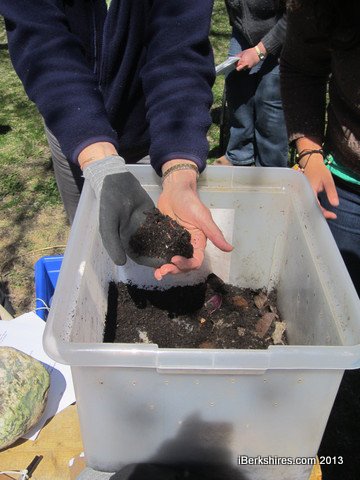 You do want a certain amount of moisture, and fresh food scraps will provide a fair amount on their own. Some composters prefer to leave the pile exposed to the elements and let rain do the job, but if we get a particularly dry summer, you may need to use a hose or watering can to help the pile maintain "the consistency of a wrung-out sponge," Grippaldi said.
Because most people will not want to "feed" the bin every day — especially in the winter — Grippaldi recommended keeping a small plastic compost bucket in the kitchen to collect waste up to a week at a time.
Relatively recently, she learned the trick of using folded up newsprint to line that bucket. The paper itself can go right into the compost pile (as a "brown"), and the lining keeps the kitchen bucket clean, Grippaldi said.
Above all, she emphasized repeatedly that the composting process is low maintenance with high reward.
"Compost happens," Grippaldi said. "It is a science, but it's not so much of a science that you have to be all that concerned about it."
And if you happen not to have a ready supply of leaves in your yard to feed your bin, Grippaldi offered one more "lazy composter" tip.
"Go to Pittsfield," she said. "People rake up all their leaves and bag them and put them out on the curb for you.
"I'm all for letting someone else do all the work for me."
Tags: environment, gardens, home & garden,